Sainte-Justine University Hospital Azrieli Research Centre, Montréal, QC, Canada.
Department of Mathematics and Statistics, Université de Montréal, Montréal, QC, Canada.
NPJ Syst Biol Appl. 2024 Aug 18;10(1):91. doi: 10.1038/s41540-024-00419-4.
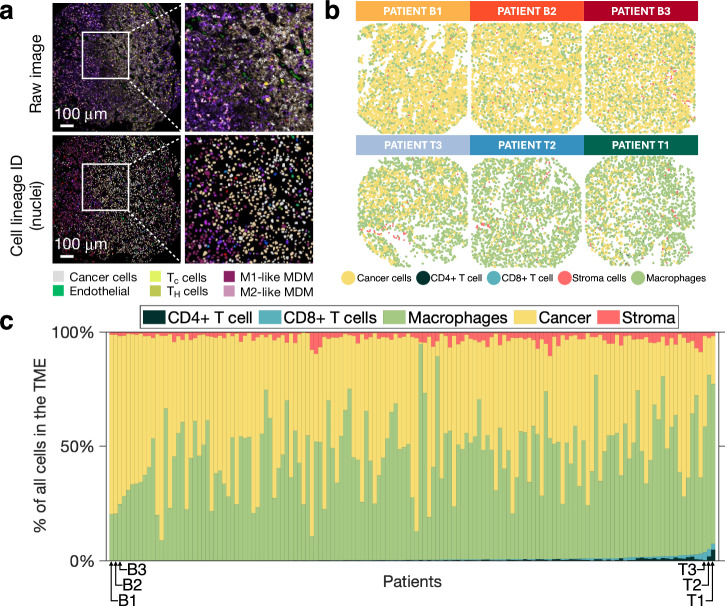
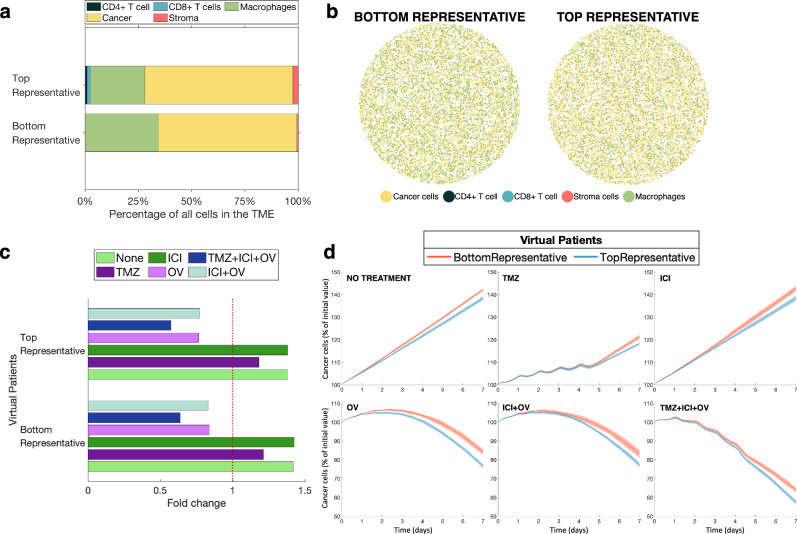
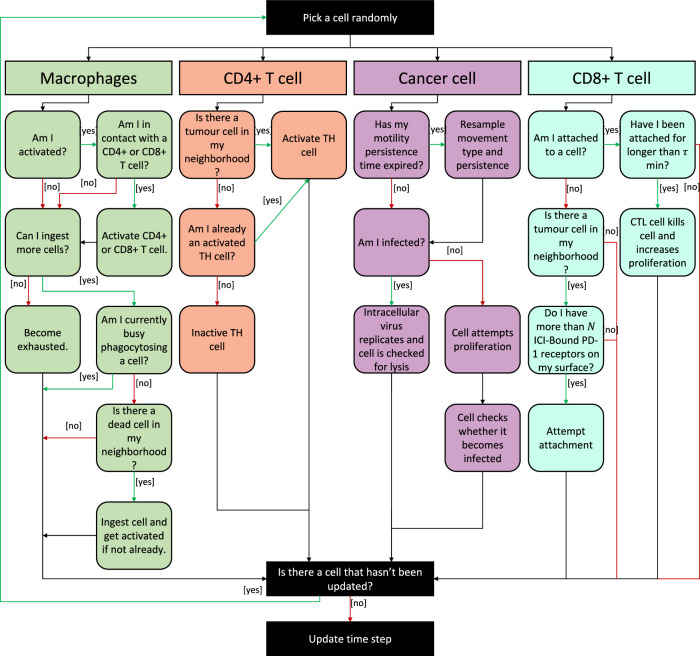
Glioblastoma is the most common and deadliest brain tumour in adults, with a median survival of 15 months under the current standard of care. Immunotherapies like immune checkpoint inhibitors and oncolytic viruses have been extensively studied to improve this endpoint. However, most thus far have failed. To improve the efficacy of immunotherapies to treat glioblastoma, new single-cell imaging modalities like imaging mass cytometry can be leveraged and integrated with computational models. This enables a better understanding of the tumour microenvironment and its role in treatment success or failure in this hard-to-treat tumour. Here, we implemented an agent-based model that allows for spatial predictions of combination chemotherapy, oncolytic virus, and immune checkpoint inhibitors against glioblastoma. We initialised our model with patient imaging mass cytometry data to predict patient-specific responses and found that oncolytic viruses drive combination treatment responses determined by intratumoral cell density. We found that tumours with higher tumour cell density responded better to treatment. When fixing the number of cancer cells, treatment efficacy was shown to be a function of CD4 + T cell and, to a lesser extent, of macrophage counts. Critically, our simulations show that care must be put into the integration of spatial data and agent-based models to effectively capture intratumoral dynamics. Together, this study emphasizes the use of predictive spatial modelling to better understand cancer immunotherapy treatment dynamics, while highlighting key factors to consider during model design and implementation.
胶质母细胞瘤是成年人中最常见和最致命的脑肿瘤,在当前的标准治疗下,中位生存期为 15 个月。免疫疗法,如免疫检查点抑制剂和溶瘤病毒,已被广泛研究以改善这一终点。然而,迄今为止,大多数都失败了。为了提高免疫疗法治疗胶质母细胞瘤的疗效,可以利用成像质谱细胞术等新的单细胞成像方式,并将其与计算模型相结合。这可以更好地了解肿瘤微环境及其在这种难以治疗的肿瘤中治疗成功或失败中的作用。在这里,我们实施了一个基于代理的模型,该模型允许对胶质母细胞瘤的联合化疗、溶瘤病毒和免疫检查点抑制剂进行空间预测。我们用患者成像质谱细胞术数据初始化我们的模型来预测患者的特异性反应,发现溶瘤病毒驱动联合治疗反应取决于肿瘤内细胞密度。我们发现肿瘤细胞密度较高的肿瘤对治疗的反应更好。当固定癌细胞数量时,治疗效果是 CD4+T 细胞数量的函数,在较小程度上是巨噬细胞数量的函数。至关重要的是,我们的模拟表明,必须注意将空间数据和基于代理的模型整合起来,以有效地捕获肿瘤内动力学。总之,这项研究强调了使用预测性空间建模来更好地理解癌症免疫治疗的治疗动态,同时突出了在模型设计和实施过程中需要考虑的关键因素。