Buglioni Alessia, Jenkins Sarah M, Nasr Samih H, Zhang Pingchuan, Gibson Ian W, Alexander Mariam P, Herrera Hernandez Loren P, Fidler Mary E, Takahashi Naoki, Hogan Marie C, Cornell Lynn D
Division of Anatomic Pathology, Department of Laboratory Medicine and Pathology, Mayo Clinic, Rochester, Minnesota, USA.
Division of Clinical Trials and Biostatistics, Mayo Clinic, Rochester, Minnesota, USA.
Kidney Int Rep. 2024 May 15;9(8):2462-2473. doi: 10.1016/j.ekir.2024.05.011. eCollection 2024 Aug.
IgG4-related disease (IgG4-RD) is a systemic immune-mediated disease that can involve nearly any organ. IgG4-RD can affect the kidney in different disease patterns, collectively referred to as IgG4-related kidney disease (IgG4-RKD).
We conducted a tissue-based cohort study with clinicopathological correlation in 125 patients with IgG4-RKD.
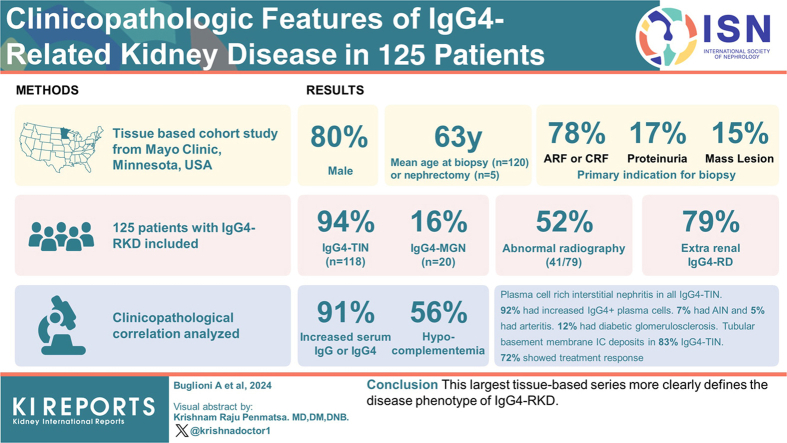
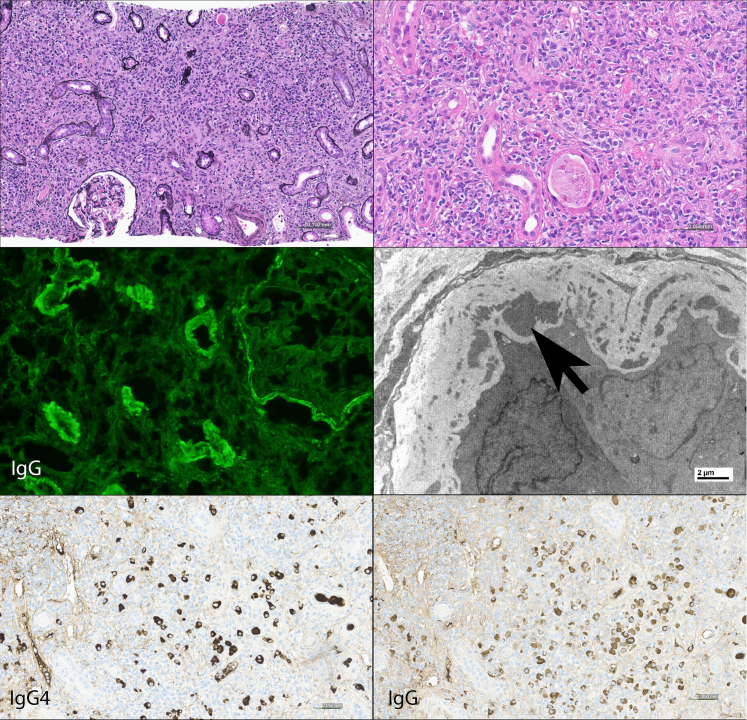
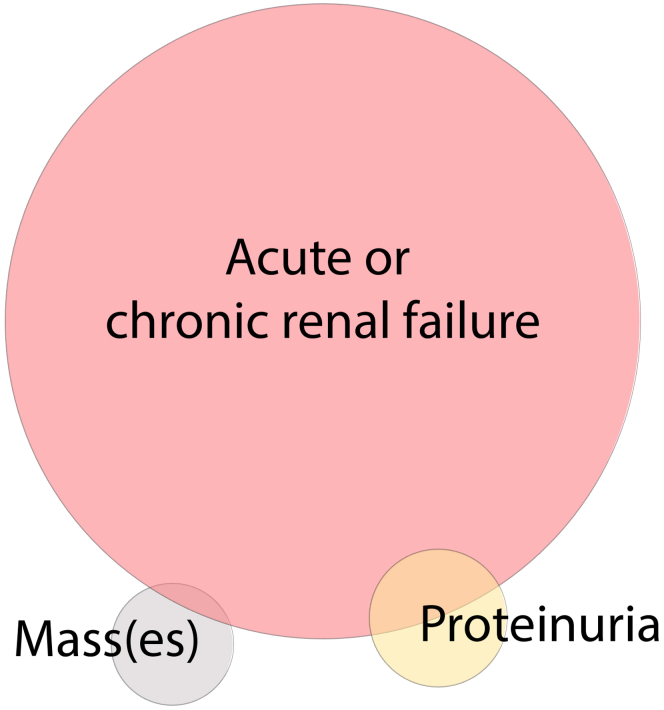
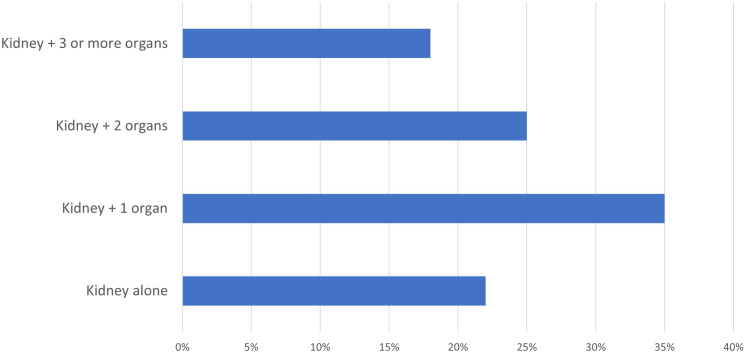
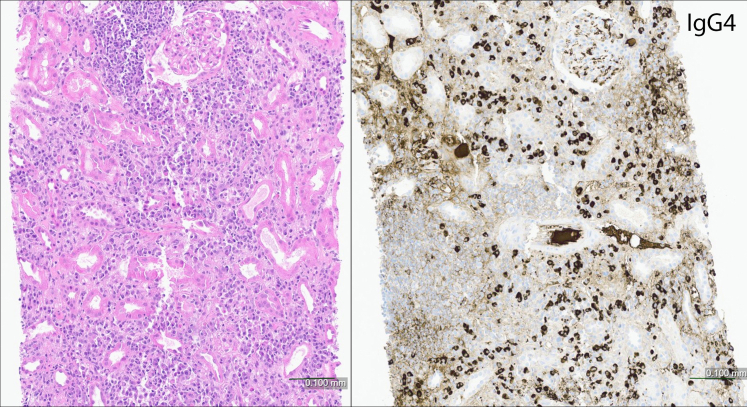
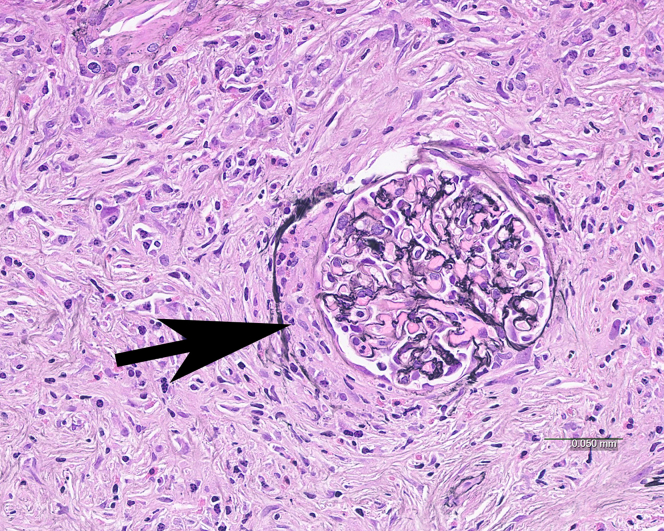
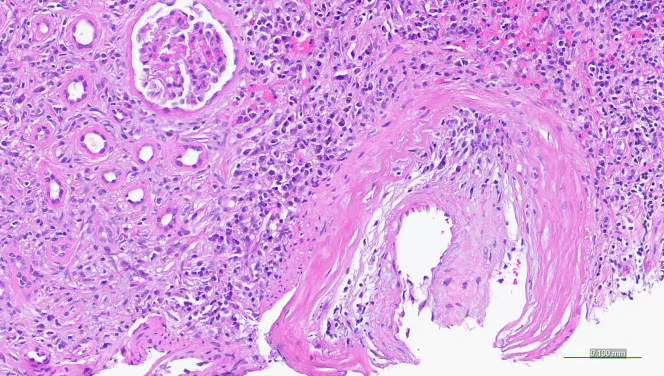
The mean age at biopsy ( = 120) or nephrectomy ( = 5) was 63 years; 80% were male. One hundred eighteen patients (94%) had IgG4-related tubulointerstitial nephritis (IgG4-TIN); 20 patients (16%) had IgG4-related membranous glomerulonephritis (IgG4-MGN; 13 with concurrent IgG4-TIN). The primary clinical indication for biopsy/nephrectomy was acute or chronic renal failure in 78%, proteinuria in 17%, and mass lesion(s) in 15% (with overlap in primary indication). Fifty-two percent patients (41/79) had abnormal radiographic findings, including masses in 30% (24/79). All patients with IgG4-MGN had proteinuria. Extrarenal involvement by IgG4-RD was present in 79%. Median serum creatinine at presentation was 2.5 mg/dl (range 0.7-12). Serum IgG and/or IgG4 was increased in 91% (53/58); hypocomplementemia was present in 56% (43/77). Light microscopy showed plasma cell-rich interstitial nephritis in all cases of IgG4-TIN. Ninety-two percent of patients showed increased IgG4+ plasma cells. Seven percent showed an acute interstitial nephritis (AIN) pattern, and 5% showed non-necrotizing arteritis. Tubular basement membrane immune deposits were present in 83% of IgG4-TIN. Treatment information was available for 71 patients; 62 were treated with immunosuppression. Of those with elevated creatinine, 72% (41/57) showed a treatment response.
This largest tissue-based series more clearly defines the disease phenotype of IgG4-RKD.
IgG4相关性疾病(IgG4-RD)是一种可累及几乎任何器官的系统性免疫介导疾病。IgG4-RD可通过不同疾病模式影响肾脏,统称为IgG4相关性肾病(IgG4-RKD)。
我们对125例IgG4-RKD患者进行了一项基于组织的队列研究,并进行临床病理相关性分析。
活检(n = 120)或肾切除术(n = 5)时的平均年龄为63岁;80%为男性。118例患者(94%)患有IgG4相关性肾小管间质性肾炎(IgG4-TIN);20例患者(16%)患有IgG4相关性膜性肾小球肾炎(IgG4-MGN;13例同时患有IgG4-TIN)。活检/肾切除术的主要临床指征为急性或慢性肾衰竭,占78%,蛋白尿占17%,占位性病变占15%(主要指征有重叠)。52%的患者(41/79)有异常影像学表现,其中30%(24/79)有肿块。所有IgG4-MGN患者均有蛋白尿。79%的患者存在IgG4-RD肾外受累。就诊时血清肌酐中位数为2.5mg/dl(范围0.7 - 12)。91%(53/58)的患者血清IgG和/或IgG4升高;56%(43/77)的患者存在低补体血症。光镜检查显示,所有IgG4-TIN病例均有富含浆细胞的间质性肾炎。92%的患者IgG4+浆细胞增多。7%表现为急性间质性肾炎(AIN)模式,5%表现为非坏死性动脉炎。83%的IgG4-TIN患者存在肾小管基底膜免疫沉积物。71例患者有治疗信息;62例接受了免疫抑制治疗。在肌酐升高的患者中,72%(41/57)有治疗反应。
这个最大的基于组织的系列研究更清晰地定义了IgG4-RKD的疾病表型。