Singh Kanwarmandeep, Aulakh Smriti K, Nijjar Gurkamal Singh, Singh Sumerjit, Sandhu Ajay Pal Singh, Luthra Shivansh, Tanvir Fnu, Kaur Yasmeen, Singla Abhinandan, Kaur Meet Sirjana
Internal Medicine, Government Medical College, Amritsar, IND.
Internal Medicine, Sri Guru Ram Das University of Health Sciences and Research, Amritsar, IND.
Cureus. 2024 Jul 17;16(7):e64738. doi: 10.7759/cureus.64738. eCollection 2024 Jul.
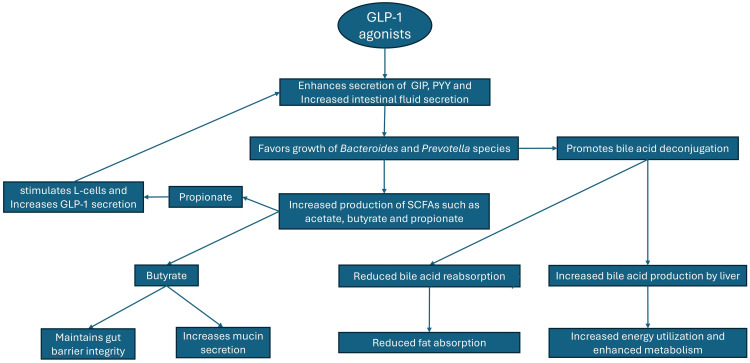
Obesity significantly impacts gut microbial composition, exacerbating metabolic dysfunction and weight gain. Traditional treatment methods often fall short, underscoring the need for innovative approaches. Glucagon-like peptide-1 (GLP-1) agonists have emerged as promising agents in obesity management, demonstrating significant potential in modulating gut microbiota. These agents promote beneficial bacterial populations, such as , , , while reducing harmful species like . By influencing gut microbiota composition, GLP-1 agonists enhance gut barrier integrity, reducing permeability and systemic inflammation, which are hallmarks of metabolic dysfunction in obesity. Additionally, GLP-1 agonists improve metabolic functions by increasing the production of short-chain fatty acids like butyrate, propionate, and acetate, which serve as energy sources for colonocytes, modulate immune responses, and enhance the production of gut hormones that regulate appetite and glucose homeostasis. By increasing microbial diversity, GLP-1 agonists create a more resilient gut microbiome capable of resisting pathogenic invasions and maintaining metabolic balance. Thus, by shifting the gut microbiota toward a healthier profile, GLP-1 agonists help disrupt the vicious cycle of obesity-induced gut dysbiosis and inflammation. This review highlights the intricate relationship between obesity, gut microbiota, and GLP-1 agonists, providing valuable insights into their combined role in effective obesity treatment and metabolic health enhancement.
肥胖显著影响肠道微生物组成,加剧代谢功能障碍和体重增加。传统治疗方法往往效果不佳,这凸显了创新方法的必要性。胰高血糖素样肽-1(GLP-1)激动剂已成为肥胖管理中颇具前景的药物,在调节肠道微生物群方面显示出巨大潜力。这些药物促进有益细菌种群的生长,如 、 、 ,同时减少有害菌,如 。通过影响肠道微生物群组成,GLP-1激动剂增强肠道屏障完整性,降低通透性和全身炎症,而这些正是肥胖中代谢功能障碍的特征。此外,GLP-1激动剂通过增加丁酸、丙酸和乙酸等短链脂肪酸的产生来改善代谢功能,这些短链脂肪酸可作为结肠细胞的能量来源,调节免疫反应,并增强调节食欲和葡萄糖稳态的肠道激素的产生。通过增加微生物多样性,GLP-1激动剂创造出一个更具弹性的肠道微生物群,能够抵抗病原体入侵并维持代谢平衡。因此,通过将肠道微生物群转变为更健康的状态,GLP-1激动剂有助于打破肥胖诱导的肠道菌群失调和炎症的恶性循环。本综述强调了肥胖、肠道微生物群和GLP-1激动剂之间的复杂关系,为它们在有效治疗肥胖和增强代谢健康方面的联合作用提供了有价值的见解。