Suri Smriti, Boora Geeta S, Kaur Rajandeep, Chauhan Anshika, Ghoshal Sushmita, Pal Arnab
Department of Biochemistry, Postgraduate Institute of Medical Education and Research, Chandigarh, India.
Department of Radiotherapy, Postgraduate Institute of Medical Education and Research, Chandigarh, India.
Front Oral Health. 2024 Aug 2;5:1426507. doi: 10.3389/froh.2024.1426507. eCollection 2024.
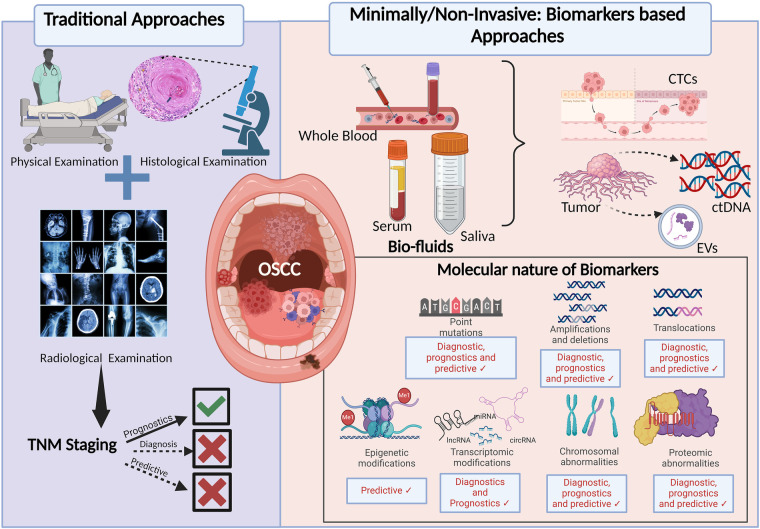
Oral cancer is the 6th most common type of cancer worldwide, and oral squamous cell carcinoma (OSCC) accounts for >90% of oral cancers. It is a major health problem, particularly in low- and middle-income countries (LMICs), due to both its high incidence and significant mortality and morbidity. Despite being a global burden, and even with the significant advancement in the management of OSCC, the overall outcome of the disease is still abysmal. With the advent of time, advanced diagnostic and treatment approaches have come into practice, but the burden of the disease has not improved significantly. Major reasons attributed to the poor outcome are delay in diagnosis, locoregional recurrence and resistance to the currently available treatment regimen. In this review, we have highlighted the existing challenges in the diagnosis and have emphasized the advancements in minimally invasive biomarkers. Additionally, the importance of collaborative multidimensional approaches involving clinicians and researchers has been discussed, as well as the need to redefine and establish better utility and management of existing diagnostic and treatment protocols along with the minimally invasive/non-invasive biomarkers.
口腔癌是全球第六大常见癌症类型,口腔鳞状细胞癌(OSCC)占口腔癌的90%以上。它是一个重大的健康问题,特别是在低收入和中等收入国家(LMICs),这是由于其高发病率以及显著的死亡率和发病率。尽管它是一个全球性负担,并且即使OSCC的管理取得了重大进展,但该疾病的总体预后仍然很差。随着时间的推移,先进的诊断和治疗方法已付诸实践,但该疾病的负担并未显著改善。导致预后不良的主要原因是诊断延迟、局部区域复发以及对当前可用治疗方案的耐药性。在本综述中,我们强调了诊断方面现有的挑战,并强调了微创生物标志物的进展。此外,还讨论了临床医生和研究人员协作的多维方法的重要性,以及重新定义和建立现有诊断和治疗方案以及微创/非侵入性生物标志物更好的效用和管理的必要性。