Chai Khai Li, Wellard Cameron, Thao Ltp, Aoki Naomi, Moore Elizabeth M, Augustson Bradley M, Bapat Akshay, Blacklock Hilary, Chng Wee J, Cooke Rachel, Forsyth Cecily J, Goh Yeow-Tee, Hamad Nada, Harrison Simon J, Ho P Joy, Hocking Jay, Kerridge Ian, Kim Jin Seok, Kim Kihyun, King Tracy, McCaughan Georgia J, Mollee Peter, Morrissey C Orla, Murphy Nick, Quach Hang, Tan Xuan Ni, Tso Allison Cy, Wong Kimberly Sq, Yoon Sung-Soo, Spencer Andrew, Wood Erica M, McQuilten Zoe K
Transfusion Research Unit School of Public Health and Preventive Medicine Monash University Melbourne Australia.
Department of Haematology Sir Charles Gairdner Hospital Perth Australia.
EJHaem. 2024 Jun 16;5(4):690-697. doi: 10.1002/jha2.938. eCollection 2024 Aug.
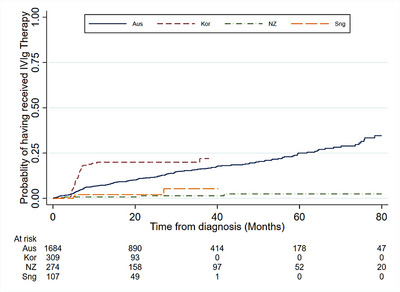
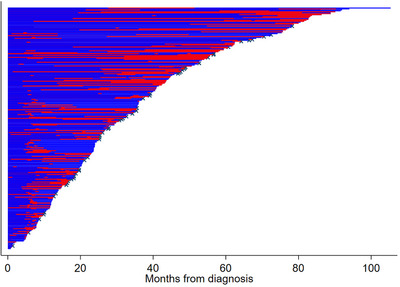
Serious infection is common in patients with multiple myeloma due to immune deficiency from the underlying disease and/or its treatment. Immunoglobulin replacement is one approach to reduce infection risk in these patients. However, few real-world data exist on its use in patients with myeloma. We investigated immunoglobulin use in Australia, New Zealand and Asia-Pacific using registry data and explored its association with survival outcomes. A total of 2374 patients with a median follow-up time of 29.5 months (interquartile range 13.3-54.3 months) were included in the analysis - 1673 from Australia, 313 Korea, 281 New Zealand and 107 Singapore. Overall, 7.1% of participants received immunoglobulin replacement within 24 months of diagnosis. Patients who received immunoglobulin replacement were likely to be younger, had lower baseline IgG levels (excluding paraprotein), were more likely to have baseline hypogammaglobulinaemia, baseline severe hypogammaglobulinaemia and abnormal baseline fluorescent in-situ hybridisation status, receive first-line myeloma treatment with immunomodulatory drugs or anti-CD38 therapy and undergo upfront autologous stem cell transplant. In our patient cohort, the use of immunoglobulin was not associated with overall survival benefit at the time of last follow-up (adjusted hazard ratio 0.72, 95% CI 0.46-1.14, = 0.16). Understanding treatment approaches in clinical practice can help support future planning and provision of immunoglobulin resources.
由于潜在疾病和/或其治疗导致的免疫缺陷,严重感染在多发性骨髓瘤患者中很常见。免疫球蛋白替代疗法是降低这些患者感染风险的一种方法。然而,关于其在骨髓瘤患者中的实际应用,几乎没有真实世界的数据。我们使用登记数据调查了澳大利亚、新西兰和亚太地区免疫球蛋白的使用情况,并探讨了其与生存结果的关联。共有2374名患者纳入分析,中位随访时间为29.5个月(四分位间距13.3 - 54.3个月),其中1673名来自澳大利亚,313名来自韩国,281名来自新西兰,107名来自新加坡。总体而言,7.1%的参与者在诊断后24个月内接受了免疫球蛋白替代治疗。接受免疫球蛋白替代治疗的患者可能更年轻,基线IgG水平较低(不包括副蛋白),更有可能有基线低丙种球蛋白血症、基线严重低丙种球蛋白血症和异常的基线荧光原位杂交状态,接受免疫调节药物或抗CD38疗法的一线骨髓瘤治疗,并接受前期自体干细胞移植。在我们的患者队列中,在最后一次随访时,免疫球蛋白的使用与总体生存获益无关(调整后风险比0.72,95%置信区间0.46 - 1.14,P = 0.16)。了解临床实践中的治疗方法有助于支持未来免疫球蛋白资源的规划和供应。