Centre for Primary Care and Health Services Research, Institute of Population Health, University of Manchester, Manchester, England.
BMC Prim Care. 2024 Aug 19;25(1):309. doi: 10.1186/s12875-024-02545-8.
There is a considerable amount of research showing an association between continuity of care and improved health outcomes. However, the methods used in most studies examine only the pattern of interactions between patients and clinicians through administrative measures of continuity. The patient experience of continuity can also be measured by using patient reported experience measures. Unlike administrative measures, these can allow elements of continuity such as the presence of information or how joined up care is between providers to be measured. Patient experienced continuity is a marker of healthcare quality in its own right. However, it is unclear if, like administrative measures, patient reported continuity is also linked to positive health outcomes.
Cohort and interventional studies that examined the relationship between patient reported continuity of care and a health outcome were eligible for inclusion. Medline, EMBASE, CINAHL and the Cochrane Library were searched in April 2021. Citation searching of published continuity measures was also performed. QUIP and Cochrane risk of bias tools were used to assess study quality. A box-score method was used for study synthesis.
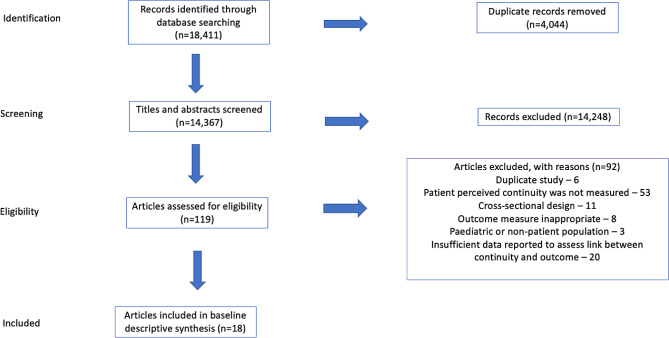
Nineteen studies were eligible for inclusion. 15 studies measured continuity using a validated, multifactorial questionnaire or the continuity/co-ordination subscale of another instrument. Two studies placed patients into discrete groups of continuity based on pre-defined questions, one used a bespoke questionnaire, one calculated an administrative measure of continuity using patient reported data. Outcome measures examined were quality of life (n = 11), self-reported health status (n = 8), emergency department use or hospitalisation (n = 7), indicators of function or wellbeing (n = 6), mortality (n = 4) and physiological measures (n = 2). Analysis was limited by the relatively small number of hetrogenous studies. The majority of studies showed a link between at least one measure of continuity and one health outcome.
Whilst there is emerging evidence of a link between patient reported continuity and several outcomes, the evidence is not as strong as that for administrative measures of continuity. This may be because administrative measures record something different to patient reported measures, or that studies using patient reported measures are smaller and less able to detect smaller effects. Future research should use larger sample sizes to clarify if a link does exist and what the potential mechanisms underlying such a link could be. When measuring continuity, researchers and health system administrators should carefully consider what type of continuity measure is most appropriate.
有相当多的研究表明,连续性护理与改善健康结果之间存在关联。然而,大多数研究使用的方法仅通过连续性的行政措施来检查患者和临床医生之间的互动模式。患者对连续性的体验也可以通过使用患者报告的体验措施来衡量。与行政措施不同,这些措施可以衡量连续性的要素,例如信息的存在或提供者之间的护理衔接程度。患者体验的连续性本身就是医疗保健质量的一个标志。然而,尚不清楚患者报告的连续性是否像行政措施一样,与积极的健康结果相关联。
合格的研究为检查患者报告的连续性护理与健康结果之间的关系的队列研究和干预研究。2021 年 4 月,对 Medline、EMBASE、CINAHL 和 Cochrane 图书馆进行了检索,并对已发表的连续性措施进行了引文搜索。QUIP 和 Cochrane 偏倚风险工具用于评估研究质量。使用箱线图方法进行研究综合。
有 19 项研究符合纳入标准。15 项研究使用经过验证的多因素问卷或另一工具的连续性/协调子量表来测量连续性。两项研究根据预定义问题将患者分为不同的连续性组,一项使用了专门的问卷,一项使用患者报告的数据计算了连续性的行政措施。检查的结果衡量指标包括生活质量(n=11)、自我报告的健康状况(n=8)、急诊使用或住院(n=7)、功能或福利指标(n=6)、死亡率(n=4)和生理指标(n=2)。分析受到相对较少的异质研究的限制。大多数研究表明,连续性的至少一个衡量标准与一个健康结果之间存在联系。
虽然有越来越多的证据表明患者报告的连续性与几个结果之间存在联系,但证据不如连续性的行政措施那么强。这可能是因为行政措施记录的内容与患者报告的措施不同,或者使用患者报告的措施的研究规模较小,无法检测到较小的影响。未来的研究应使用更大的样本量来明确是否存在联系,以及这种联系的潜在机制可能是什么。在衡量连续性时,研究人员和卫生系统管理人员应仔细考虑哪种连续性衡量标准最合适。