Liu Lin, Yao Yucen, Liu Yang, Hong Bingrong, Li Ziqing, Chen Xuejun, Zhang Yaofeng, Fu Hongbo, Yang Degong, Yang Chunrong
Department of Pharmacy, The Second Affiliated Hospital of Shantou University Medical College, Shantou 515041, China.
Department of Pharmacy, Shantou University Medical College, Shantou 515041, China.
Biomater Res. 2024 Aug 19;28:0061. doi: 10.34133/bmr.0061. eCollection 2024.
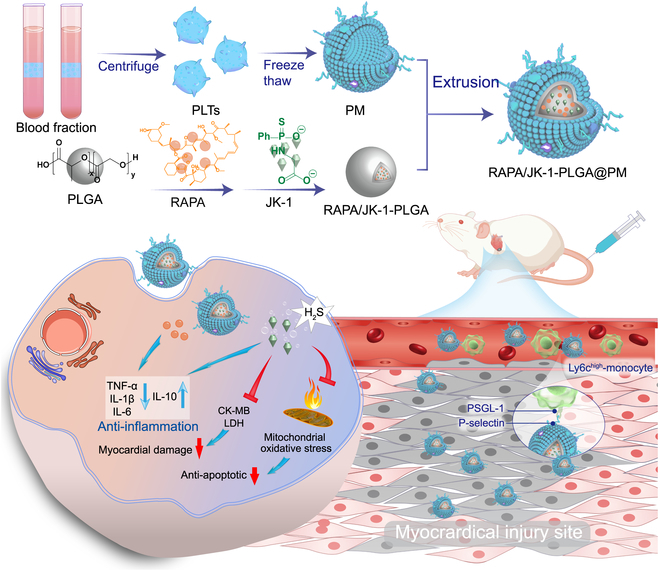
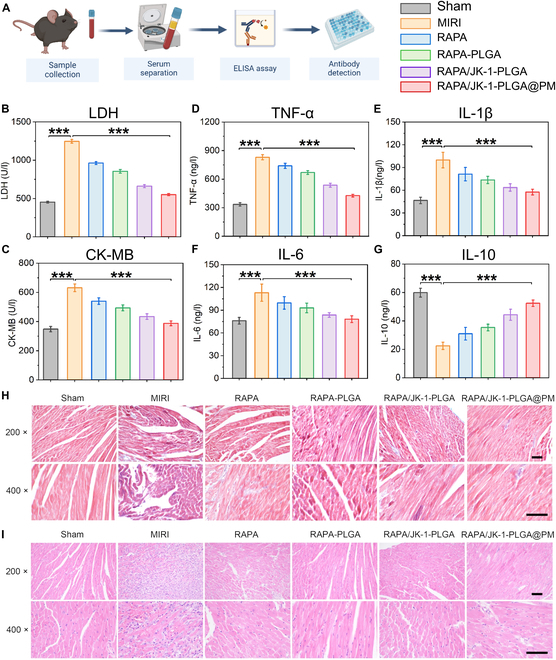
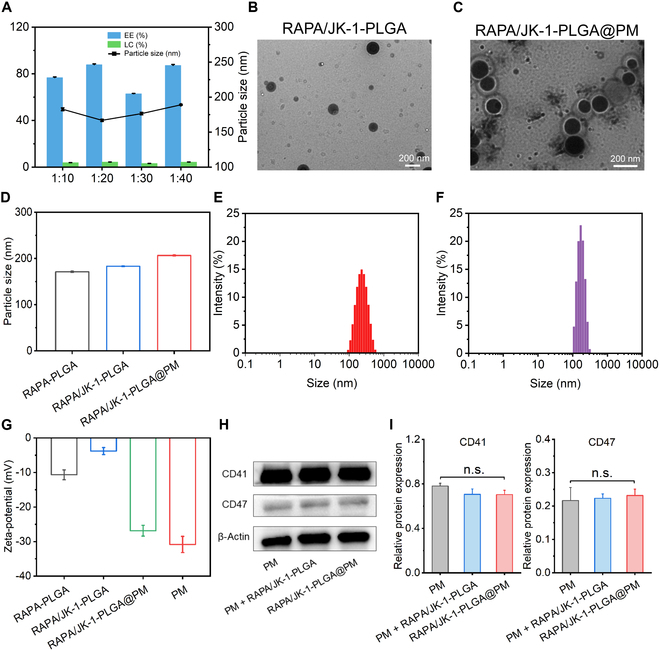
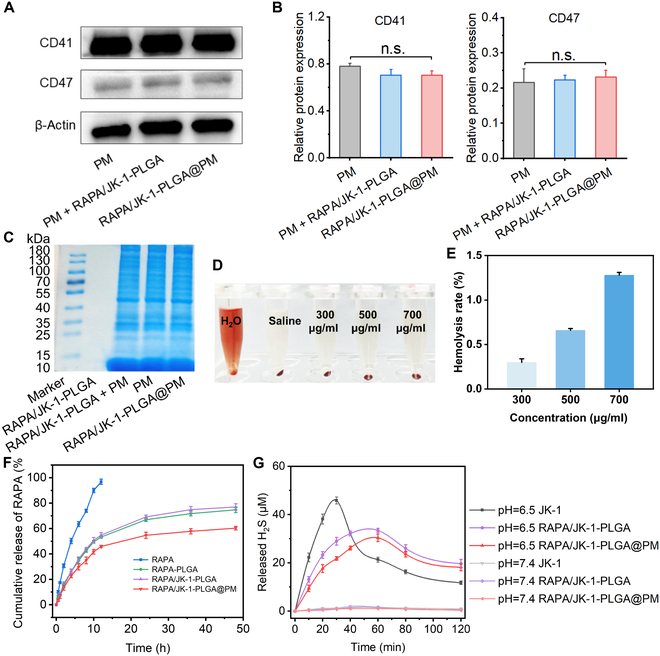
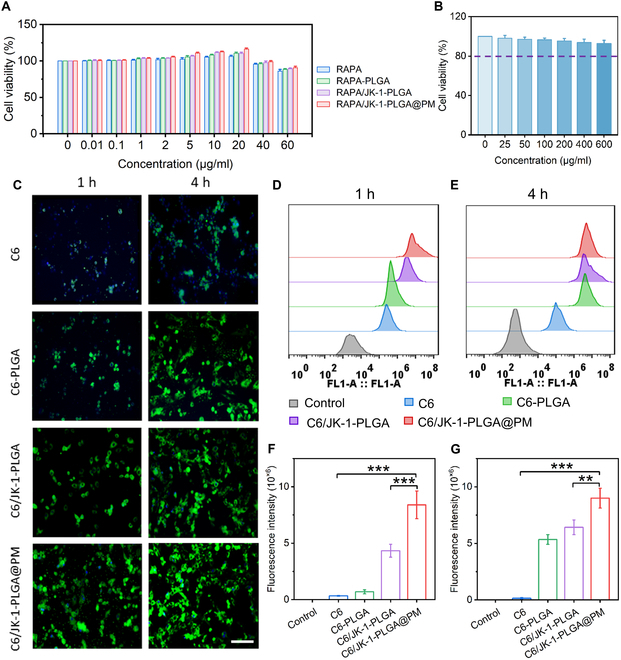
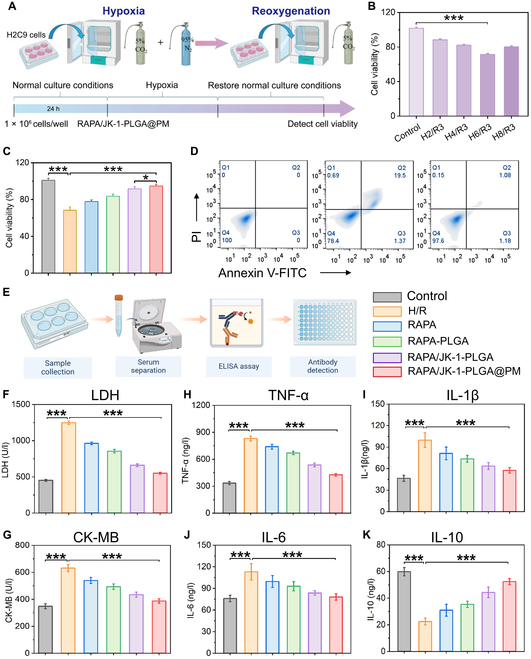
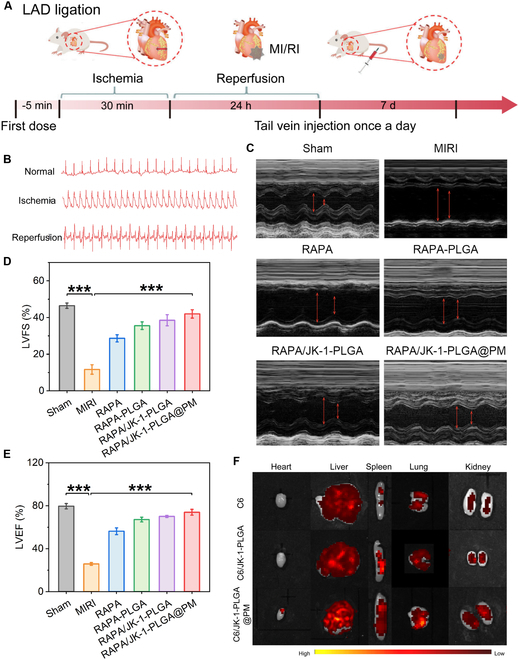
Management of myocardial ischemia-reperfusion injury (MIRI) in reperfusion therapy remains a major obstacle in the field of cardiovascular disease, but current available therapies have not yet been achieved in mitigating myocardial injury due to the complex pathological mechanisms of MIRI. Exogenous delivery of hydrogen sulfide (HS) to the injured myocardium can be an effective strategy for treating MIRI due to the multiple physiologic functions of HS, including anti-inflammatory, anti-apoptotic, and mitochondrial protective effects. Here, to realize the precise delivery and release of HS, we proposed the targeted HS-mediated gas therapy with pH-sensitive release property mediated by platelet membranes (PMs). In this study, a biomimetic functional poly(lactic-co-ethanolic acid) nanoparticle (RAPA/JK-1-PLGA@PM) was fabricated by loading rapamycin (RAPA; mTOR inhibitor) and JK-1 (HS donor) and then coated with PM. In vitro observations were conducted including pharmaceutical evaluation, HS release behaviors, hemolysis analysis, serum stability, cellular uptake, cytotoxicity, inhibition of myocardial apoptosis, and anti-inflammation. In vivo examinations were performed including targeting ability, restoration of cardiac function, inhibition of pathological remodeling, and anti-inflammation. RAPA/JK-1-PLGA@PM was successfully prepared with good size distribution and stability. Utilizing the natural infarct-homing ability of PM, RAPA/JK-1-PLGA@PM could be effectively targeted to the damaged myocardium. RAPA/JK-1-PLGA@PM continuously released HS triggered by inflammatory microenvironment, which could inhibit cardiomyocyte apoptosis, realize the transition of pro-inflammation, and alleviate myocardial injury demonstrated in hypoxia/reoxygenation myocardial cell in vitro. Precise delivery and release of HS attenuated inflammatory response and cardiac damage, promoted cardiac repair, and ameliorated cardiac function proven in MIRI mouse model in vivo. This research outlined the novel nanoplatform that combined immunosuppressant agents and HS donor with the pH-sensitive release property, offering a promising therapeutic for MIRI treatment that leveraged the synergistic effects of gas therapy.
在再灌注治疗中,心肌缺血再灌注损伤(MIRI)的管理仍然是心血管疾病领域的一个主要障碍,但由于MIRI复杂的病理机制,目前可用的治疗方法尚未在减轻心肌损伤方面取得成效。由于硫化氢(HS)具有抗炎、抗凋亡和线粒体保护等多种生理功能,向受损心肌外源性递送HS可能是治疗MIRI的有效策略。在此,为了实现HS的精确递送和释放,我们提出了由血小板膜(PMs)介导的具有pH敏感释放特性的靶向HS介导气体疗法。在本研究中,通过负载雷帕霉素(RAPA;mTOR抑制剂)和JK-1(HS供体),然后用PM包被,制备了一种仿生功能聚(乳酸-乙醇酸)纳米颗粒(RAPA/JK-1-PLGA@PM)。进行了体外观察,包括药物评价、HS释放行为、溶血分析、血清稳定性、细胞摄取、细胞毒性、抑制心肌细胞凋亡和抗炎作用。进行了体内检查,包括靶向能力、心脏功能恢复、抑制病理重塑和抗炎作用。成功制备了尺寸分布良好且稳定性高的RAPA/JK-1-PLGA@PM。利用PM的天然梗死归巢能力,RAPA/JK-1-PLGA@PM可以有效地靶向受损心肌。由炎症微环境触发的RAPA/JK-1-PLGA@PM持续释放HS,可抑制心肌细胞凋亡,实现促炎转变,并减轻体外缺氧/复氧心肌细胞中显示的心肌损伤。HS的精确递送和释放在体内MIRI小鼠模型中证实可减轻炎症反应和心脏损伤,促进心脏修复,并改善心脏功能。本研究概述了一种新型纳米平台,该平台将免疫抑制剂和HS供体与pH敏感释放特性相结合,为利用气体疗法的协同效应治疗MIRI提供了一种有前景的治疗方法。