Dong Jian, Ruan Binjia, Zhang Lijun, Wei Ai, Li Chuling, Tang Neng, Zhu Linxi, Jiang Qing, Cao Wangsen
State Key Laboratory of Pharmaceutical Biotechnology, Branch of National Clinical Research Center for Orthopedics, Sports Medicine and Rehabilitation, Division of Sports Medicine and Adult Reconstructive Surgery, Department of Orthopedic Surgery, Nanjing Drum Tower Hospital, Affiliated Hospital of Medical School, Nanjing University, Nanjing, China.
Nanjing University Medical School, JiangsuKey Lab of Molecular Medicine, Nanjing, China.
Research (Wash D C). 2024 Aug 19;7:0457. doi: 10.34133/research.0457. eCollection 2024.
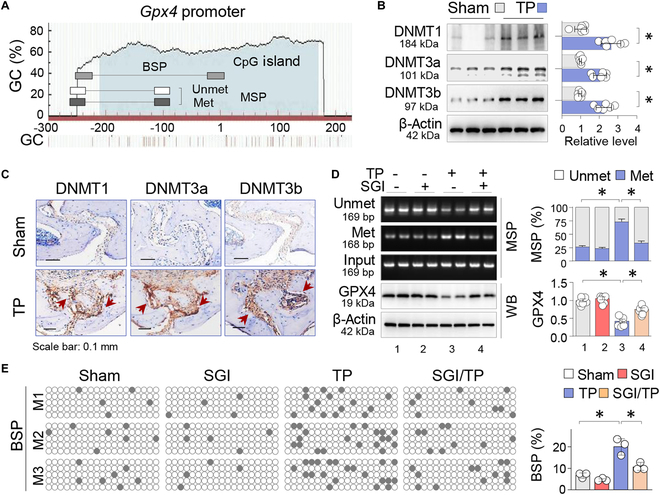
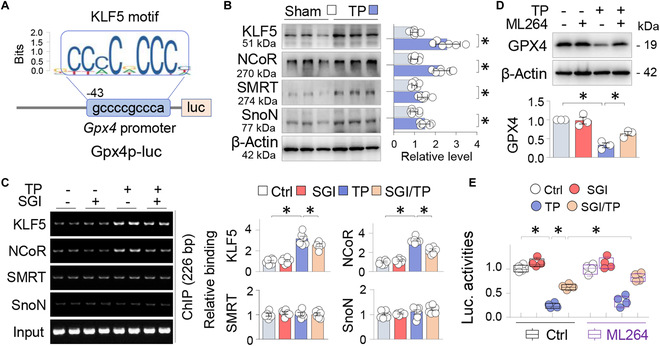
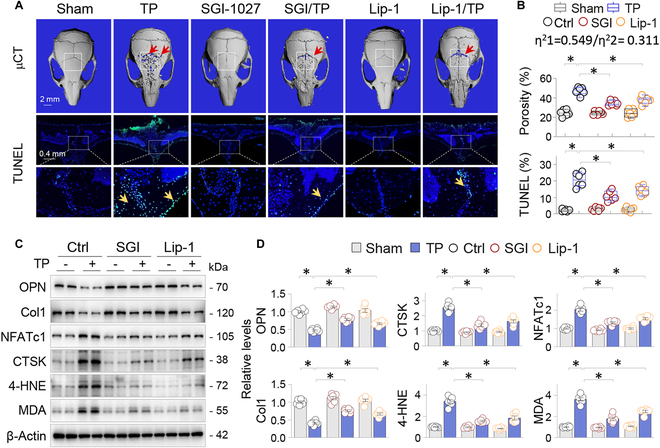
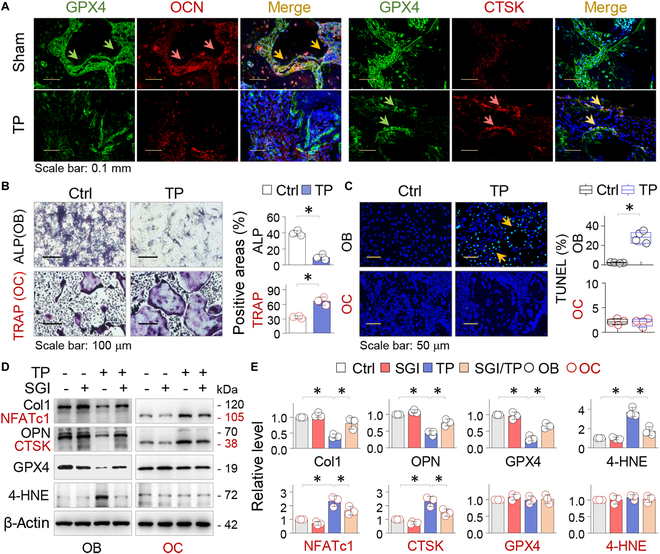
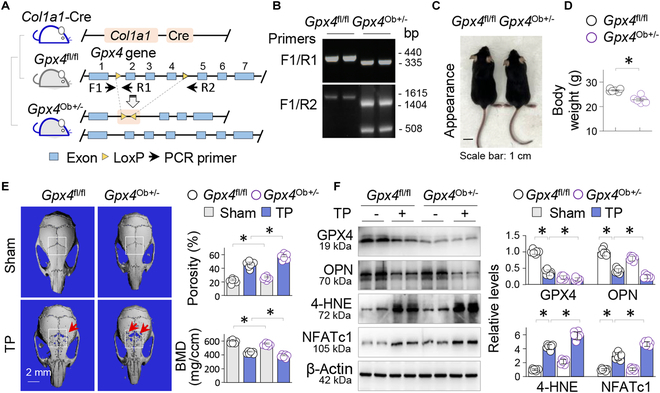
Metal wear particles generated by the movement of joint prostheses inevitably lead to aseptic osteolytic damage and ultimately prosthesis loosening, which are aggravated by various types of regulated cell death of bone. Nevertheless, the exact cellular nature and regulatory network underlying osteoferroptosis are poorly understood. Here, we report that titanium particles (TP) induced severe peri-implant osteolysis and ferroptotic changes with concomitant transcriptional repression of a key anti-ferroptosis factor, GPX4, in a mouse model of calvarial osteolysis. GPX4 repression was accompanied by an increase in DNA methyltransferases (DNMTs) 1/3a/3b and hypermethylation of the promoter, which were partly mediated by the transcriptional regulator/co-repressor KLF5 and NCoR. Conversely, treatment with SGI-1027, a DNMT-specific inhibitor, resulted in marked reversal of promoter hypermethylation and GPX4 repression, as well as improvement in ferroptotic osteolysis to a similar extent as with a ferroptosis inhibitor, liproxstatin-1. This suggests that epigenetic GPX4 repression and ferroptosis caused by the increase of DNMT1/3a/3b have a causal influence on TP-induced osteolysis. In cultured primary osteoblasts and osteoclasts, GPX4 repression and ferroptotic changes were observed primarily in osteoblasts that were alleviated by SGI-1027 in a GPX4 inactivation-sensitive manner. Furthermore, we developed a mouse strain with haplodeficiency in osteoblasts ( ) that exhibited worsened ferroptotic osteolysis in control and TP-treated calvaria and largely abolished the anti-ferroptosis and osteoprotective effects of SGI-1027. Taken together, our results demonstrate that DNMT1/3a/3b elevation, resulting GPX4 repression, and osteoblastic ferroptosis form a critical epigenetic pathway that significantly contributes to TP-induced osteolysis, and that targeting DNMT aberration and the associated osteoferroptosis could be a potential strategy to prevent or slow down prosthesis-related osteolytic complications.
关节假体运动产生的金属磨损颗粒不可避免地导致无菌性骨溶解损伤,并最终导致假体松动,而各种类型的骨细胞程序性死亡会加剧这种情况。然而,骨铁死亡背后的确切细胞性质和调控网络仍知之甚少。在此,我们报告在颅骨溶解小鼠模型中,钛颗粒(TP)诱导了严重的种植体周围骨溶解和铁死亡变化,同时关键抗铁死亡因子GPX4的转录受到抑制。GPX4的抑制伴随着DNA甲基转移酶(DNMT)1/3a/3b的增加以及启动子的高甲基化,这部分是由转录调节因子/共抑制因子KLF5和NCoR介导的。相反,用DNMT特异性抑制剂SGI-1027处理导致启动子高甲基化和GPX4抑制的显著逆转,以及铁死亡性骨溶解的改善,其程度与铁死亡抑制剂liproxstatin-1相似。这表明由DNMT1/3a/3b增加引起的表观遗传GPX4抑制和铁死亡对TP诱导的骨溶解有因果影响。在原代培养的成骨细胞和破骨细胞中,主要在成骨细胞中观察到GPX4抑制和铁死亡变化,而SGI-1027以GPX4失活敏感的方式缓解了这些变化。此外,我们培育了一种成骨细胞单倍体缺陷的小鼠品系( ),该品系在对照和TP处理的颅骨中表现出更严重的铁死亡性骨溶解,并且基本消除了SGI-1027的抗铁死亡和骨保护作用。综上所述,我们的结果表明,DNMT1/3a/3b升高导致GPX4抑制和成骨细胞铁死亡,形成了一条关键的表观遗传途径,对TP诱导的骨溶解有显著贡献,针对DNMT异常和相关的骨铁死亡可能是预防或减缓假体相关骨溶解并发症的潜在策略。