Department of Clinical, Henan University of Chinese Medicine, No.156 Jinshui East Road, Zhengzhou, Henan, 450046, China.
Department of Pharmacology, Henan University of Chinese Medicine, No.156 Jinshui East Road, Zhengzhou, Henan, 450046, China.
Aging Clin Exp Res. 2024 Aug 20;36(1):172. doi: 10.1007/s40520-024-02811-w.
Substantial evidence supports that glaucoma and dementia share pathological mechanisms and pathogenic risk factors. However, the association between glaucoma, cognitive decline and dementia has yet to be elucidated.
This study was aimed to assess whether glaucoma increase the risk of dementia or cognitive impairment.
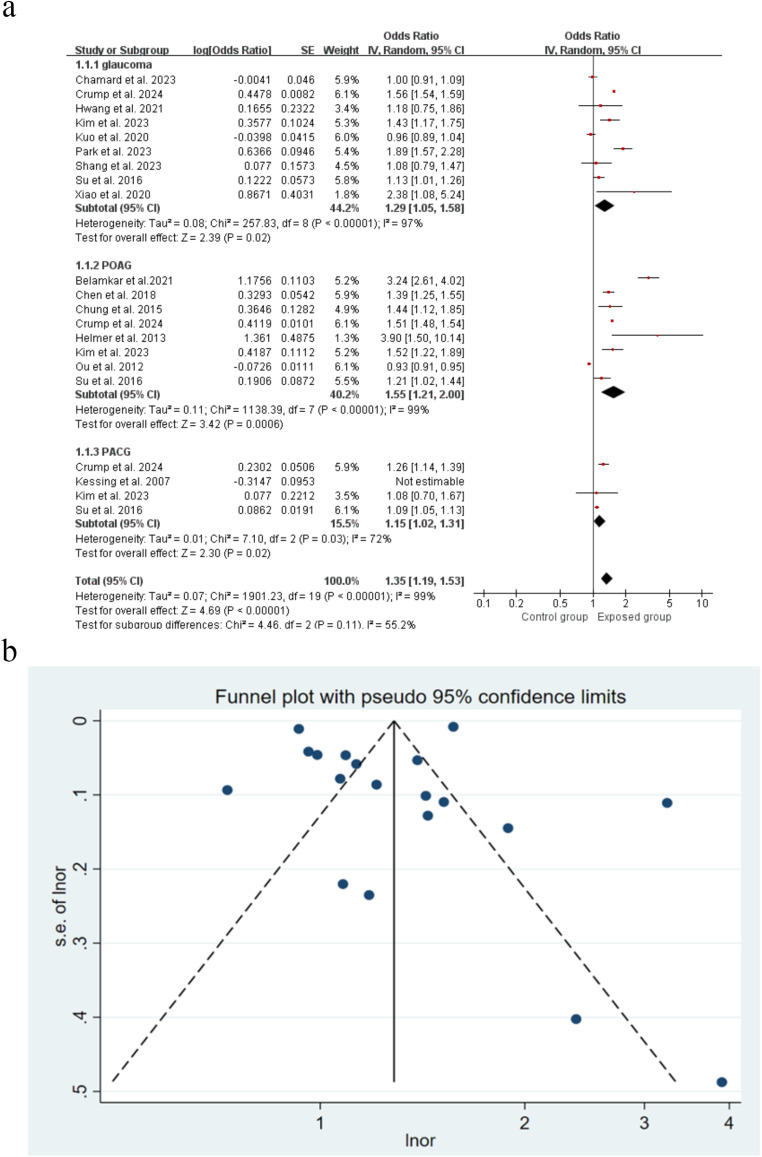
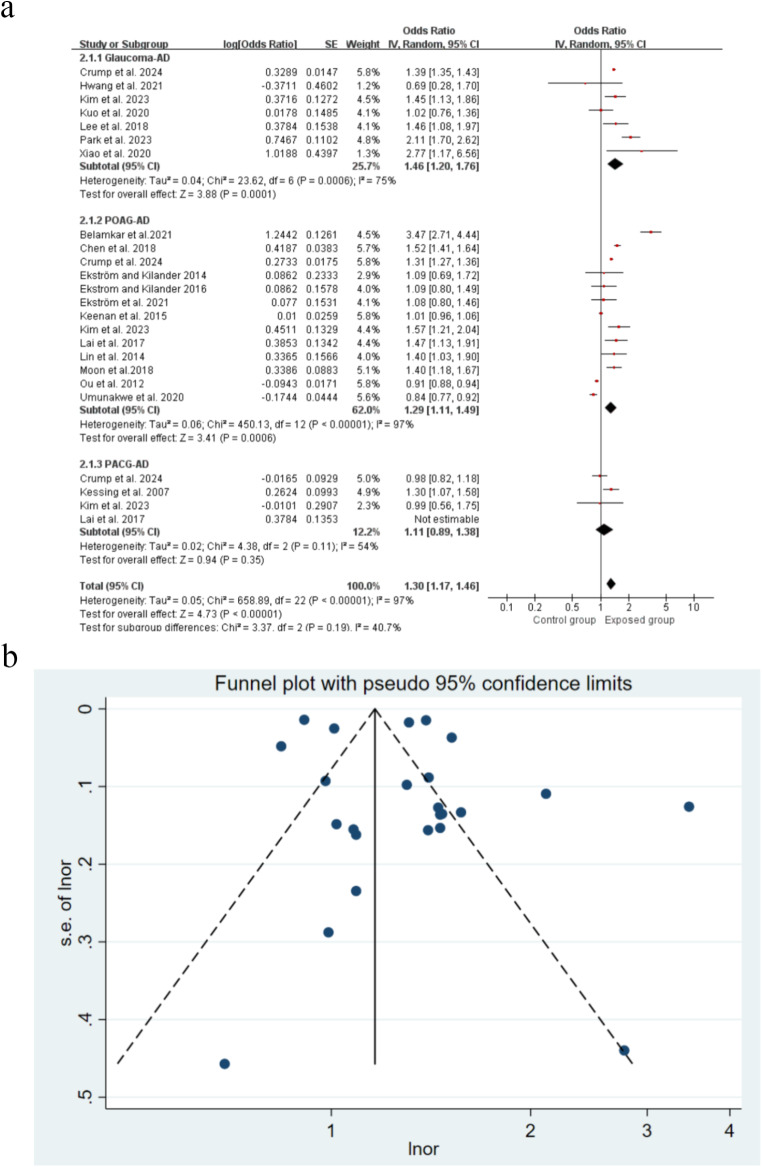
PubMed, Cochrane Library, Web of Science, and EMBASE databases for cohort or case-control studies were searched from inception to March 10, 2024. The Newcastle-Ottawa Quality Assessment Scale (NOS) was used to the risk of bias. Heterogeneity was rigorously evaluated using the I test, while publication bias was assessed by visual inspection of the funnel plot and by Egger' s regression asymmetry test. Subgroup analyses were applied to determine the sources of heterogeneity.
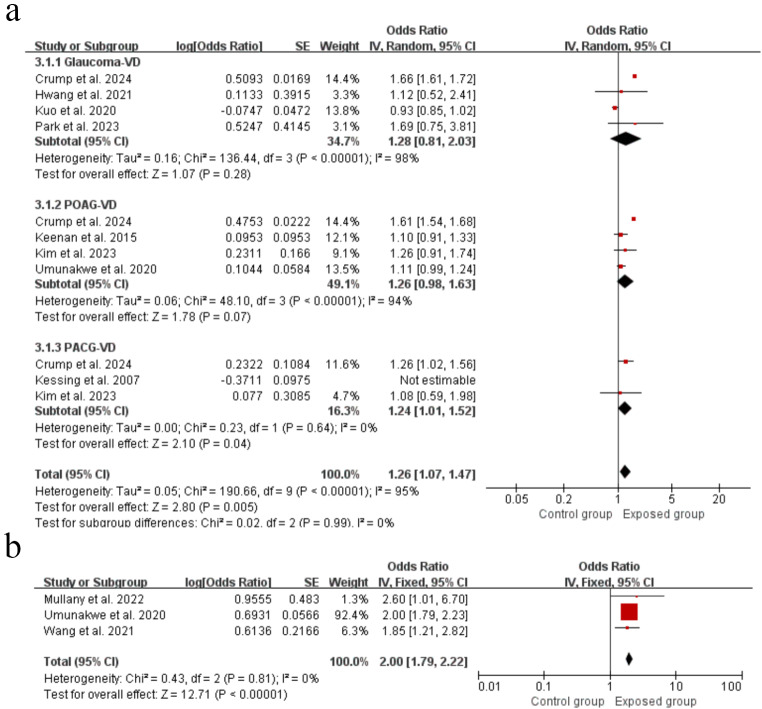
Twenty-seven studies covering 9,061,675 individuals were included. Pooled analyses indicated that glaucoma increased the risk of all-cause dementia, Alzheimer's disease, vascular dementia, and cognitive impairment. Subgroup analysis showed that the prevalence of dementia was 2.90 (95% CI: 1.45-5.77) in age ≥ 65 years and 2.07 (95% CI: 1.18-3.62) in age<65 years; the incidence rates in female glaucoma patients was 1.46 (95% CI: 1.06-2.00), respectively, which was no statistical significance in male patients. Among glaucoma types, POAG was more likely to develop dementia and cognitive impairment. There were also differences in regional distribution, with the highest prevalence in the Asia region, while glaucoma was not associated with dementia in Europe and North America regions.
Glaucoma increased the risk of subsequent cognitive impairment and dementia. The type of glaucoma, gender, age, and region composition of the study population may significantly affect the relationship between glaucoma and dementia.
大量证据表明青光眼和痴呆症具有共同的病理机制和致病风险因素。然而,青光眼、认知能力下降和痴呆症之间的关联尚未阐明。
本研究旨在评估青光眼是否会增加痴呆症或认知障碍的风险。
从建库至 2024 年 3 月 10 日,检索 PubMed、Cochrane 图书馆、Web of Science 和 EMBASE 数据库中的队列或病例对照研究。使用纽卡斯尔-渥太华质量评估量表(NOS)评估偏倚风险。使用 I 检验严格评估异质性,通过漏斗图和 Egger 回归不对称检验评估发表偏倚。进行亚组分析以确定异质性的来源。
共纳入 27 项研究,涵盖 9061675 人。汇总分析表明,青光眼增加了全因痴呆、阿尔茨海默病、血管性痴呆和认知障碍的风险。亚组分析显示,年龄≥65 岁的痴呆患病率为 2.90(95%CI:1.45-5.77),年龄<65 岁的患病率为 2.07(95%CI:1.18-3.62);女性青光眼患者的发病率为 1.46(95%CI:1.06-2.00),而男性患者则无统计学意义。在青光眼类型中,POAG 更易发展为痴呆和认知障碍。在地域分布上也存在差异,亚洲地区的患病率最高,而欧洲和北美地区的青光眼与痴呆症无关。
青光眼增加了后续认知障碍和痴呆症的风险。青光眼的类型、性别、年龄和研究人群的地域构成可能会显著影响青光眼与痴呆症之间的关系。