University of Groningen, University Medical Center Groningen, Department of Pathology and Medical Biology, Groningen, the Netherlands.
University of Groningen, University Medical Center Groningen, Department of Medical Microbiology and Infection Prevention, Groningen, the Netherlands.
Redox Biol. 2024 Oct;76:103310. doi: 10.1016/j.redox.2024.103310. Epub 2024 Aug 19.
Post-COVID-19 syndrome (PCS) remains a major health issue worldwide, while its pathophysiology is still poorly understood. Systemic oxidative stress (OS) may be involved in PCS, which is reflected by lower circulating free thiols (R-SH, sulfhydryl groups), as they are receptive to rapid oxidation by reactive species. This study aimed to investigate the longitudinal dynamics of serum R-SH after SARS-CoV-2 infection and its association with the development of PCS in individuals with mild COVID-19.
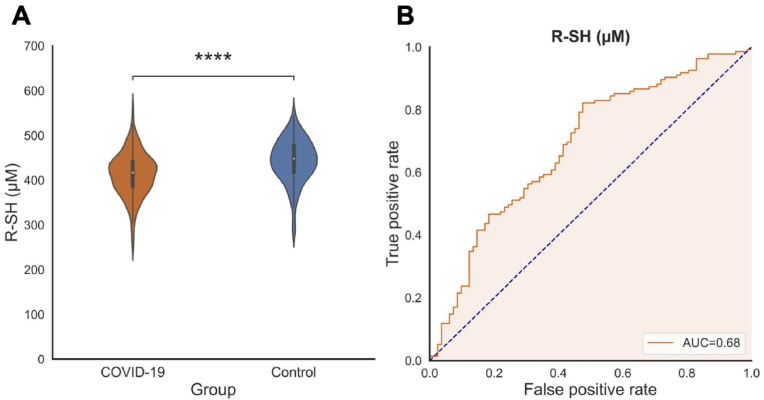
Baseline serum R-SH concentrations were measured and compared between 135 non-hospitalized COVID-19 subjects and 82 healthy controls (HC). In COVID-19 subjects, serum R-SH concentrations were longitudinally measured during the acute disease phase (up to 3 weeks) and at 3, 6, and 12 months of follow-up, and their associations with relevant clinical parameters were investigated, including the development of PCS.
Baseline albumin-adjusted serum R-SH were significantly reduced in non-hospitalized COVID-19 subjects as compared to HC (p = 0.041), reflecting systemic OS. In mild COVID-19 subjects, trajectories of albumin-adjusted serum R-SH levels over a course of 12 months were longitudinally associated with the future presence of PCS 18 months after initial infection (b = -9.48, p = 0.023).
Non-hospitalized individuals with COVID-19 show evidence of systemic oxidative stress, which is longitudinally associated with the development of PCS. Our results provide a rationale for future studies to further investigate the value of R-SH as a monitoring biomarker and a potential therapeutic target in the development of PCS.
新冠病毒后综合征(PCS)仍然是全球范围内的一个主要健康问题,但其病理生理学仍知之甚少。全身氧化应激(OS)可能与 PCS 有关,这反映在循环游离硫醇(R-SH,巯基)较低,因为它们容易被活性物质快速氧化。本研究旨在调查 SARS-CoV-2 感染后血清 R-SH 的纵向动态及其与轻度 COVID-19 患者 PCS 发展的关系。
测量了 135 名未住院的 COVID-19 患者和 82 名健康对照者(HC)的基线血清 R-SH 浓度,并进行了比较。在 COVID-19 患者中,在急性疾病期(最长 3 周)和随访 3、6 和 12 个月时纵向测量了血清 R-SH 浓度,并研究了它们与相关临床参数的关系,包括 PCS 的发展。
与 HC 相比,未住院的 COVID-19 患者的基线白蛋白校正血清 R-SH 明显降低(p=0.041),反映了全身 OS。在轻度 COVID-19 患者中,12 个月内白蛋白校正血清 R-SH 水平的轨迹与初次感染 18 个月后 PCS 的存在呈纵向相关(b=-9.48,p=0.023)。
患有 COVID-19 的未住院患者表现出全身氧化应激的证据,这种应激与 PCS 的发展呈纵向相关。我们的结果为进一步研究 R-SH 作为监测生物标志物和 PCS 发展的潜在治疗靶点的价值提供了依据。