Department of Biomedical Engineering, National Cheng Kung University, Tainan, Taiwan, ROC.
Medical Device Innovation Center, National Cheng Kung University, No.138, Shengli Rd., North District, Tainan City, 704, Taiwan, ROC.
BMC Geriatr. 2024 Aug 20;24(1):694. doi: 10.1186/s12877-024-05262-0.
This study conducted in-depth interviews to explore the factors that influence the adoption of fall detection technology among older adults and their families, providing a valuable evaluation framework for healthcare providers in the field of fall detection, with the ultimate goal of assisting older adults immediately and effectively when falls occur.
The method employed a qualitative approach, utilizing semi-structured interviews with 30 older adults and 29 families, focusing on their perspectives and expectations of fall detection technology. Purposive sampling ensured representation from older adults with conditions such as Parkinson's, dementia, and stroke.
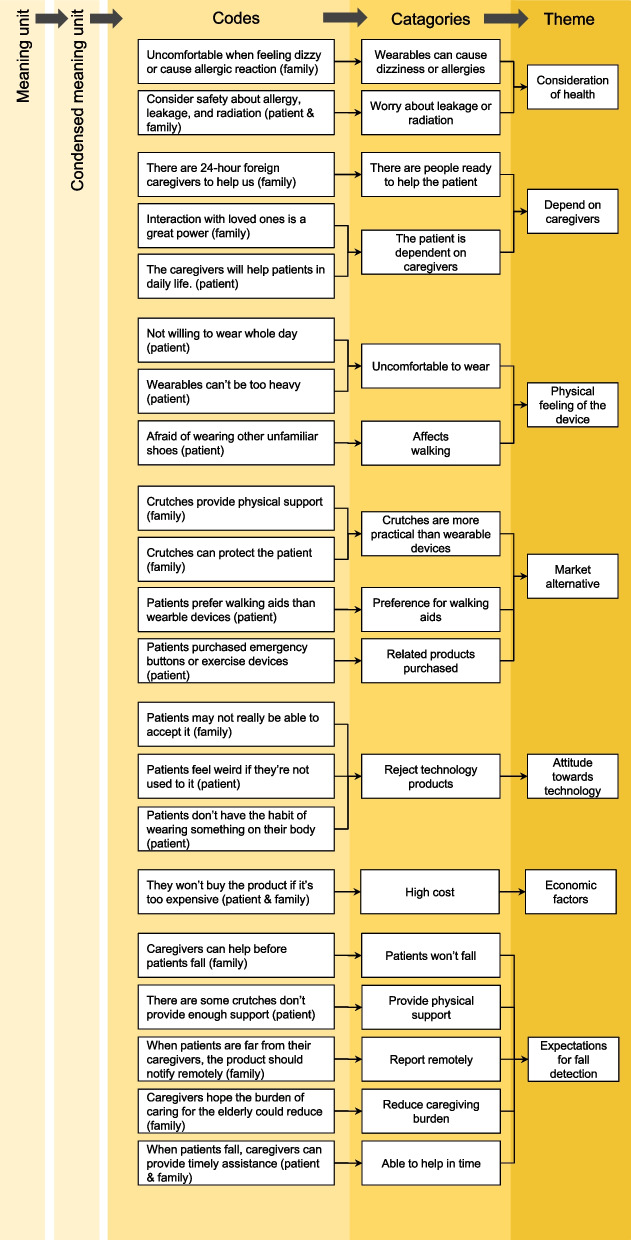
The results reveal key considerations influencing the adoption of fall-detection devices, including health factors, reliance on human care, personal comfort, awareness of market alternatives, attitude towards technology, financial concerns, and expectations for fall detection technology.
This study identifies seven key factors influencing the adoption of fall detection technology among older adults and their families. The conclusion highlights the need to address these factors to encourage adoption, advocating for user-centered, safe, and affordable technology. This research provides valuable insights for the development of fall detection technology, aiming to enhance the safety of older adults and reduce the caregiving burden.
本研究通过深入访谈,探讨了影响老年人及其家庭采用跌倒检测技术的因素,为跌倒检测领域的医疗保健提供者提供了有价值的评估框架,最终目标是在跌倒发生时能够立即、有效地为老年人提供帮助。
本研究采用定性方法,对 30 名老年人和 29 个家庭进行了半结构化访谈,重点关注他们对跌倒检测技术的看法和期望。采用目的性抽样,确保了有帕金森病、痴呆和中风等疾病的老年人的代表性。
研究结果揭示了影响跌倒检测设备采用的关键因素,包括健康因素、对人照顾的依赖、个人舒适度、对市场替代品的认知、对技术的态度、经济因素以及对跌倒检测技术的期望。
本研究确定了影响老年人及其家庭采用跌倒检测技术的七个关键因素。结论强调需要解决这些因素,以鼓励采用,倡导以用户为中心、安全和经济实惠的技术。本研究为跌倒检测技术的发展提供了有价值的见解,旨在提高老年人的安全性并减轻照护负担。