Almutairy Ali F, Alhamed Abdullah S, Grant Stephen G, Falso Miranda J, Day Billy W, Simmons Colton R, Latimer Jean J
Department of Pharmacology and Toxicology, College of Pharmacy, Qassim University, Buraidah, Saudi Arabia.
Department of Pharmaceutical Sciences, Barry and Judy Silverman College of Pharmacy, Nova Southeastern University, Fort Lauderdale, FL, United States.
Front Oncol. 2024 Aug 6;14:1406946. doi: 10.3389/fonc.2024.1406946. eCollection 2024.
Breast cancer (BC) is the most common cancer affecting women in the United States. Ductal carcinoma (DCIS) is the earliest identifiable pre-invasive BC lesion. Estimates show that 14 to 50% of DCIS cases progress to invasive BC.
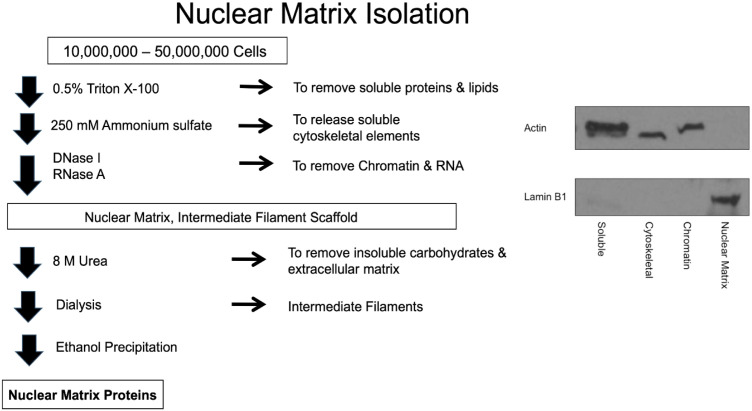
Our objective was to identify nuclear matrix proteins (NMP) with specifically altered expression in DCIS and later stages of BC compared to non-diseased breast reduction mammoplasty and a contralateral breast explant culture using mass spectrometry and RNA sequencing to accurately identify aggressive DCIS.
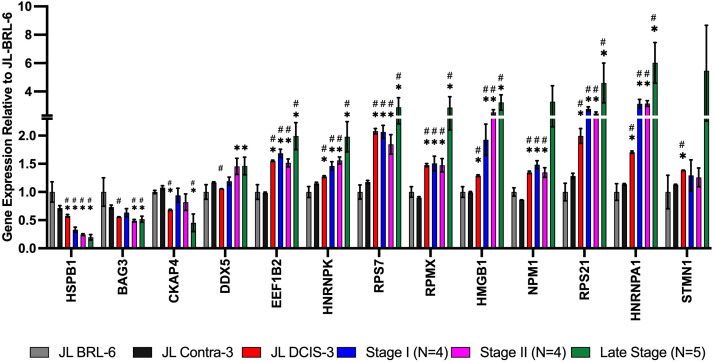
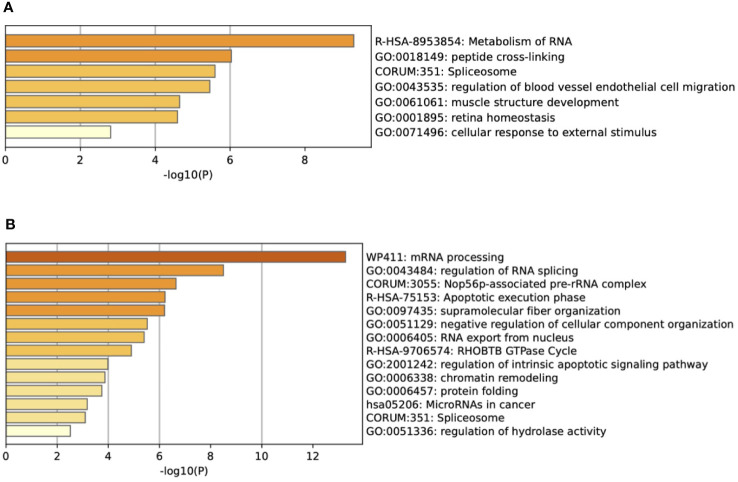
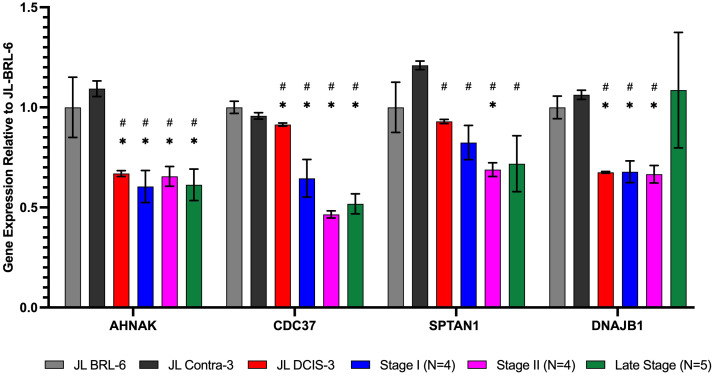
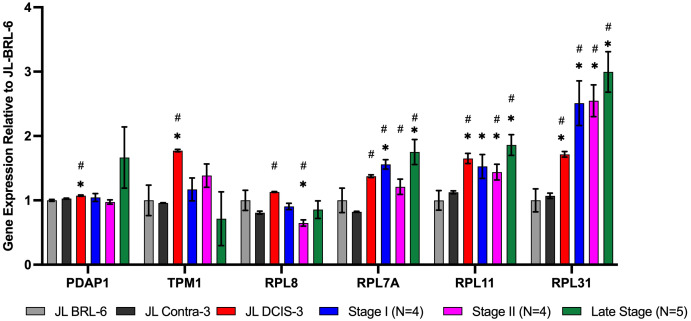
Sixty NMPs were significantly differentially expressed between the DCIS and non-diseased breast epithelium in an isogenic contralateral pair of patient-derived extended explants. Ten of the sixty showed significant mRNA expression level differences that matched the protein expression. These 10 proteins were similarly expressed in non-diseased breast reduction cells. Three NMPs (RPL7A, RPL11, RPL31) were significantly upregulated in DCIS and all other BC stages compared to the matching contralateral breast culture and an unrelated non-diseased breast reduction culture. RNA sequencing analyses showed that these three genes were increasingly upregulated with BC progression. Finally, we identified three NMPs (AHNAK, CDC37 and DNAJB1) that were significantly downregulated in DCIS and all other BC stages compared to the isogenically matched contralateral culture and the non-diseased breast reduction culture using both proteomics and RNA sequencing techniques.
These genes should form the basis of, or contribute to, a molecular diagnostic panel that could identify DCIS lesions likely to be indolent and therefore not requiring aggressive treatment.
乳腺癌(BC)是美国影响女性的最常见癌症。导管原位癌(DCIS)是最早可识别的浸润前乳腺癌病变。据估计,14%至50%的DCIS病例会进展为浸润性乳腺癌。
我们的目标是通过质谱分析和RNA测序,与未患病的乳房缩小整形术及对侧乳房外植体培养物相比,鉴定出在DCIS和乳腺癌后期阶段表达有特异性改变的核基质蛋白(NMP),以准确识别侵袭性DCIS。
在一组同基因的患者来源的扩展外植体对中,DCIS与未患病的乳腺上皮之间有60种NMP存在显著差异表达。这60种中的10种显示出与蛋白质表达相匹配的显著mRNA表达水平差异。这10种蛋白质在未患病的乳房缩小细胞中也有类似表达。与匹配的对侧乳房培养物及无关的未患病乳房缩小培养物相比,三种NMP(RPL7A、RPL11、RPL31)在DCIS及所有其他乳腺癌阶段显著上调。RNA测序分析表明,这三个基因随着乳腺癌进展而上调程度增加。最后,我们使用蛋白质组学和RNA测序技术鉴定出三种NMP(AHNAK、CDC37和DNAJB1),与同基因匹配的对侧培养物及未患病的乳房缩小培养物相比,它们在DCIS及所有其他乳腺癌阶段显著下调。
这些基因应构成一个分子诊断面板的基础或对其有贡献,该面板可识别可能为惰性因而无需积极治疗的DCIS病变。