Alkaabi Muzoon Matar Saleh, Rabbani Syed Arman, Rao Padma Gm, Mohamedelhassan Mai Ismail
Department of Clinical Pharmacy and Pharmacology, RAK College of Pharmacy, RAK Medical and Health Sciences University, Ras Al Khaimah, UAE.
Department of Pharmacy Practice, Manipal College of Pharmaceutical Sciences, MAHE, Manipal, Karnataka, India.
SAGE Open Med. 2024 Aug 19;12:20503121241271817. doi: 10.1177/20503121241271817. eCollection 2024.
Biological agents have revolutionized care in specialties such as oncology, immunology, infectious diseases, and genetic disorders, offering targeted actions on specific molecules or select immune cells. Monoclonal antibodies, known for their high specificity and precision, represent one of the most significant and rapidly expanding categories of these agents. Understanding the drug utilization patterns of monoclonal antibodies is crucial to ensure their optimal use, especially given their high cost and potential adverse effects.
This analytical cross-sectional study was conducted in a secondary hospital in the United Arab Emirates. Patients of either gender receiving monoclonal antibodies at the study site were included. Treatment patterns, utilization, and factors associated with the discontinuation of monoclonal antibodies were assessed.
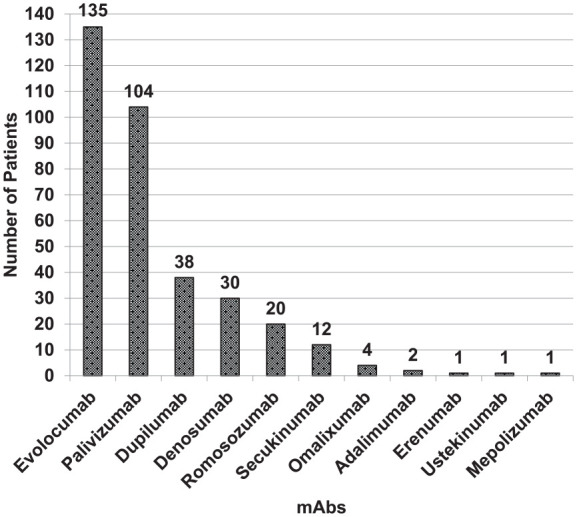
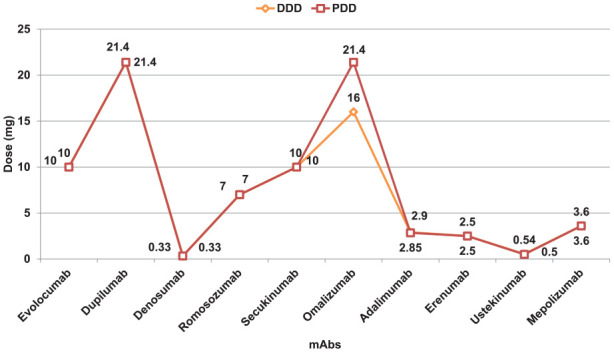
Hyperlipidemia (136, 39.1%) was the most common indication for monoclonal antibodies, followed by prophylaxis of respiratory syncytial virus infection in congenital heart disease (104, 29.9%) and osteoporosis (42, 12.1%). Evolocumab was the most commonly prescribed monoclonal antibody (135, 38.8%), followed by palivizumab (104, 29.9%), and dupilumab (38, 10.9%). The majority of monoclonal antibodies demonstrated a prescribed daily dose to defined daily dose ratio of 1.0, reflecting their appropriate utilization. One hundred twenty-nine patients (37.0%) discontinued their treatment during the study. Patient's level of education (OR: 0.416, 95% CI: 0.183-0.943, = 0.036), BMI (OR: 2.358, 95% CI: 1.164-4.777, = 0.017), number of concomitant medications (OR: 2.457, 95% CI: 1.202-5.025, = 0.014), and treatment duration (OR: 9.180, 95% CI: 4.909-17.165, p < 0.001) were identified as predictors of discontinuation of monoclonal antibodies.
This study represents the first comprehensive investigation in the United Arab Emirates focused on treatment patterns, utilization, and discontinuation of monoclonal antibodies among the local population. Monoclonal antibodies were prescribed for the management of a wide range of clinical conditions. The study reports appropriate utilization of most monoclonal antibodies and identifies factors such as patient education level, BMI, concomitant medications, and treatment duration as independent predictors of monoclonal antibody treatment discontinuation.
生物制剂彻底改变了肿瘤学、免疫学、传染病和遗传性疾病等专科的治疗方式,对特定分子或特定免疫细胞具有靶向作用。单克隆抗体以其高特异性和精准性而闻名,是这些生物制剂中最重要且发展迅速的类别之一。了解单克隆抗体的药物使用模式对于确保其最佳使用至关重要,特别是考虑到它们的高成本和潜在的不良反应。
这项分析性横断面研究在阿拉伯联合酋长国的一家二级医院进行。纳入在研究地点接受单克隆抗体治疗的所有性别患者。评估了治疗模式、使用情况以及与单克隆抗体停药相关的因素。
高脂血症(136例,39.1%)是单克隆抗体最常见的适应证,其次是先天性心脏病中呼吸道合胞病毒感染的预防(104例,29.9%)和骨质疏松症(42例,12.1%)。依洛尤单抗是最常处方的单克隆抗体(135例,38.8%),其次是帕利珠单抗(104例,29.9%)和度普利尤单抗(38例,10.9%)。大多数单克隆抗体的规定日剂量与限定日剂量之比为1.0,表明其使用合理。129名患者(37.0%)在研究期间停止了治疗。患者的教育程度(OR:0.416,95%CI:0.183 - 0.943,P = 0.036)、体重指数(OR:2.358,95%CI:1.164 - 4.777,P = 0.017)、合并用药数量(OR:2.457,95%CI:1.202 - 5.025,P = 0.014)和治疗持续时间(OR:9.180,95%CI:4.909 - 17.165,P < 0.001)被确定为单克隆抗体停药的预测因素。
本研究是阿拉伯联合酋长国首次针对当地人群中单克隆抗体的治疗模式、使用情况和停药情况进行的全面调查。单克隆抗体被用于治疗多种临床病症。该研究报告了大多数单克隆抗体的合理使用情况,并确定患者教育程度、体重指数、合并用药和治疗持续时间等因素是单克隆抗体治疗停药的独立预测因素。