Instituto de Efectividad Clínica y Sanitaria, Ciudad de Buenos Aires, Argentina.
AbbVie Argentina, Buenos Aires, Argentina.
Rev Peru Med Exp Salud Publica. 2024 Aug 19;41(2):129-139. doi: 10.17843/rpmesp.2024.412.12934.
OBJECTIVES.: To analyze the budget impact of upadacitinib (UPA) 15 mg + methotrexate (MTX) for the treatment of moderate-to-severe rheumatoid arthritis (RA) in patients with an inadequate response to conventional disease-modifying antirheumatic drugs (cDMARD-IR) from the perspective of social security and the private health sector in Argentina.
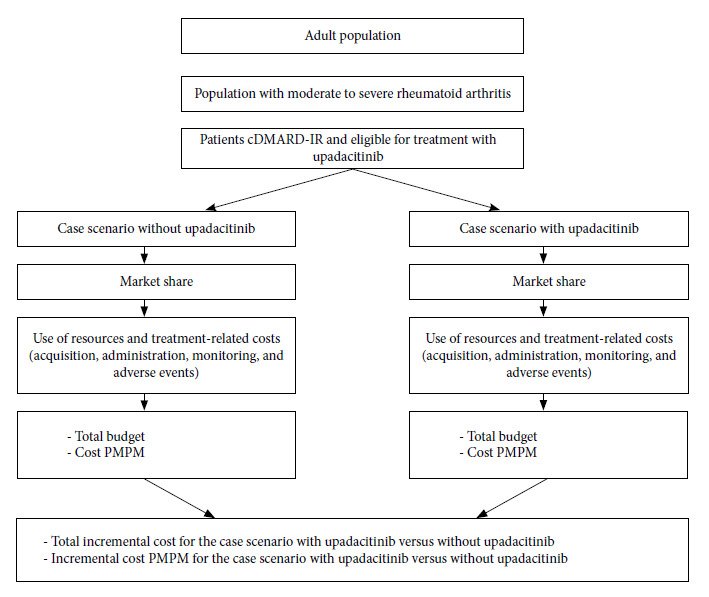
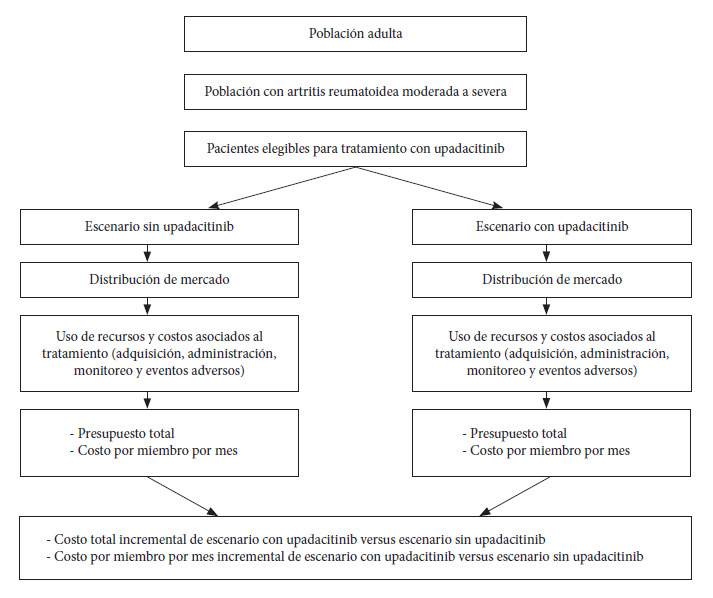
MATERIALS AND METHODS.: A budget impact analysis model was developed for a hypothetical cohort of 100,000 adults with health insurance coverage who were diagnosed with RA over a 5-year time horizon. The model parameters were obtained through literature review and validated by local experts. The costs are expressed in 2024 US dollars (USD).
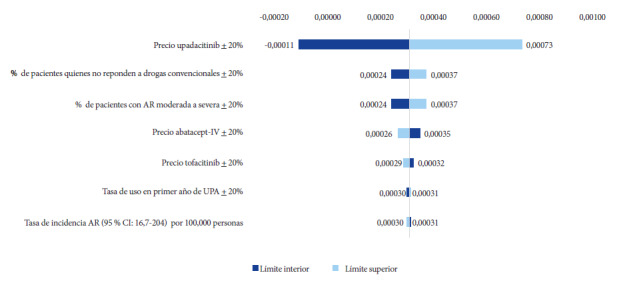
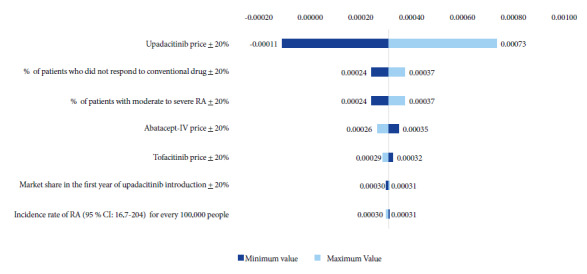
RESULTS.: The introduction of UPA 15 mg + MTX for the treatment of moderate-to-severe RA and cDMARD-IR resulted in minimal increase, with a five-year total cumulative incremental cost of USD 1,855 for social security and USD 1,812 for the private health sector, representing 2% of the total budget. The acquisition cost of UPA was the most influential variable in the sensitivity analysis.
CONCLUSIONS.: The introduction of UPA 15 mg + MTX for the treatment of moderate-to-severe RA and cDMARD-IR can provide an effective treatment option with a minimal increase in costs for the healthcare system in Argentina, which is especially important in developing countries where health system budgets are more limited. Providing evidence-based estimates is a valuable tool for informing healthcare policies and can help policymakers make informed decisions about the allocation of healthcare resources to improve patient outcomes while also managing costs.
Motivation for the study. Rheumatoid arthritis (RA) is a disease that hasn’t cure, so it’s important to know the budget impact of treatment with upadacitinib (UPA) 15 mg + methotrexate (MTX) in patients with moderate to severe RA who didn’t respond well to conventional antirheumatic drugs. Main findings. UPA + MTX would entail a minimal increase in costs for the healthcare system in Argentina, potentially making this effective treatment option more accessible to patients with RA. Access to this treatment can improve the outcome of patients with RA. Public health implications. In resource-constrained settings such as Argentina, providing evidence-based cost estimates can help healthcare managers allocate resources efficiently while improving patient outcomes. This study provides evidence to inform healthcare policies and decisions regarding the inclusion of UPA + MTX in treatment guidelines or formularies for RA management.
分析乌帕替尼(UPA)15 毫克+甲氨蝶呤(MTX)联合治疗对常规疾病修饰抗风湿药物(cDMARD-IR)应答不足的中度至重度类风湿关节炎(RA)患者的预算影响,从社会保障和阿根廷私营医疗保健部门的角度出发。
针对 10 万名有医疗保险的成年人,假设他们在 5 年内被诊断患有 RA,开发了一个预算影响分析模型。模型参数通过文献回顾获得,并由当地专家验证。成本以 2024 年美元(USD)表示。
引入 UPA 15 毫克+MTX 治疗中度至重度 RA 和 cDMARD-IR 仅导致轻微增加,社会保障五年累计增量总成本为 1855 美元,私营医疗保健部门为 1812 美元,占总预算的 2%。UPA 的采购成本是敏感性分析中最具影响力的变量。
引入 UPA 15 毫克+MTX 治疗中度至重度 RA 和 cDMARD-IR 可以为阿根廷的医疗保健系统提供一种有效的治疗选择,同时对成本增加影响最小,这在卫生系统预算更为有限的发展中国家尤为重要。提供基于证据的估计值是为医疗保健政策提供信息的有价值工具,可以帮助决策者在分配医疗资源以改善患者结果的同时管理成本方面做出明智决策。
研究动机。类风湿关节炎(RA)是一种无法治愈的疾病,因此了解乌帕替尼(UPA)15 毫克+甲氨蝶呤(MTX)治疗对中度至重度 RA 患者的治疗预算影响非常重要,这些患者对常规抗风湿药物反应不佳。主要发现。UPA+MTX 将使阿根廷的医疗保健系统的成本增加最小,这可能使这种有效的治疗选择更容易被 RA 患者获得。这种治疗方法的可及性可以改善 RA 患者的预后。公共卫生意义。在资源有限的情况下,如阿根廷,提供基于证据的成本估计可以帮助医疗保健管理者在提高患者预后的同时有效分配资源。本研究提供了证据,为制定卫生政策和决策提供了信息,包括将 UPA+MTX 纳入 RA 管理治疗指南或处方集。