Hospital Alemão Oswaldo Cruz, São Paulo, SP, Brazil.
Centro Universitário FMABC, Santo André, SP, Brazil.
Einstein (Sao Paulo). 2024 Aug 16;22:eAO0620. doi: 10.31744/einstein_journal/2024AO0620. eCollection 2024.
Barros et al. demonstrated a 3D printed model that exhibits anatomical representativeness, low cost, and scalability. The model was created based on subtraction data obtained from computed tomography scans. Images were modeled and reconstructed in 3D to display the male inguinal region, typically viewed using a laparoscopic approach. To evaluate the functionality and quality of the anatomical representation of the hernia 3D training model.
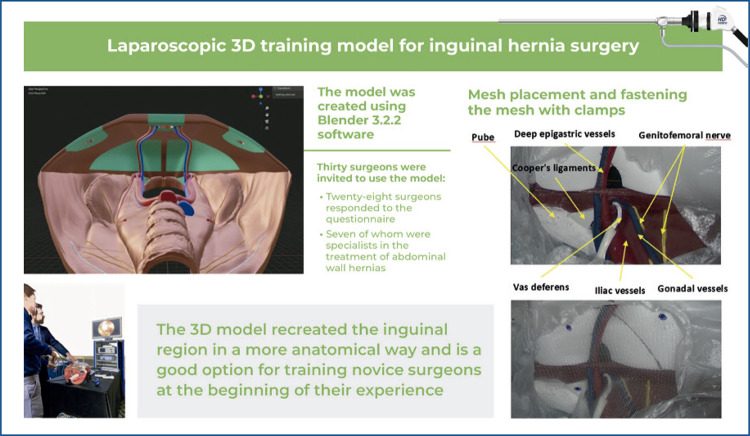
A model was created based on subtraction data derived from computed tomography scans of the pelvic bones and lumbar spine using the Blender 3.2.2 software program. Images were modeled and reconstructed in 3D to display the male inguinal region, typically viewed using a laparoscopic approach. Polylactic acid plastic was used to print the model. Some structures were made using ethylene vinyl acetate to enable possible material replacement and model reutilization. Thirty surgeons with various training levels were invited to use the model. Transabdominal inguinal hernioplasty was performed by simulating the same steps as those of a laparoscopic surgery, and the surgeons answered a questionnaire regarding the simulation.
Twenty-eight surgeons responded, seven of whom were experts in the treatment of abdominal wall hernias. The model was deemed easy to use, realistic, and anatomically precise, establishing it as a valuable supplement to minimally invasive surgery training.
The evaluation of this 3D model was favorable, as it accurately depicted the inguinal region anatomically, while also proving to be cost-effective for training purposes. The model could be a good option, particularly beneficial for training surgeons at the beginning of their careers.
Barros 等人展示了一种 3D 打印模型,该模型具有解剖代表性、低成本和可扩展性。该模型是基于计算机断层扫描获得的减影数据创建的。使用 Blender 3.2.2 软件程序对图像进行建模和 3D 重建,以显示男性腹股沟区域,通常使用腹腔镜方法进行观察。评估疝 3D 培训模型的解剖代表性和功能质量。
使用 Blender 3.2.2 软件程序基于骨盆和腰椎的计算机断层扫描的减影数据创建模型。对图像进行建模和 3D 重建,以显示男性腹股沟区域,通常使用腹腔镜方法进行观察。使用聚乳酸塑料打印模型。使用乙烯-醋酸乙烯酯制造一些结构,以实现可能的材料替换和模型再利用。邀请了 30 名具有不同培训水平的外科医生使用该模型。通过模拟腹腔镜手术的相同步骤进行经腹腹股沟疝修补术,外科医生回答了关于模拟的问卷。
28 名外科医生做出了回应,其中 7 名是腹壁疝治疗专家。该模型被认为易于使用、逼真且解剖精确,是微创外科培训的有价值的补充。
对该 3D 模型的评估是有利的,因为它准确地描绘了腹股沟区域的解剖结构,同时也证明了其在培训方面的成本效益。该模型可能是一个不错的选择,特别是对职业生涯初期的外科医生培训有帮助。