Thoracic Oncology Service, Department of Medicine, Memorial Sloan Kettering Cancer Center, New York, NY, USA.
Weill Cornell Medical College, New York, NY, USA.
Ann Surg Oncol. 2024 Nov;31(12):7973-7977. doi: 10.1245/s10434-024-16004-2. Epub 2024 Aug 21.
Well-differentiated papillary peritoneal mesothelial tumors (WDPMTs) are understudied and discrete from peritoneal mesotheliomas (PMs). We report clinicopathologic characteristics and outcomes of a large prospective WDPMT cohort.
Patients with WDPMT identified between August 2007 and December 2020 were followed through January 2023. Clinical characteristics and outcomes were annotated. Overall survival (OS) was assessed from pathologic diagnosis. Germline variants were analyzed, and targeted next-generation sequencing (NGS; MSK-IMPACT) data were compared to PMs and diffuse pleural mesotheliomas (DPMs).
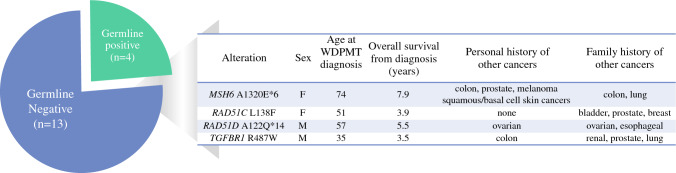
Among 54 patients, median age at diagnosis was 55 (range 20-76), 50% were female (n = 27), and 46% were smokers (n = 25; median 8 pack/years). Most (94%, n = 51) WDPMTs were found during surgical explorations for other indications, primarily other malignancies. Two patients underwent surgical resection for WDPMT; none received systemic therapy for WDPMT. Median OS was not reached (19/54; median follow up 4.5 years). Somatic NGS was available for 35% (19/54) of patients. TRAF7 alterations were enriched in WDPMT (89%; 17/19) compared with PM (0%; 0/50; p < 0.0001) and DPM (0%; 0/74; p < 0.0001). In WDPMT compared with PM and DPM, there were less BAP1 (0% [0/0] vs. 4% [8/50] vs. 46% [34/74]; p = 0.001 and p < 0.0001, respectively) and NF2 (0% [0/0] vs. 24% [12/50] vs. 31% [23/74]; p = 0.03 and p = 0.001 respectively) alterations. Pathogenic germline variants were present in 23% (4/17) of WDPMTs.
Well-differentiated papillary peritoneal mesothelial tumors were primarily incidental findings. There was no WDPMT-related mortality, so there was no distinct role for routine cytoreductive surgery or systemic therapy. Genomic profiles can help to differentiate WDPMT from DPM and PM.
分化良好的乳头状腹膜间皮瘤(WDPMTs)研究较少,与腹膜间皮瘤(PMs)不同。我们报告了一个大型前瞻性 WDPMT 队列的临床病理特征和结果。
在 2007 年 8 月至 2020 年 12 月期间确诊的 WDPMT 患者,随访至 2023 年 1 月。对临床特征和结果进行注释。从病理诊断开始评估总生存(OS)。分析种系变异,并比较靶向下一代测序(MSK-IMPACT)数据与 PMs 和弥漫性胸膜间皮瘤(DPMs)。
在 54 名患者中,中位诊断年龄为 55 岁(范围 20-76 岁),50%为女性(n=27),46%为吸烟者(n=25;中位 8 包/年)。大多数(94%,n=51)WDPMT 是在其他适应症的手术探查中发现的,主要是其他恶性肿瘤。两名患者因 WDPMT 接受了手术切除;均未接受 WDPMT 的系统治疗。中位 OS 未达到(19/54;中位随访 4.5 年)。35%(19/54)的患者可进行体细胞 NGS。与 PM(0%[0/50];p<0.0001)和 DPM(0%[0/74];p<0.0001)相比,WDPMT 中 TRAF7 改变更为丰富(89%[17/19])。与 PM 和 DPM 相比,WDPMT 中 BAP1(0%[0/0] vs. 4%[8/50] vs. 46%[34/74];p=0.001 和 p<0.0001)和 NF2(0%[0/0] vs. 24%[12/50] vs. 31%[23/74];p=0.03 和 p=0.001)改变较少。23%(4/17)的 WDPMT 存在致病性种系变异。
分化良好的乳头状腹膜间皮瘤主要为偶然发现。没有与 WDPMT 相关的死亡,因此常规细胞减灭术或系统治疗没有明确的作用。基因组谱有助于将 WDPMT 与 DPM 和 PM 区分开来。