Department of Molecular, Cellular, and Developmental Biology, University of California, Santa Barbara, CA, USA.
Neuroscience Research Institute, University of California, Santa Barbara, CA, USA.
Nature. 2024 Sep;633(8030):615-623. doi: 10.1038/s41586-024-07848-5. Epub 2024 Aug 21.
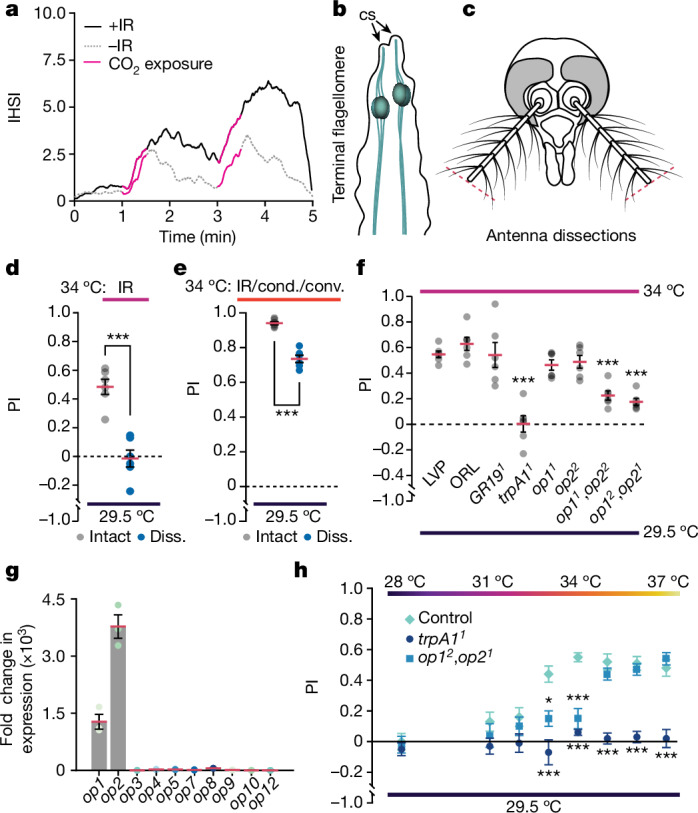
Mosquito-borne diseases affect hundreds of millions of people annually and disproportionately impact the developing world. One mosquito species, Aedes aegypti, is a primary vector of viruses that cause dengue, yellow fever and Zika. The attraction of Ae. aegypti female mosquitos to humans requires integrating multiple cues, including CO from breath, organic odours from skin and visual cues, all sensed at mid and long ranges, and other cues sensed at very close range. Here we identify a cue that Ae. aegypti use as part of their sensory arsenal to find humans. We demonstrate that Ae. aegypti sense the infrared (IR) radiation emanating from their targets and use this information in combination with other cues for highly effective mid-range navigation. Detection of thermal IR requires the heat-activated channel TRPA1, which is expressed in neurons at the tip of the antenna. Two opsins are co-expressed with TRPA1 in these neurons and promote the detection of lower IR intensities. We propose that radiant energy causes local heating at the end of the antenna, thereby activating temperature-sensitive receptors in thermosensory neurons. The realization that thermal IR radiation is an outstanding mid-range directional cue expands our understanding as to how mosquitoes are exquisitely effective in locating hosts.
蚊媒疾病每年影响数亿人,并且不成比例地影响发展中国家。一种蚊子,埃及伊蚊,是导致登革热、黄热病和寨卡病毒的主要传播媒介。埃及伊蚊雌性蚊子对人类的吸引力需要整合多种线索,包括呼吸中的二氧化碳、皮肤散发的有机气味和视觉线索,所有这些都在中远程和长距离感知,而其他线索则在非常近距离感知。在这里,我们确定了埃及伊蚊在其感觉器官中使用的一种线索,用于寻找人类。我们证明,埃及伊蚊感知来自其目标的红外(IR)辐射,并将此信息与其他线索结合使用,以实现高效的中程导航。检测热 IR 需要热激活通道 TRPA1,该通道在触角末端的神经元中表达。两种视蛋白与这些神经元中的 TRPA1 共同表达,并促进对较低 IR 强度的检测。我们提出,辐射能在天线末端引起局部加热,从而激活热敏神经元中的温度敏感受体。认识到热 IR 辐射是一种出色的中程定向线索,扩展了我们对蚊子如何极其有效地定位宿主的理解。