Qiu Dandan, Ju Jianguo, Ren Shumin, Zhang Tongtong, Tu Huijuan, Tan Xin, Xie Fei
School of Information Science and Technology, Northwest University, Xi'an, Shaanxi, China.
Department of Radiology, Kunshan Hospital of Chinese Medicine, Kunshan, Jiangsu, China.
Front Oncol. 2024 Aug 7;14:1328146. doi: 10.3389/fonc.2024.1328146. eCollection 2024.
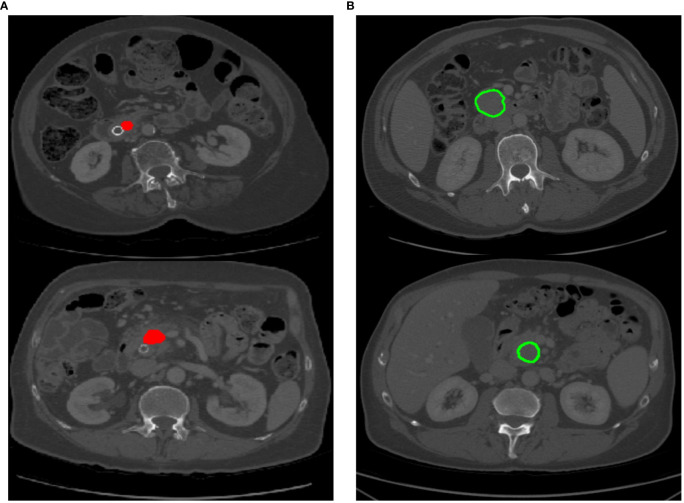
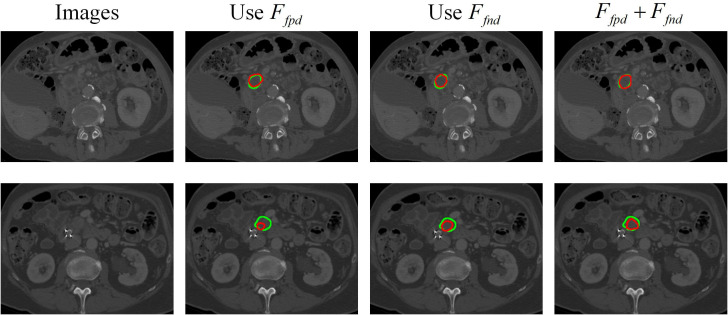
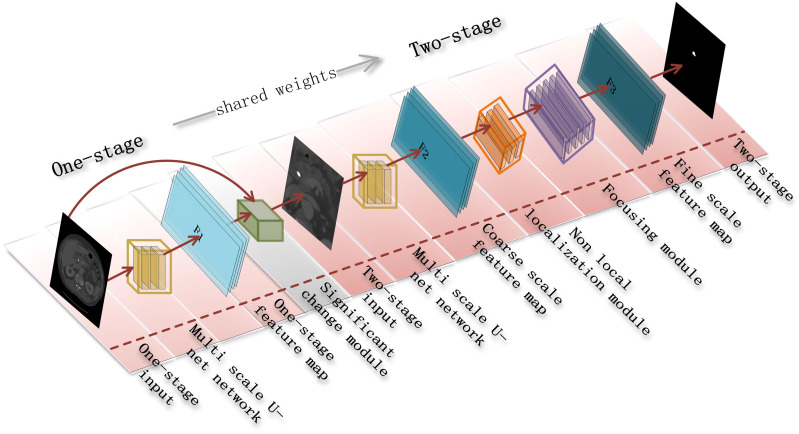
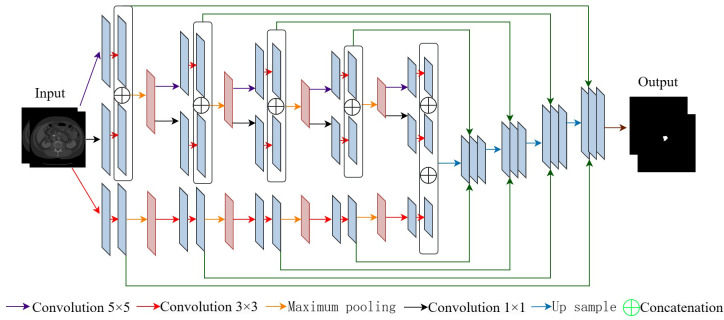
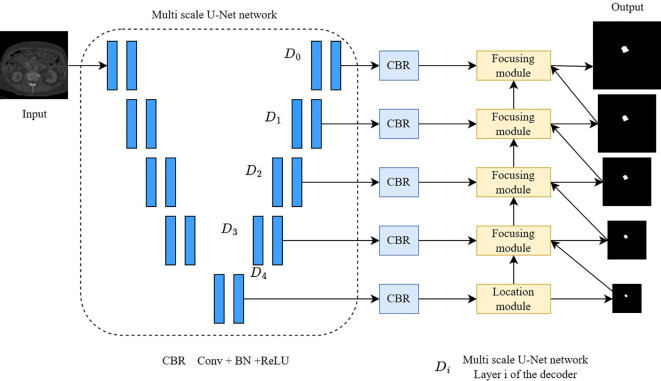
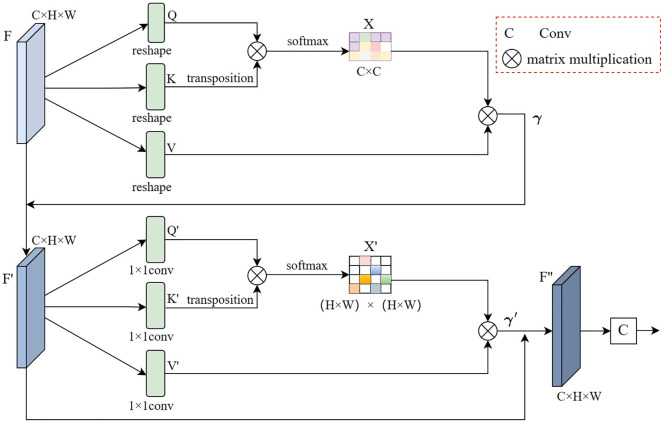
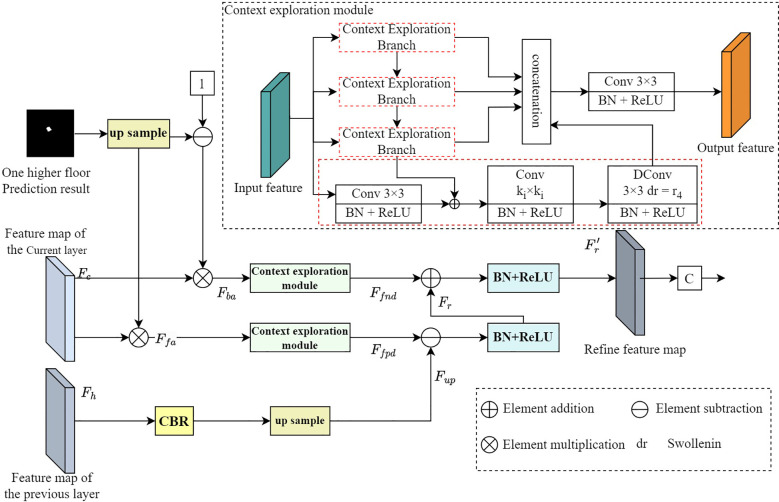
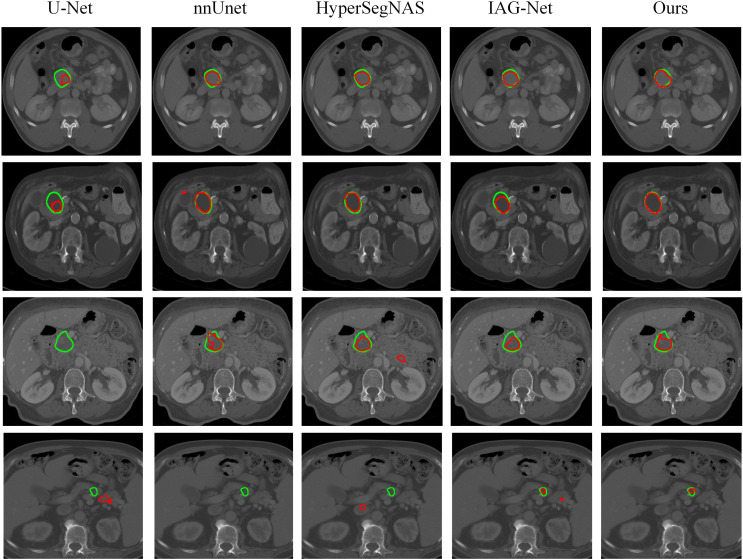
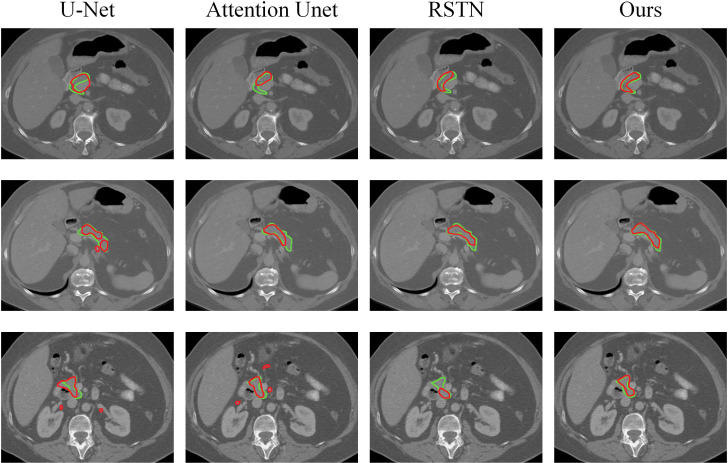
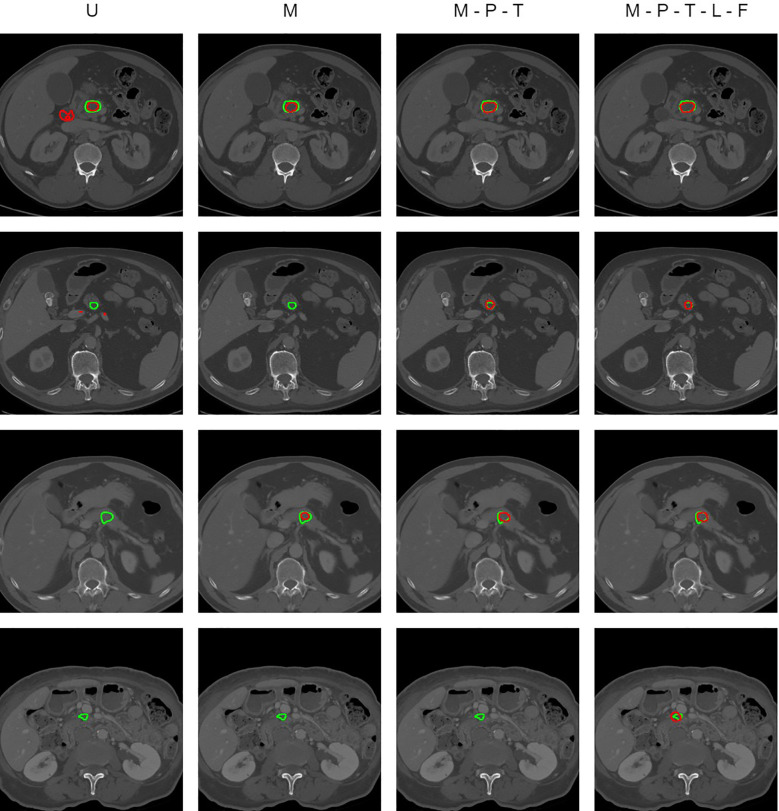
Pancreatic tumors are small in size, diverse in shape, and have low contrast and high texture similarity with surrounding tissue. As a result, the segmentation model is easily confused by complex and changeable background information, leading to inaccurate positioning of small targets and false positives and false negatives. Therefore, we design a cascaded pancreatic tumor segmentation algorithm. In the first stage, we use a general multi-scale U-Net to segment the pancreas, and we exploit a multi-scale segmentation network based on non-local localization and focusing modules to segment pancreatic tumors in the second stage. The non-local localization module learns channel and spatial position information, searches for the approximate area where the pancreatic tumor is located from a global perspective, and obtains the initial segmentation results. The focusing module conducts context exploration based on foreground features (or background features), detects and removes false positive (or false negative) interference, and obtains more accurate segmentation results based on the initial segmentation. In addition, we design a new loss function to alleviate the insensitivity to small targets. Experimental results show that the proposed algorithm can more accurately locate pancreatic tumors of different sizes, and the Dice coefficient outperforms the existing state-of-the-art segmentation model. The code will be available at https://github.com/HeyJGJu/Pancreatic-Tumor-SEG.
胰腺肿瘤体积小、形状多样,与周围组织的对比度低且纹理相似度高。因此,分割模型很容易被复杂多变的背景信息所迷惑,导致小目标定位不准确以及出现假阳性和假阴性。为此,我们设计了一种级联胰腺肿瘤分割算法。在第一阶段,我们使用通用的多尺度U-Net对胰腺进行分割,在第二阶段,我们利用基于非局部定位和聚焦模块的多尺度分割网络对胰腺肿瘤进行分割。非局部定位模块学习通道和空间位置信息,从全局角度搜索胰腺肿瘤所在的大致区域,并获得初始分割结果。聚焦模块基于前景特征(或背景特征)进行上下文探索,检测并去除假阳性(或假阴性)干扰,并基于初始分割获得更准确的分割结果。此外,我们设计了一种新的损失函数来减轻对小目标的不敏感性。实验结果表明,所提出的算法能够更准确地定位不同大小的胰腺肿瘤,并且Dice系数优于现有的最先进分割模型。代码将在https://github.com/HeyJGJu/Pancreatic-Tumor-SEG上提供。