
钙稳态与子宫内膜异位症:一项孟德尔随机化研究。
Calcium homeostasis and endometriosis: A Mendelian randomization study.
作者信息
Deng Zhi-Min, Dai Fang-Fang, Wang Rui-Qi, Chen Gan-Tao, Yang Xiao, Cheng Yan-Xiang
机构信息
Department of Obstetrics and Gynecology, Renmin Hospital of Wuhan University, Wuhan, Hubei, 430060, PR China.
Department of Gastroenterology, Renmin Hospital of Wuhan University, Wuhan, Hubei, 430060, PR China.
出版信息
Heliyon. 2024 Jul 24;10(15):e35160. doi: 10.1016/j.heliyon.2024.e35160. eCollection 2024 Aug 15.
BACKGROUND
Previous observational studies have investigated the correlation between calcium homeostasis modulator levels and endometriosis risk. Yet, the genetic association between body calcium homeostasis and endometriosis risk remains to be elucidated.
METHODS
Four tiers of Mendelian randomization (MR) analysis were conducted, as follows: (1) single univariate MR and (2) multivariate MR to evaluate the correlation between calcium homeostasis regulators and endometriosis; (3) inverse MR to probe the influence of endometriosis on body calcium homeostasis; (4) two-sample MR to scrutinize the connection between calcium levels and endometriosis categories.
RESULTS
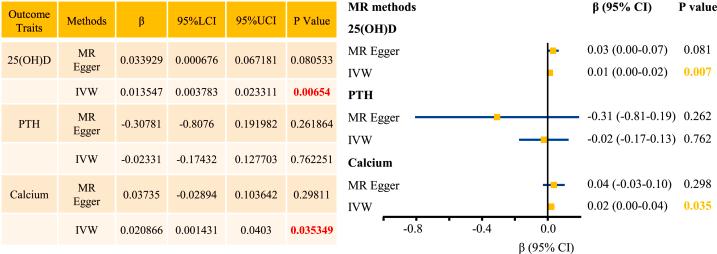
The two-sample MR analysis unveiled a robust positive correlation between genetically inferred calcium levels and endometriosis risk (IVW: OR = 1.15, 95 % CI: 1.02-1.29, = 0.018). The MVMR analysis corroborated that the positive correlation of calcium levels with endometriosis persisted after adjusting for 25(OH)D and PTH. The inverse MR analysis disclosed a significant association between endometriosis and 25(OH)D (β = 0.01, 95 % CI: 0.00-0.02, = 0.007) and calcium (β = 0.02, 95 % CI: 0.00-0.04, = 0.035). The two-sample MR analysis further demonstrated that calcium levels were positively linked solely to endometriosis of uterus (i.e. adenomyosis, IVW: OR = 1.23, 95 % CI: 1.01-1.49, = 0.038), with no evidence of a influence on other endometriosis categories.
CONCLUSIONS
This study, employing various types of MR, offers some genetic evidence for the relationship between calcium homeostasis and endometriosis, augmenting the current comprehension of the complex association between the two and suggesting that calcium levels are a risk factor for endometriosis. These findings provide a unique genetic perspective that may spur further investigation and may inform future strategies for managing patients with endometriosis.
背景
既往观察性研究探讨了钙稳态调节剂水平与子宫内膜异位症风险之间的相关性。然而,机体钙稳态与子宫内膜异位症风险之间的遗传关联仍有待阐明。
方法
进行了四个层次的孟德尔随机化(MR)分析,具体如下:(1)单变量MR和(2)多变量MR,以评估钙稳态调节剂与子宫内膜异位症之间的相关性;(3)反向MR,以探究子宫内膜异位症对机体钙稳态的影响;(4)两样本MR,以审查钙水平与子宫内膜异位症类别之间的联系。
结果
两样本MR分析揭示了基因推断的钙水平与子宫内膜异位症风险之间存在显著正相关(IVW:OR = 1.15,95%CI:1.02 - 1.29,P = 0.018)。多变量MR分析证实,在调整25(OH)D和甲状旁腺激素后,钙水平与子宫内膜异位症的正相关仍然存在。反向MR分析显示子宫内膜异位症与25(OH)D(β = 0.01,95%CI:0.00 - 0.02,P = 0.007)和钙(β = 0.02,95%CI:0.00 - 0.04,P = 0.035)之间存在显著关联。两样本MR分析进一步表明,钙水平仅与子宫子宫内膜异位症(即子宫腺肌病,IVW:OR = 1.23,95%CI:1.01 - 1.49,P = 0.038)呈正相关,没有证据表明对其他子宫内膜异位症类别有影响。
结论
本研究采用多种类型的MR,为钙稳态与子宫内膜异位症之间的关系提供了一些遗传证据,加深了目前对两者复杂关联的理解,并表明钙水平是子宫内膜异位症的一个危险因素。这些发现提供了一个独特的遗传视角,可能会激发进一步的研究,并为未来子宫内膜异位症患者的管理策略提供参考。


 Zotero 插件