Danso Emelia Konadu, Asare Prince, Osei-Wusu Stephen, Tetteh Phillip, Tetteh Amanda Yaa, Boadu Augustine Asare, Lamptey Ivy Naa Koshie, Sylverken Augustina Angelina, Obiri-Danso Kwasi, Afriyie Mensah Jane, Adjei Abraham, Yeboah-Manu Dorothy
Department of Bacteriology, Noguchi Memorial Institute for Medical Research, University of Ghana, Accra, Ghana.
Department of Theoretical and Applied Biology, Kwame Nkrumah University of Science and Technology, Kumasi, Ghana.
Heliyon. 2024 Aug 6;10(15):e35670. doi: 10.1016/j.heliyon.2024.e35670. eCollection 2024 Aug 15.
This study aimed to investigate the impact of diabetes mellitus (DM) on tuberculosis (TB) treatment response using bacterial clearance as a surrogate marker.
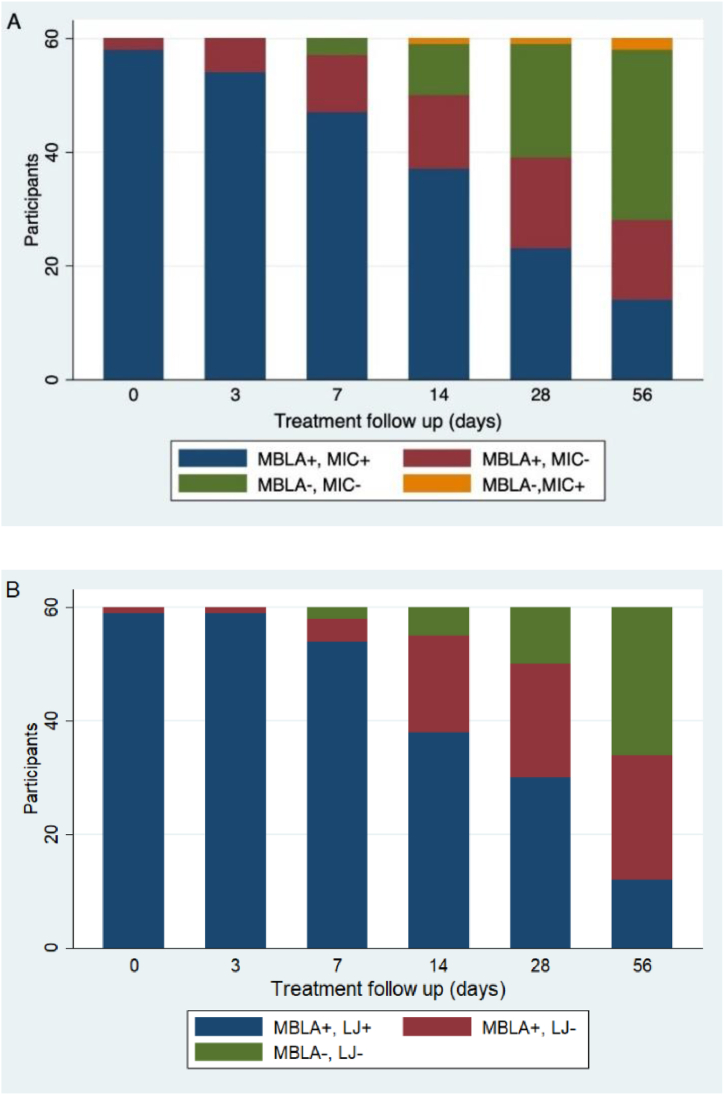
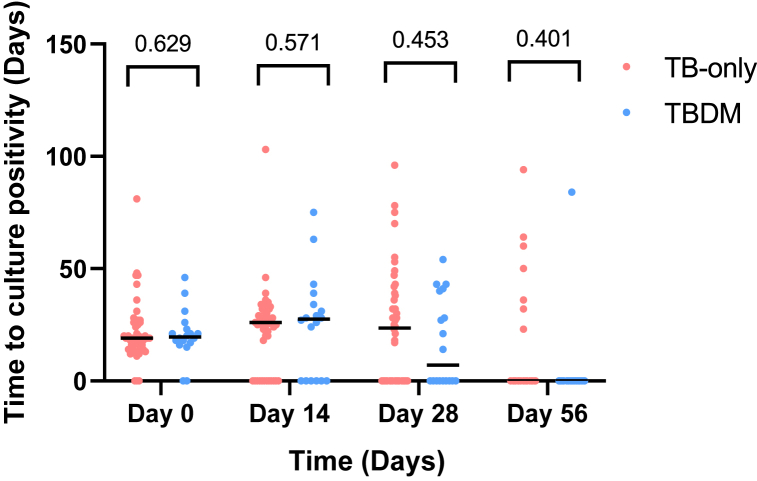
We compared smear microscopy, culture, and tuberculosis molecular bacterial load assay (TB-MBLA) for treatment monitoring. Following that, bacterial clearance was longitudinally monitored among TB-only (TB without DM) and TB-diabetes (TBDM) patients using TB-MBLA.
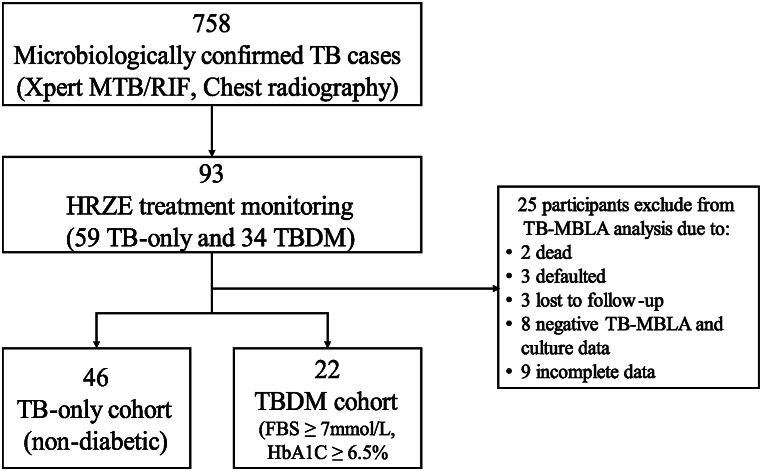
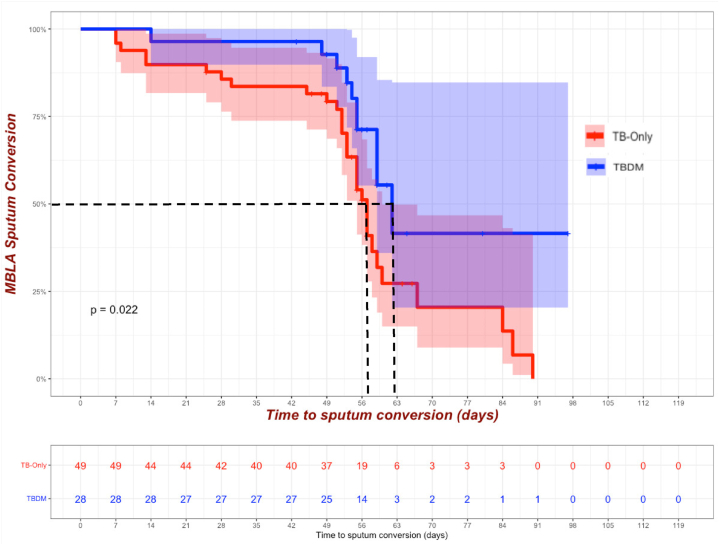
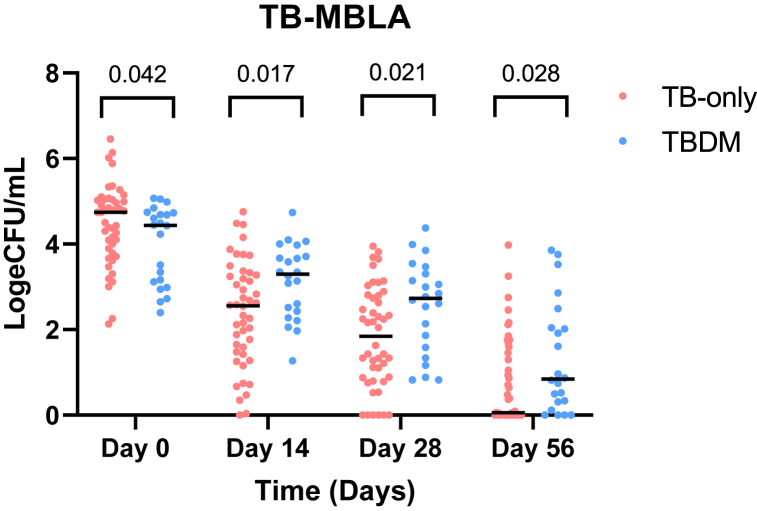
Ninety-three participants, including 59 TB-only and 34 TBDM patients, were enrolled. TB-only patients exhibited higher upper zone infiltrations (32/35 vs 16/22, p = 0.059) suggesting a trend towards significance, and significantly more cavitation in the same zone (16/18 vs 7/13, p = 0.028). There was a high proportion of (Maf) among the TBDM cohort (p = 0.0044).At baseline, TB-only patients exhibited a higher average bacterial burden (4.49 logeCFU/mL) compared to the TBDM group (3.91 logeCFU/mL) (p = 0.042). The bacterial load in the TB-only group decreased significantly during treatment but the TBDM group experienced delayed clearance throughout the intensive phase of anti-TB treatment even at day 56 (p = 0.028). The TB-only group demonstrated a shorter median time to TB-MBLA conversion to negative (57 days) compared to the TBDM group (62 days) (p = 0.022).
These findings underscore the urgent call for understanding the interplay between diabetes and TB, emphasizing the need for tailored interventions in optimizing TB care for individuals comorbid with diabetes.
本研究旨在以细菌清除作为替代指标,调查糖尿病(DM)对结核病(TB)治疗反应的影响。
我们比较了涂片显微镜检查、培养和结核病分子细菌载量测定(TB-MBLA)用于治疗监测的情况。随后,使用TB-MBLA对单纯结核病(无DM的TB)和结核-糖尿病(TBDM)患者的细菌清除情况进行纵向监测。
共纳入93名参与者,包括59名单纯结核病患者和34名TBDM患者。单纯结核病患者上叶浸润更高(32/35比16/22,p = 0.059),显示出显著趋势,且同一区域的空洞形成明显更多(16/18比7/13,p = 0.028)。TBDM队列中的(Maf)比例较高(p = 0.0044)。基线时,单纯结核病患者的平均细菌负荷(4.49 logeCFU/mL)高于TBDM组(3.91 logeCFU/mL)(p = 0.042)。单纯结核病组在治疗期间细菌载量显著下降,但TBDM组在抗结核治疗的强化期整个过程中清除延迟,即使在第56天也是如此(p = 0.028)。与TBDM组(62天)相比,单纯结核病组TB-MBLA转为阴性的中位时间更短(57天)(p = 0.022)。
这些发现强调了迫切需要了解糖尿病与结核病之间的相互作用,强调了针对合并糖尿病的个体优化结核病护理进行量身定制干预措施的必要性。