Guliev Bakhman, Komyakov Boris, Shevnin Maksim, Agagyulov Murad, Talyshinskii Ali
Department of Urology, North-Western State Medical University, St. Petersburg, Russia.
Center of Urology, City Mariinsky Hospital, St. Petersburg, Russia.
Curr Urol. 2024 Jun;18(2):155-158. doi: 10.1097/CU9.0000000000000136. Epub 2024 Jun 21.
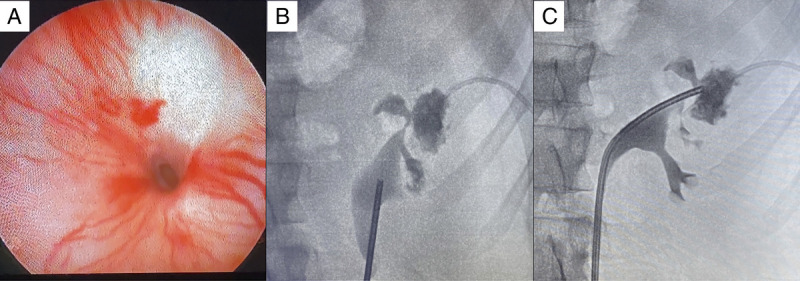
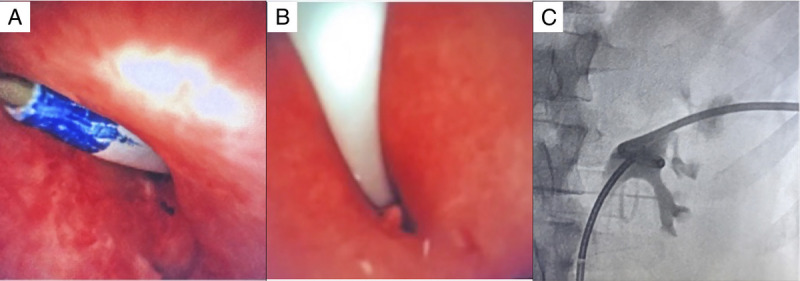
Urinary leak is one of the most significant complications after partial nephrectomy. In case of persistent urine leaks, placement of a ureteral stent is effective but not always sufficient. This study included 5 patients with persistent urinary leak after partial nephrectomy. The patients underwent flexible ureteroscopy wherein we identified the damaged calyx. Subsequently, we performed percutaneous puncture targeting the distal end of the endoscope at this calyx and installed a nephrostomy tube. Then, the endoscope was removed, and the ureter was drained with a stent. Ureteral stenting ensures elimination of urinary leak in most patients after partial nephrectomy. In patients with persistent urinary leak, retrograde endoscopic percutaneous drainage of the pelvicalyceal system is the method of choice because it allows for rapid and effective treatment of urinary fistulas.
尿漏是部分肾切除术后最严重的并发症之一。对于持续性尿漏,放置输尿管支架有效,但并不总是足够。本研究纳入了5例部分肾切除术后持续性尿漏患者。患者接受了软性输尿管镜检查,在此过程中我们识别出受损的肾盏。随后,我们针对该肾盏处的内镜远端进行经皮穿刺并置入肾造瘘管。然后,取出内镜,并用支架引流输尿管。输尿管支架置入可确保大多数部分肾切除术后患者的尿漏得以消除。对于持续性尿漏患者,肾盂肾盏系统逆行内镜经皮引流是首选方法,因为它能快速有效地治疗尿瘘。