Moya Quiros Vincent, Adham Ahmed, Convers Philippe, Lesca Gaetan, Mauguiere François, Soulier Hugo, Arzimanoglou Alexis, Bayat Allan, Braakman Hilde, Camdessanche Jean-Philippe, Casenave Philippe, Chaton Laurence, Chaix Yves, Chochoi Maxime, Depienne Christel, Desportes Vincent, De Ridder Jessie, Dinkelacker Vera, Gardella Elena, Kluger Gerhard J, Jung Julien, Lemesle Martin Martine, Mancardi Maria Margherita, Mueller Markus, Poulat Anne-Lise, Platzer Konrad, Roubertie Agathe, Stokman Marijn F, Vulto-van Silfhout Anneke T, Wiegand Gert, Mazzola Laure
Neurology Department, University Hospital, Saint-Etienne, France.
Physical Medicine and Rehabilitation Department, University Hospital of Saint-Étienne, Saint-Étienne, France.
Ann Neurol. 2024 Aug 23;97(1):34-50. doi: 10.1002/ana.27063.
There is currently scarce data on the electroclinical characteristics of epilepsy associated with synapsin 1 (SYN1) pathogenic variations. We examined clinical and electro-encephalographic (EEG) features in patients with epilepsy and SYN1 variants, with the aim of identifying a distinctive electroclinical pattern.
In this retrospective multicenter study, we collected and reviewed demographic, genetic, and epilepsy data of 19 male patients with SYN1 variants. Specifically, we analyzed interictal EEG data for all patients, and electro-clinical data from 10 epileptic seizures in 5 patients, using prolonged video-EEG monitoring recordings. Inter-ictal EEG functional connectivity parameters and frequency spectrum of the 10 patients over 12 years of age, were computed and compared with those of 56 age- and sex-matched controls.
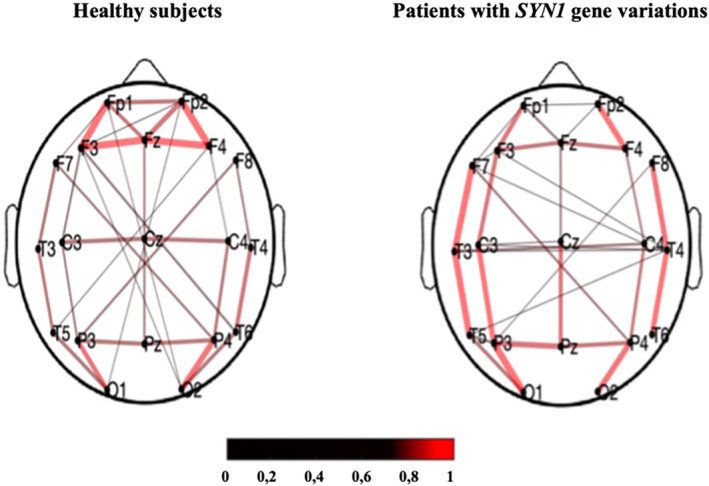
The main electroclinical features of epilepsy in patients with SYN1 were (1) EEG background and organization mainly normal; (2) interictal abnormalities are often rare or not visible on EEG; (3) more than 60% of patients had reflex seizures (cutaneous contact with water and defecation being the main triggers) isolated or associated with spontaneous seizures; (4) electro-clinical semiology of seizures was mainly temporal or temporo-insulo/perisylvian with a notable autonomic component; and (5) ictal EEG showed a characteristic rhythmic theta/delta activity predominating in temporo-perisylvian regions at the beginning of most seizures. Comparing patients with SYN1 to healthy subjects, we observed a shift to lower frequency bands in power spectrum of interictal EEG and an increased connectivity in both temporal regions.
A distinct epilepsy syndrome emerges in patients with SYN1, with a rather characteristic clinical and EEG pattern suggesting predominant temporo-insular involvement. ANN NEUROL 2024.
目前关于与突触素1(SYN1)致病变异相关的癫痫的电临床特征的数据稀缺。我们研究了癫痫合并SYN1变异患者的临床和脑电图(EEG)特征,旨在确定一种独特的电临床模式。
在这项回顾性多中心研究中,我们收集并审查了19例具有SYN1变异的男性患者的人口统计学、遗传学和癫痫数据。具体而言,我们分析了所有患者的发作间期EEG数据,以及5例患者10次癫痫发作的电临床数据,使用了延长的视频EEG监测记录。计算了10例12岁以上患者的发作间期EEG功能连接参数和频谱,并与56例年龄和性别匹配的对照进行比较。
SYN1患者癫痫的主要电临床特征为:(1)EEG背景和结构基本正常;(2)发作间期异常在EEG上通常罕见或不可见;(3)超过60%的患者有反射性发作(主要触发因素为皮肤接触水和排便),单独发作或与自发性发作相关;(4)发作的电临床症状学主要为颞叶或颞岛/颞周区,伴有明显的自主神经成分;(5)发作期EEG显示,在大多数发作开始时,颞周区有特征性的节律性θ/δ活动占主导。将SYN1患者与健康受试者进行比较,我们观察到发作间期EEG功率谱向低频带转移,且两个颞区的连接性增加。
SYN1患者出现了一种独特的癫痫综合征,具有相当特征性的临床和EEG模式,提示主要累及颞岛区。《神经病学纪事》2024年