Department of Microbiology and Immunology, David H. Smith Center for Vaccine Biology and Immunology, University of Rochester, Rochester, NY.
Department of Pathology, University of Rochester Medical Center, Rochester, NY.
Proc Natl Acad Sci U S A. 2024 Aug 27;121(35):e2406748121. doi: 10.1073/pnas.2406748121. Epub 2024 Aug 23.
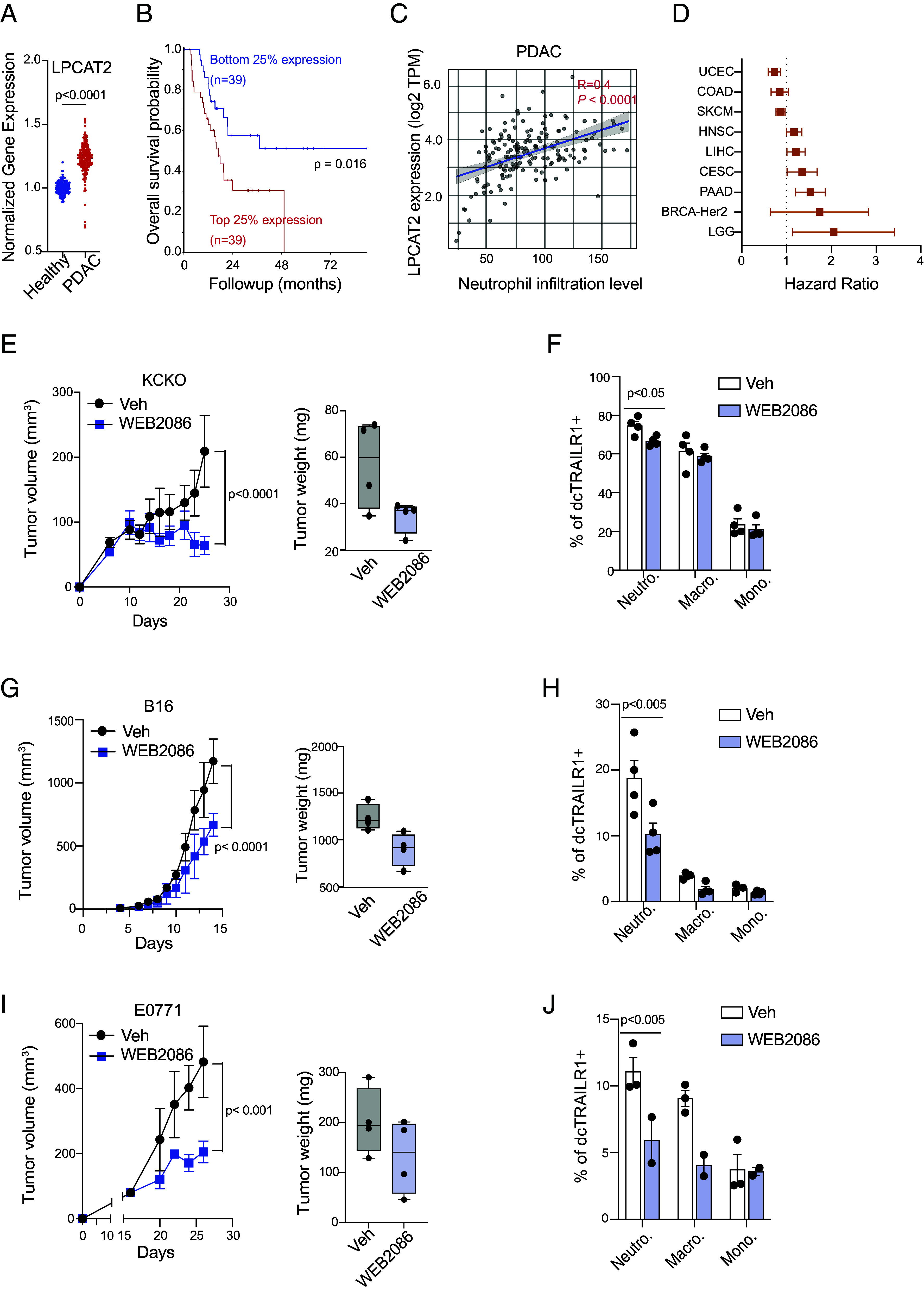
Chronic inflammatory milieu in the tumor microenvironment (TME) leads to the recruitment and differentiation of myeloid-derived suppressor cells (MDSCs). Polymorphonuclear (PMN)-MDSCs, which are phenotypically and morphologically defined as a subset of neutrophils, cause major immune suppression in the TME, posing a significant challenge in the development of effective immunotherapies. Despite recent advances in our understanding of PMN-MDSC functions, the mechanism that gives rise to immunosuppressive neutrophils within the TME remains elusive. Both in vivo and in vitro, newly recruited neutrophils into the tumor sites remained activated and highly motile for several days and developed immunosuppressive phenotypes, as indicated by increased arginase 1 (Arg1) and dcTrail-R1 expression and suppressed anticancer CD8 T cell cytotoxicity. The strong suppressive function was successfully recapitulated by incubating naive neutrophils with cancer cell culture supernatant in vitro. Cancer metabolite secretome analyses of the culture supernatant revealed that both murine and human cancers released lipid mediators to induce the differentiation of immunosuppressive neutrophils. Liquid chromatography-mass spectrometry (LC-MS) lipidomic analysis identified platelet-activation factor (PAF; 1--alkyl-2-acetyl--glycero-3-phosphocholine) as a common tumor-derived lipid mediator that induces neutrophil differentiation. Lysophosphatidylcholine acyltransferase 2 (LPCAT2), the PAF biosynthetic enzyme, is up-regulated in human pancreatic ductal adenocarcinoma (PDAC) and shows an unfavorable correlation with patient survival across multiple cancer types. Our study identifies PAF as a lipid-driven mechanism of MDSC differentiation in the TME, providing a potential target for cancer immunotherapy.
肿瘤微环境(TME)中的慢性炎症环境导致髓系来源的抑制性细胞(MDSCs)的募集和分化。多形核(PMN)-MDSCs 在表型和形态上被定义为中性粒细胞的一个子集,在 TME 中引起主要的免疫抑制,这给有效的免疫治疗的发展带来了重大挑战。尽管我们对 PMN-MDSC 功能的理解最近有了进展,但导致 TME 中免疫抑制性中性粒细胞产生的机制仍然难以捉摸。无论是在体内还是在体外,新招募到肿瘤部位的中性粒细胞在几天内仍然保持激活和高度迁移,并表现出免疫抑制表型,如精氨酸酶 1(Arg1)和 dcTrail-R1 表达增加以及抑制抗癌 CD8 T 细胞细胞毒性。通过在体外将幼稚中性粒细胞与癌细胞培养上清孵育,成功地再现了这种强烈的抑制功能。对培养上清液的癌症代谢物分泌组分析表明,无论是小鼠还是人类癌症都会释放脂质介质来诱导免疫抑制性中性粒细胞的分化。液相色谱-质谱(LC-MS)脂质组学分析鉴定出血小板激活因子(PAF;1--烷基-2-乙酰--甘油-3-磷酸胆碱)作为一种常见的肿瘤衍生脂质介质,可诱导中性粒细胞分化。PAF 的生物合成酶溶血磷脂酰胆碱酰基转移酶 2(LPCAT2)在人类胰腺导管腺癌(PDAC)中上调,并在多种癌症类型中与患者生存呈不利相关性。我们的研究确定 PAF 是 TME 中 MDSC 分化的脂质驱动机制,为癌症免疫治疗提供了一个潜在的靶点。