Straumann Isabelle, Avedisian Isidora, Klaiber Aaron, Varghese Nimmy, Eckert Anne, Rudin Deborah, Luethi Dino, Liechti Matthias E
Clinical Pharmacology and Toxicology, Department of Biomedicine and Department of Clinical Research, University Hospital Basel, Basel, Switzerland.
Department of Pharmaceutical Sciences, University of Basel, Basel, Switzerland.
Neuropsychopharmacology. 2024 Dec;50(2):362-371. doi: 10.1038/s41386-024-01972-6. Epub 2024 Aug 23.
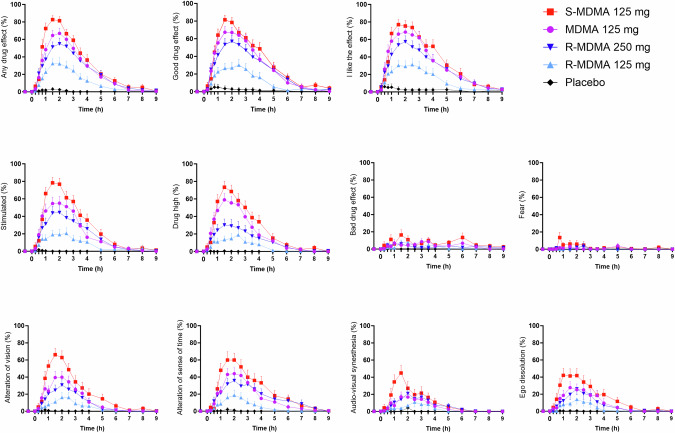
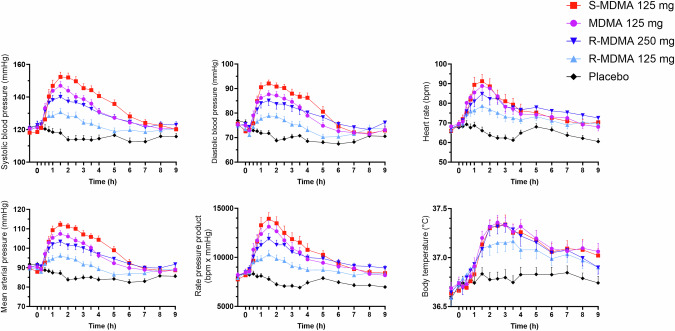
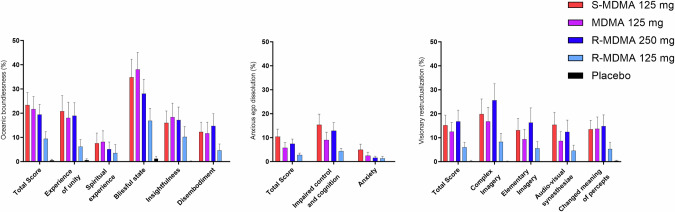
Racemic 3,4-methylenedioxymethamphetamine (MDMA) acutely increases mood, feelings of empathy, trust, and closeness to others and is investigated to assist psychotherapy. Preclinical research indicates that S-MDMA releases monoamines and oxytocin more potently than R-MDMA, whereas R-MDMA more potently stimulates serotonin 5-hydroxytryptamine-2A receptors. S-MDMA may have more stimulant properties, and R-MDMA may be more psychedelic-like. However, acute effects of S- and R-MDMA have not been examined in a controlled human study. We used a double-blind, randomized, placebo-controlled, crossover design to compare acute effects of MDMA (125 mg), S-MDMA (125 mg), R-MDMA (125 mg and 250 mg), and placebo in 24 healthy participants. Outcome measures included subjective, autonomic, and adverse effects, pharmacokinetics, and plasma oxytocin, prolactin, and cortisol concentrations. S-MDMA (125 mg) induced greater subjective effects ("stimulation," "drug high," "happy," "open") and higher increases in blood pressure than R-MDMA (both 125 and 250 mg) and MDMA (125 mg). Unexpectedly, R-MDMA did not produce more psychedelic-like effects than S-MDMA. S-MDMA increased plasma prolactin more than MDMA, and S-MDMA increased plasma cortisol and oxytocin more than MDMA and R-MDMA. The plasma elimination half-life of S-MDMA was 4.1 h after administration. The half-life of R-MDMA was 12 and 14 h after the administration of 125 and 250 mg, respectively. Half-lives for S-MDMA and R-MDMA were 5.1 h and 11 h, respectively, after racemic MDMA administration. Concentrations of the CYP2D6-formed MDMA-metabolite 4-hydroxy-3-methoxymethamphetamine were lower after R-MDMA administration compared with S-MDMA administration. The pharmacokinetic findings are consistent with the R-MDMA-mediated inhibition of CYP2D6. Stronger stimulant-like effects of S-MDMA in the present study may reflect the higher potency of S-MDMA rather than qualitative differences between S-MDMA and R-MDMA. Equivalent acute effects of S-MDMA, MDMA, and R-MDMA can be expected at doses of 100, 125, and 300 mg, respectively, and need to be investigated.Trial registration: ClinicalTrials.gov identifier: NCT05277636.
消旋3,4-亚甲基二氧甲基苯丙胺(摇头丸)能迅速提升情绪、增强同理心、信任感以及与他人的亲密感,目前正在进行相关研究以辅助心理治疗。临床前研究表明,S-摇头丸比R-摇头丸更有效地释放单胺和催产素,而R-摇头丸更有效地刺激5-羟色胺2A受体。S-摇头丸可能具有更多的兴奋特性,而R-摇头丸可能更具迷幻样特性。然而,S-和R-摇头丸的急性效应尚未在对照人体研究中得到检验。我们采用双盲、随机、安慰剂对照、交叉设计,比较了摇头丸(125毫克)、S-摇头丸(125毫克)、R-摇头丸(125毫克和250毫克)和安慰剂对24名健康参与者的急性效应。结果测量包括主观、自主神经和不良反应、药代动力学以及血浆催产素、催乳素和皮质醇浓度。与R-摇头丸(125毫克和250毫克)和摇头丸(125毫克)相比,S-摇头丸(125毫克)引起更大的主观效应(“兴奋”、“药物快感”、“快乐”、“开放”),且血压升高幅度更大。出乎意料的是,R-摇头丸并未比S-摇头丸产生更多的迷幻样效应。S-摇头丸比摇头丸更能增加血浆催乳素水平,且S-摇头丸比摇头丸和R-摇头丸更能增加血浆皮质醇和催产素水平。给药后S-摇头丸的血浆消除半衰期为4.1小时。分别给予125毫克和250毫克R-摇头丸后,其半衰期分别为12小时和14小时。给予消旋摇头丸后,S-摇头丸和R-摇头丸的半衰期分别为5.1小时和11小时。与S-摇头丸给药相比,R-摇头丸给药后CYP2D6形成的摇头丸代谢物4-羟基-3-甲氧基甲基苯丙胺浓度更低。药代动力学研究结果与R-摇头丸介导的CYP2D6抑制作用一致。本研究中S-摇头丸更强的兴奋样效应可能反映了S-摇头丸的更高效力,而非S-摇头丸和R-摇头丸之间的质的差异。分别给予100毫克、125毫克和300毫克的S-摇头丸、摇头丸和R-摇头丸,预计会产生等效的急性效应,这需要进一步研究。试验注册:ClinicalTrials.gov标识符:NCT05277636