
UBR1 是一种与胃癌免疫细胞浸润相关的预后生物标志物和治疗靶点。
UBR1 is a prognostic biomarker and therapeutic target associated with immune cell infiltration in gastric cancer.
机构信息
Department of Thyroid Surgery, Baoshan Hospital Affiliated to Shanghai University of Traditional Chinese Medicine, Shanghai 201999, China.
Department of General Surgery, The First Affiliated Hospital of Anhui Medical University, Hefei 230022, China.
出版信息
Aging (Albany NY). 2024 Aug 23;16(16):12029-12049. doi: 10.18632/aging.206079.
BACKGROUND
Ubiquitination is a targeted protein modification process mediated by intracellular molecules. UBR1 encodes a protein that binds to unstable N-terminal residues of substrate proteins and contributes to the formation of substrate-linked polyubiquitin chains. However, the function and cellular pathways of UBR1 in tumors have received inadequate attention. This study aimed to investigate the potential of UBR1 as a prognostic biomarker and immunotherapy target for stomach adenocarcinoma (STAD) as well as its biological function and molecular mechanism in relation to the disease.
METHODS
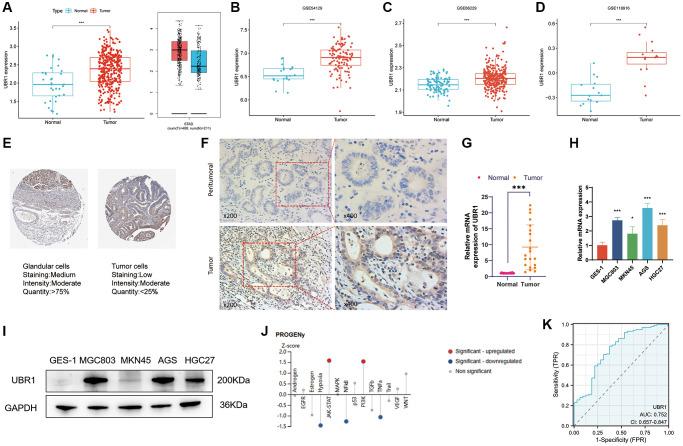
Differential expression and pan-cancer gene set enrichment analysis (GSEA) were conducted using The Cancer Genome Atlas (TCGA), Gene Expression Omnibus (GEO), and Genotype-Tissue Expression (GTEx) datasets. The Human Protein Atlas (HPA) database was utilized to identify UBR1-enriched pathways in AGS cells and to compare immunohistochemical differences between cancerous and adjacent non-cancerous tissues in gastric cancer. Quantitative Polymerase Chain Reaction (QPCR) and Western blot (WB) analyses were employed to validate these findings in both cancerous and adjacent non-cancerous tissues of gastric cancer. UBR1 expression in GES-1 and four gastric cancer cell lines was assessed using QPCR and WB. Kaplan-Meier curves, univariate and multivariate Cox regression analyses, and receiver operating characteristic (ROC) curve analyses were performed to evaluate the prognostic and diagnostic roles of UBR1. Additionally, the correlation between UBR1 expression and clinical parameters was analyzed using TCGA and GEO databases. UBR1 mutation data were obtained from the cBioPortal database. The mutation landscape, mutation-associated genes, protein structure, tumor mutation burden (TMB), and microsatellite instability (MSI) correlations were analyzed and illustrated. The biological functions of UBR1 were investigated using Gene Ontology (GO) and Kyoto Encyclopedia of Genes and Genomes (KEGG) enrichment analyses. The correlation between UBR1 and immune infiltration was assessed using TIMER and EPIC computational methods. Protein expression levels of UBR1 in gastric cancer cell lines were determined by immunohistochemistry (IHC) and WB analysis. Quantitative real-time PCR (qRT-PCR) was employed to analyze mRNA expression. Immunoprecipitation (IP) assays were conducted to detect protein-protein interactions between UBR1 and PDL1, while cellular immunofluorescence was used to observe the co-localization of these proteins. Cell proliferation was evaluated using CCK8 and colony formation assays. Cell migration was assessed using Transwell and wound healing assays. Finally, apoptosis was analyzed using flow cytometry, and WB was used to detect changes in apoptotic proteins and NF-κB P65 pathway proteins.
RESULTS
UBR1 was upregulated in 28 cancer types, including STAD, and its overexpression was validated in gastric cancer cell lines and tissues. UBR1 expression was associated with advanced pathological characteristics. High UBR1 expression was linked to poor prognostic outcomes, including overall survival (OS), progression-free interval (PFI), disease-specific survival (DSS), as well as responses to surgery, chemotherapy, and HER2 expression. UBR1 expression showed significant correlations with clinical parameters such as age, gender, TNM stage, pathological stage, tumor resection, and anti-reflux therapy. Amplifications and deletions were the most frequent genetic alterations associated with UBR1. According to KEGG and GSEA analyses, UBR1 was significantly associated with several cancer pathways, oxidative phosphorylation, and the TNF-NFκB pathway. UBR1 also exhibited a significant correlation with immune cell infiltration and immunotherapy, including a direct interaction with PDL1. Knockdown of UBR1 inhibited the proliferation, migration, and invasion of STAD cells and promoted apoptosis.
CONCLUSIONS
UBR1 is overexpressed in STAD, promoting its progression and positively correlating with immune cell infiltration and immunotherapeutic responses. Therefore, UBR1 could be a promising biomarker for the prognosis and immunotherapy of STAD.
背景
泛素化是一种由细胞内分子介导的靶向蛋白修饰过程。UBR1 编码一种与不稳定的底物蛋白 N 端残基结合的蛋白质,有助于形成底物连接的多泛素链。然而,UBR1 在肿瘤中的功能和细胞途径尚未得到充分关注。本研究旨在探讨 UBR1 作为胃腺癌(STAD)的预后生物标志物和免疫治疗靶标,以及其在疾病中的生物学功能和分子机制。
方法
使用癌症基因组图谱(TCGA)、基因表达综合数据库(GEO)和基因型组织表达(GTEx)数据集进行差异表达和泛癌症基因集富集分析(GSEA)。人类蛋白质图谱(HPA)数据库用于鉴定 AGS 细胞中 UBR1 富集的途径,并比较胃癌癌组织和相邻非癌组织的免疫组织化学差异。采用定量聚合酶链反应(QPCR)和蛋白质印迹(WB)分析在胃癌的癌组织和相邻非癌组织中验证这些发现。使用 QPCR 和 WB 评估 GES-1 和四种胃癌细胞系中 UBR1 的表达。采用 Kaplan-Meier 曲线、单因素和多因素 Cox 回归分析以及接收者操作特征(ROC)曲线分析评估 UBR1 的预后和诊断作用。此外,使用 TCGA 和 GEO 数据库分析 UBR1 表达与临床参数的相关性。从 cBioPortal 数据库获得 UBR1 突变数据。分析突变景观、突变相关基因、蛋白质结构、肿瘤突变负荷(TMB)和微卫星不稳定性(MSI)相关性,并进行图示。使用基因本体论(GO)和京都基因与基因组百科全书(KEGG)富集分析研究 UBR1 的生物学功能。使用 TIMER 和 EPIC 计算方法评估 UBR1 与免疫浸润的相关性。通过免疫组织化学(IHC)和 WB 分析确定胃癌细胞系中 UBR1 的蛋白表达水平。采用定量实时 PCR(qRT-PCR)分析 mRNA 表达。免疫沉淀(IP)试验检测 UBR1 与 PDL1 之间的蛋白-蛋白相互作用,而细胞免疫荧光用于观察这些蛋白的共定位。使用 CCK8 和集落形成试验评估细胞增殖。使用 Transwell 和划痕愈合试验评估细胞迁移。最后,通过流式细胞术分析细胞凋亡,WB 检测凋亡蛋白和 NF-κB P65 通路蛋白的变化。
结果
UBR1 在 28 种癌症类型中上调,包括 STAD,并在胃癌细胞系和组织中得到验证。UBR1 表达与晚期病理特征相关。高 UBR1 表达与不良预后结果相关,包括总生存期(OS)、无进展间隔(PFI)、疾病特异性生存期(DSS)以及对手术、化疗和 HER2 表达的反应。UBR1 表达与年龄、性别、TNM 分期、病理分期、肿瘤切除和反流治疗等临床参数显著相关。扩增和缺失是与 UBR1 相关的最常见遗传改变。根据 KEGG 和 GSEA 分析,UBR1 与几种癌症途径、氧化磷酸化和 TNF-NFκB 途径显著相关。UBR1 还与免疫细胞浸润和免疫治疗有显著相关性,包括与 PDL1 的直接相互作用。敲低 UBR1 抑制 STAD 细胞的增殖、迁移和侵袭,并促进凋亡。
结论
UBR1 在 STAD 中过度表达,促进其进展,并与免疫细胞浸润和免疫治疗反应呈正相关。因此,UBR1 可能成为 STAD 预后和免疫治疗的有前途的生物标志物。




 Zotero 插件