Hwang Sunhee, Balana Aaron T, Martin Bryan, Clarkson Michael, Di Lello Paola, Wu Hao, Li Yanjie, Fuhrmann Jakob, Dagdas Yavuz, Holder Patrick, Schroeder Christina I, Miller Stephen E, Gao Xinxin
Department of Peptide Therapeutics, Genentech Incorporated, South San Francisco, California 94080, United States.
Department of Structural Biology, Genentech Incorporated, South San Francisco, California 94080, United States.
ACS Bio Med Chem Au. 2024 Jul 12;4(4):190-203. doi: 10.1021/acsbiomedchemau.4c00026. eCollection 2024 Aug 21.
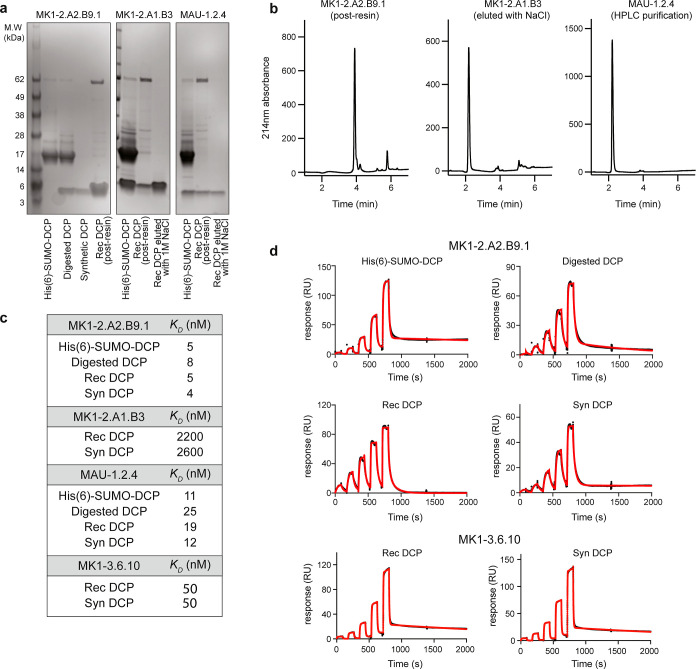
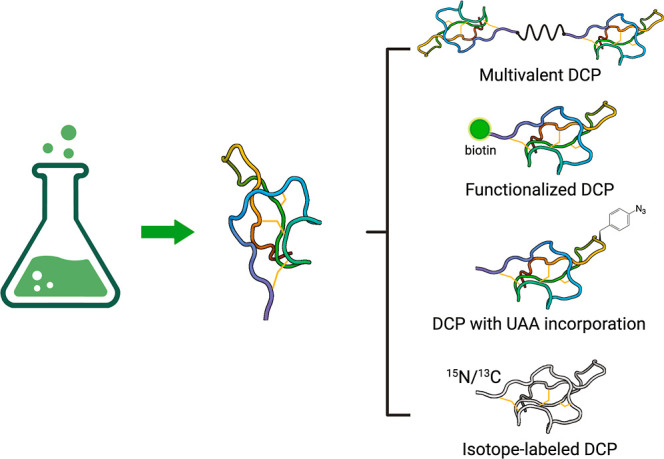
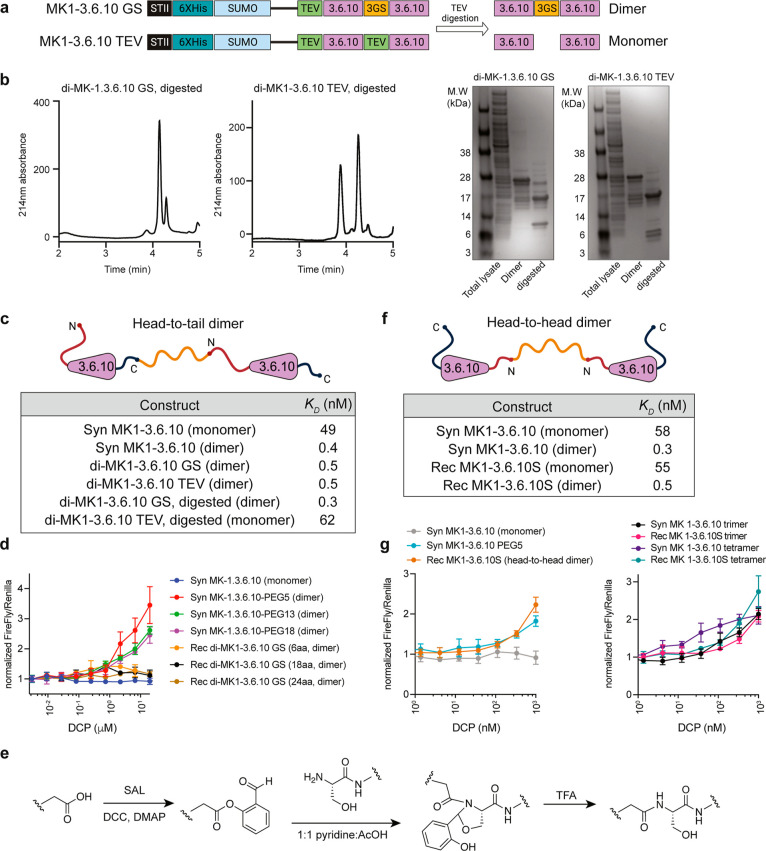
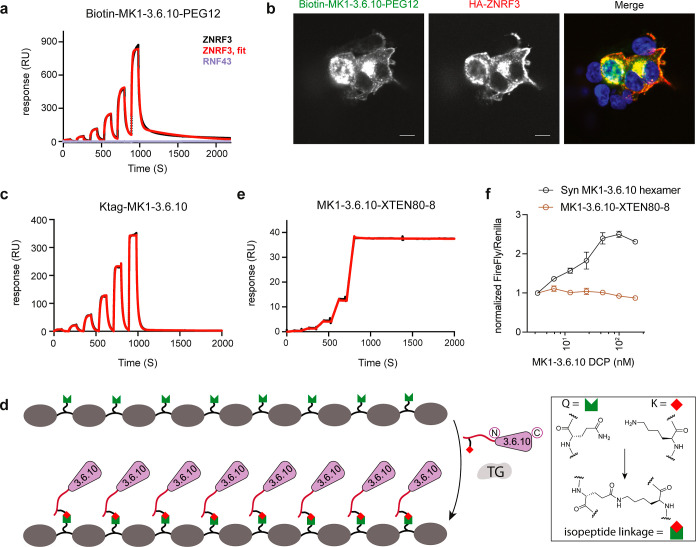
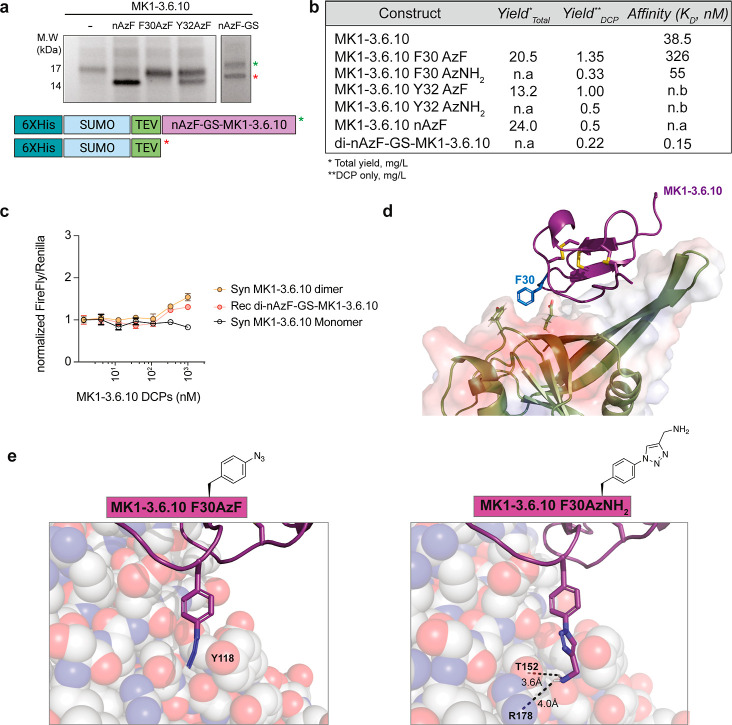
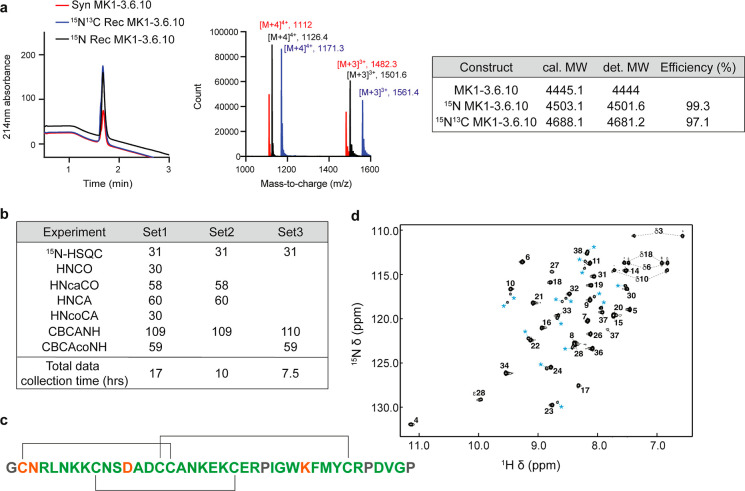
Disulfide-constrained peptides (DCPs) have gained increased attention as a drug modality due to their exceptional stability and combined advantages of large biologics and small molecules. Chemical synthesis, although widely used to produce DCPs, is associated with high cost, both economically and environmentally. To reduce the dependence on solid phase peptide synthesis and the negative environmental footprint associated with it, we present a highly versatile, low-cost, and environmentally friendly bioproduction platform to generate DCPs and their conjugates as well as chemically modified or isotope-labeled DCPs. Using the DCP against the E3 ubiquitin ligase Zinc and Ring Finger 3, MK1-3.6.10, as a model peptide, we have demonstrated the use of bacterial expression, combined with Ser ligation or transglutaminase-mediated XTEN ligation, to produce multivalent MK1-3.6.10 and MK1-3.6.10 with N-terminal functional groups. We have also developed a bioproduction method for the site-specific incorporation of unnatural amino acids into recombinant DCPs by the amber codon suppression system. Lastly, we produced N/C-labeled MK1-3.6.10 with high yield and assessed the performance of a semiautomated resonance assignment workflow that could be used to accelerate binding studies and structural characterization of DCPs. This study provides a proof of concept to generate functionalized DCPs using bioproduction, providing a potential solution to alleviate the reliance on hazardous chemicals, reduce the cost, and expedite the timeline for DCP discovery.
二硫键约束肽(DCPs)作为一种药物形式,因其卓越的稳定性以及兼具大分子生物制剂和小分子的综合优势而受到越来越多的关注。化学合成虽然广泛用于生产DCPs,但在经济和环境方面都成本高昂。为了减少对固相肽合成及其相关负面环境影响的依赖,我们提出了一个高度通用、低成本且环境友好的生物生产平台,用于生成DCPs及其缀合物,以及化学修饰或同位素标记的DCPs。以针对E3泛素连接酶锌指蛋白3(MK1-3.6.10)的DCP作为模型肽,我们展示了利用细菌表达,结合丝氨酸连接或转谷氨酰胺酶介导的XTEN连接,来生产多价MK1-3.6.10和具有N端官能团的MK1-3.6.10。我们还开发了一种生物生产方法,通过琥珀密码子抑制系统将非天然氨基酸位点特异性掺入重组DCPs中。最后,我们高产率地生产了N/C标记的MK1-3.6.10,并评估了一种半自动共振归属工作流程的性能,该流程可用于加速DCPs的结合研究和结构表征。本研究提供了一个利用生物生产生成功能化DCPs的概念验证,为减轻对有害化学品的依赖、降低成本以及加快DCP发现的时间线提供了一个潜在的解决方案。