Hossen Md Shahabul, Islam Tarikul, Hoque Sheikh Manjura, Islam Aminul, Bashar M Mahbubul, Bhat Gajanan
Department of Textile Engineering, Mawlana Bhashani Science and Technology University, Tangail, Santosh 1902, Bangladesh.
Department of Textiles, Merchandising, and Interiors, University of Georgia, Athens, Georgia 30602, United States.
ACS Omega. 2024 Aug 5;9(33):35384-35393. doi: 10.1021/acsomega.4c01268. eCollection 2024 Aug 20.
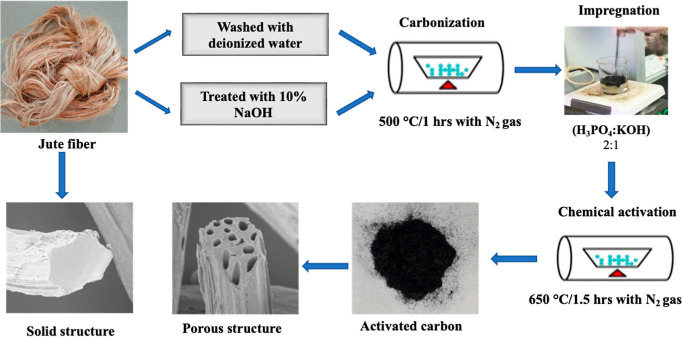
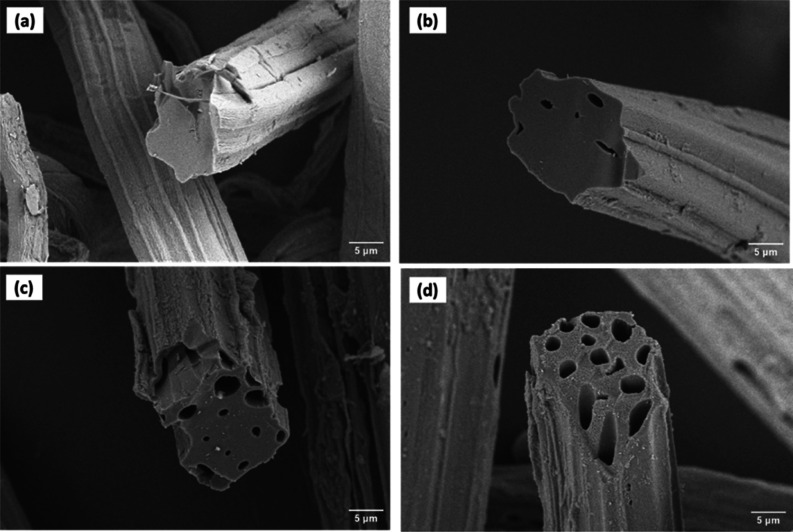
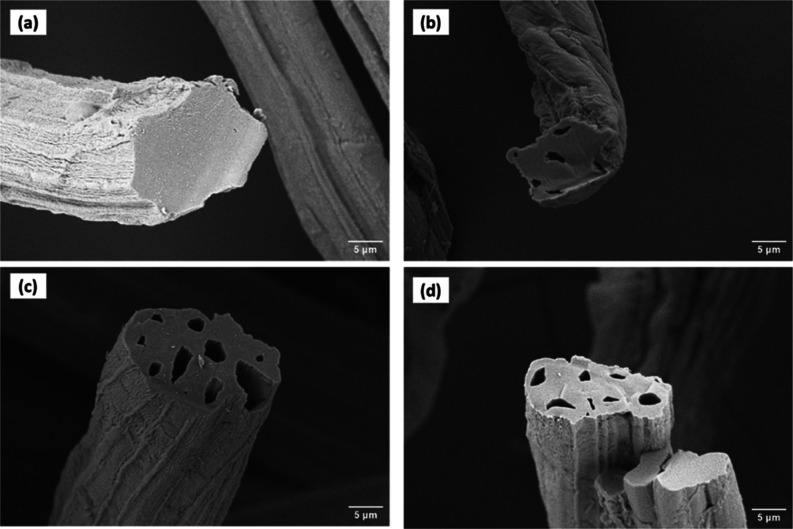
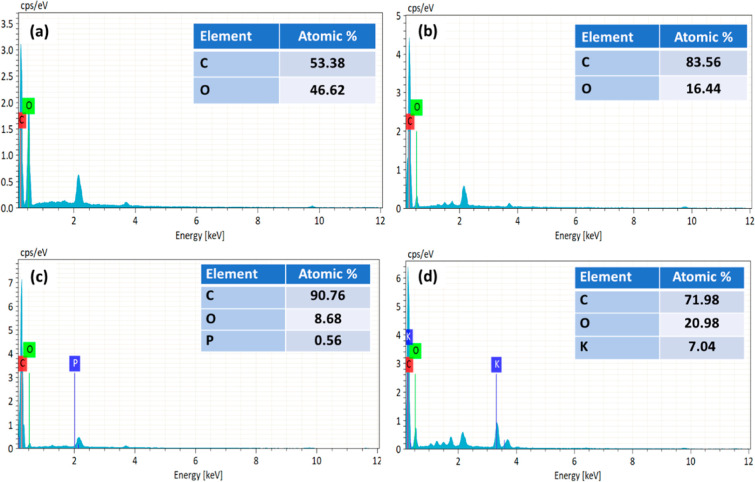
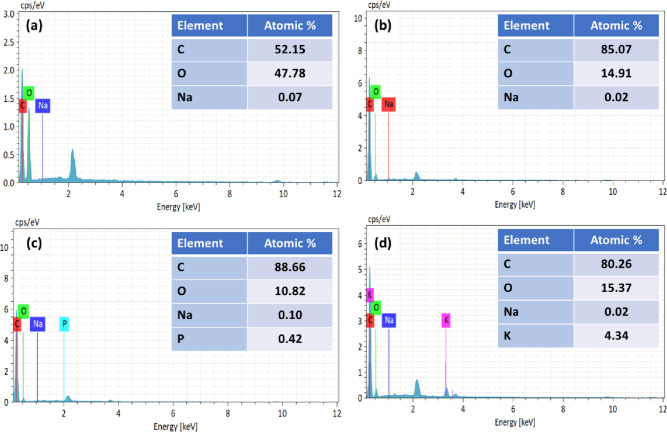
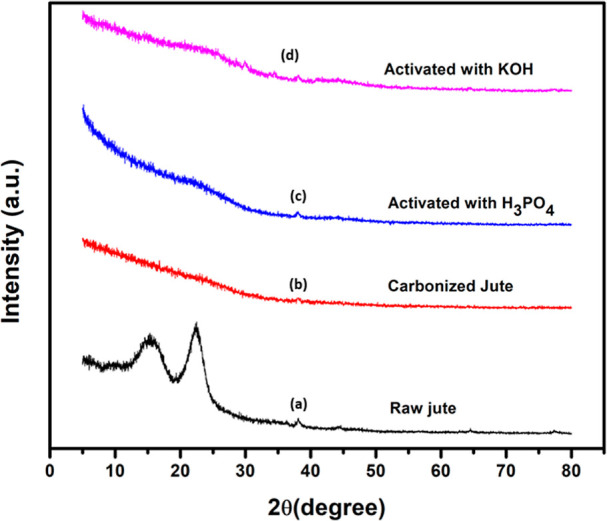
Activated carbon (AC) fiber is a carbonaceous material with a porous structure that has a tremendous scope of application in different fields. Conventionally, AC is derived from fossil fuel-based raw materials like polyacrylonitrile (PAN) and pitch. In this work, AC was synthesized from eco-friendly, renewable, and ubiquitous jute fiber. Systematically, the jute fiber was washed and pretreated with NaOH. Raw jute and NaOH-treated jute were carbonized/pyrolyzed at 500 °C for 1 h in presence of N gas. The carbonized carbon was activated with HPO and KOH and again pyrolyzed at 650 °C for 1.5 h maintaining the inert condition. The different features of activated carbons were characterized with field emission-scanning electron microscope, energy-dispersive X-ray spectroscopy (EDX), transmission electron microscopy (TEM), X-ray diffraction (XRD), and thermogravimetric analysis. The average yield of carbonized and activated carbons was recorded at 19 and 13.8%, respectively. The scanning electron microscopic images confirmed a honeycomb-like porous structure. It was observed that KOH-activated carbon exhibited a more porous structure than the HPO-activated carbons. The average pore diameter of activated carbons was noted to be 1.3 μm. The pore density was higher in case of KOH-activated carbons accounting for 2.15 pore/μm. The EDX analysis showed that HPO-activated carbons had more than 90% carbon atoms indicating a significant carbon content. The TEM images revealed that AC particles were in the nanoscale range. The average particle sizes of HPO-activated carbon and KOH-activated carbon were 36.38 and 32.8 nm, respectively. The XRD study demonstrated the highly disordered and low level of crystallinity of AC. It was detected that the AC showed much higher thermal resistance than the jute fiber. The HPO-activated carbon obtained from NaOH-treated jute remained at 84% even after 500 °C. A higher thermal resistance was achieved with HPO-activated carbon since it contains 0.56% phosphorus, which was confirmed by EDX investigation. It was found that a higher carbon yield was obtained from NaOH-treated jute. The porous structure of the material showed that it could be used as an adsorbent. Due to its high thermal stability, it is recommended for flame retardants and heat insulation applications as well.
活性炭(AC)纤维是一种具有多孔结构的含碳材料,在不同领域有着广泛的应用范围。传统上,活性炭由聚丙烯腈(PAN)和沥青等基于化石燃料的原材料制成。在这项工作中,活性炭由环保、可再生且随处可得的黄麻纤维合成。具体而言,将黄麻纤维进行洗涤并用氢氧化钠预处理。将未处理的黄麻和经氢氧化钠处理的黄麻在氮气存在下于500℃碳化/热解1小时。碳化后的碳用磷酸和氢氧化钾活化,然后在650℃再次热解1.5小时并保持惰性条件。用场发射扫描电子显微镜、能量色散X射线光谱(EDX)、透射电子显微镜(TEM)、X射线衍射(XRD)和热重分析对活性炭的不同特性进行了表征。碳化和活化后的活性炭平均产率分别记录为19%和13.8%。扫描电子显微镜图像证实了蜂窝状多孔结构。观察到氢氧化钾活化的活性炭比磷酸活化的活性炭呈现出更多孔的结构。活性炭的平均孔径为1.3μm。氢氧化钾活化的活性炭的孔密度更高,为2.15个孔/μm。EDX分析表明,磷酸活化的活性炭含有超过90%的碳原子,表明碳含量很高。TEM图像显示AC颗粒处于纳米尺度范围。磷酸活化的活性炭和氢氧化钾活化的活性炭的平均粒径分别为36.38nm和32.8nm。XRD研究表明AC具有高度无序和低结晶度。检测发现AC的热稳定性比黄麻纤维高得多。由经氢氧化钠处理的黄麻制得的磷酸活化的活性炭即使在500℃后仍保留84%。磷酸活化的活性炭实现了更高的热稳定性,因为它含有0.56%的磷,这通过EDX研究得到了证实。发现经氢氧化钠处理的黄麻获得了更高的碳产率。该材料的多孔结构表明它可以用作吸附剂。由于其高热稳定性,它也被推荐用于阻燃和隔热应用。