Benatar Michael, Macklin Eric A, Malaspina Andrea, Rogers Mary-Louise, Hornstein Eran, Lombardi Vittoria, Renfrey Danielle, Shepheard Stephanie, Magen Iddo, Cohen Yahel, Granit Volkan, Statland Jeffrey M, Heckmann Jeannine M, Rademakers Rosa, McHutchison Caroline A, Petrucelli Leonard, McMillan Corey T, Wuu Joanne
Department of Neurology, University of Miami Miller School of Medicine, Miami, FL, USA.
Departments of Neurology and Medicine, Massachusetts General Hospital, Harvard Medical School, Boston, MA USA.
medRxiv. 2024 Aug 13:2024.08.12.24311876. doi: 10.1101/2024.08.12.24311876.
With increasing recognition of the value of incorporating prognostic markers into amyotrophic lateral sclerosis (ALS) trial design and analysis plans, there is a pressing need to understand among the prevailing clinical and biochemical markers have real value, and they can be optimally used.
A subset of patients with ALS recruited through the multi-center Phenotype-Genotype-Biomarker study (clinicaltrials.gov: NCT02327845) was identified as "trial-like" based on meeting common trial eligibility criteria. Clinical phenotyping was performed by evaluators trained in relevant assessments. Serum neurofilament light (NfL) and phosphorylated neurofilament heavy (pNfH), urinary p75, plasma microRNA-181, and an array of biochemical and clinical measures were evaluated for their prognostic value. Associations with functional progression were estimated by random-slopes mixed models of ALS functional rating scale-revised (ALSFRS-R) score. Associations with survival were estimated by log-rank test and Cox proportional hazards regression. Potential sample size savings from adjusting for given biomarkers in a hypothetical trial were estimated.
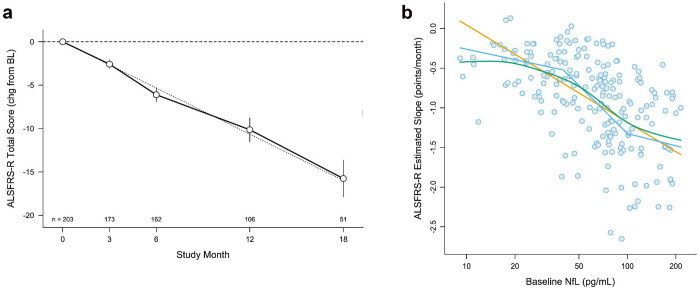
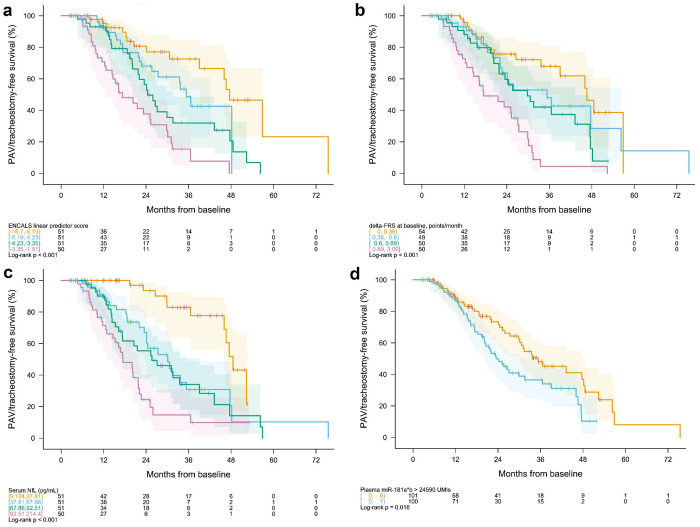
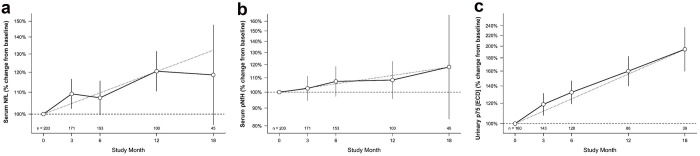
Baseline serum NfL is a powerful prognostic biomarker, predicting survival and ALSFRS-R rate of decline. Serum NfL <40pg/ml and >100pg/ml correspond to future ALSFRS-R slopes of ~0.5 and 1.5 points/month, respectively. Serum NfL also adds value to the best available clinical predictors, encapsulated by the European Network to Cure ALS (ENCALS) predictor score. In models of functional decline, the addition of NfL yields ~25% sample size saving above those achieved by inclusion of either clinical predictors or ENCALS score alone. The prognostic value of serum pNfH, urinary p75, and plasma miR-181ab is more limited.
Among the multitude of biomarkers considered, only blood NfL adds value to the ENCALS prediction model and should be incorporated into analysis plans for all ongoing and future ALS trials. Defined thresholds of NfL might also be used in trial design, for enrichment or stratified randomisation, to improve trial efficiency.
NIH (U01-NS107027, U54-NS092091). ALSA (16-TACL-242).
随着人们越来越认识到将预后标志物纳入肌萎缩侧索硬化症(ALS)试验设计和分析计划的价值,迫切需要了解目前的临床和生化标志物中哪些具有实际价值,以及如何最佳地使用它们。
通过多中心表型-基因型-生物标志物研究(clinicaltrials.gov:NCT02327845)招募的一部分ALS患者,根据符合常见试验纳入标准被确定为“类似试验”。临床表型分析由接受相关评估培训的评估人员进行。评估了血清神经丝轻链(NfL)和磷酸化神经丝重链(pNfH)、尿p75、血浆微小RNA-181以及一系列生化和临床指标的预后价值。通过肌萎缩侧索硬化功能评定量表修订版(ALSFRS-R)评分的随机斜率混合模型估计与功能进展的关联。通过对数秩检验和Cox比例风险回归估计与生存的关联。估计了在假设试验中调整特定生物标志物后可能节省的样本量。
基线血清NfL是一种强大的预后生物标志物,可预测生存和ALSFRS-R下降率。血清NfL<40pg/ml和>100pg/ml分别对应于未来ALSFRS-R斜率约为每月0.5分和1.5分。血清NfL也为欧洲治愈ALS网络(ENCALS)预测评分所涵盖的最佳可用临床预测指标增加了价值。在功能下降模型中,加入NfL比仅纳入临床预测指标或ENCALS评分可节省约25%的样本量。血清pNfH、尿p75和血浆miR-181ab的预后价值较为有限。
在考虑的众多生物标志物中,只有血液NfL为ENCALS预测模型增加了价值,应纳入所有正在进行和未来的ALS试验的分析计划中。NfL的定义阈值也可用于试验设计,用于富集或分层随机化,以提高试验效率。
美国国立卫生研究院(U01-NS107027,U54-NS092091)。肌萎缩侧索硬化协会(16-TACL-242)。