Bergmann Christina, Chenguiti Fakhouri Sara, Trinh-Minh Thuong, Filla Tim, Rius Rigau Aleix, Ekici Arif B, Merlevede Benita, Hallenberger Ludwig, Zhu Honglin, Dees Clara, Matei Alexandru-Emil, Auth Janina, Györfi Andrea-Hermina, Zhou Xiang, Rauber Simon, Bozec Aline, Dickel Nicholas, Liang Chunguang, Kunz Meik, Schett Georg, Distler Jörg H W
Deutsches Zentrum für Immuntherapie, Friedrich-Alexander-Universität Erlangen-Nürnberg and Uniklinikum Erlangen, Erlangen, Germany.
Hiller Research Center, University Hospital Düsseldorf and Heinrich Heine University, Düsseldorf, Germany.
Arthritis Rheumatol. 2025 Jan;77(1):92-98. doi: 10.1002/art.42979. Epub 2024 Oct 20.
Deregulation of the cJUN/AP-1 and hedgehog/GLI2 signaling pathways has been implicated in fibroblast activation in systemic sclerosis (SSc). However, the consequences of their concomitant up-regulation are unknown. Here, we tested the hypothesis that mutual amplification of both pathways might drive persistent fibroblast activation.
Cultured fibroblasts and skin sections of patients with diffuse SSc and healthy volunteers were analyzed. cJUN/AP-1 signaling and hedgehog/GLI2 signaling were inhibited using knockdown and pharmacologic approaches. Hedgehog signaling was activated in mice by fibroblast-specific overexpression of constitutively active Smoothened.
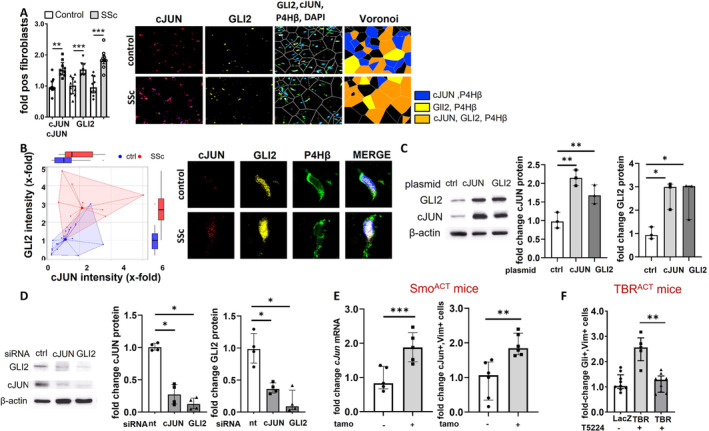
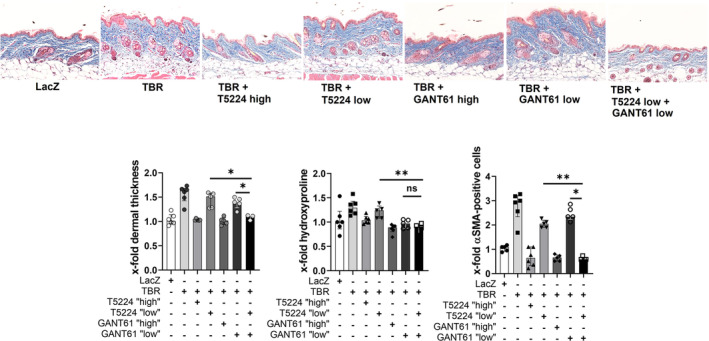
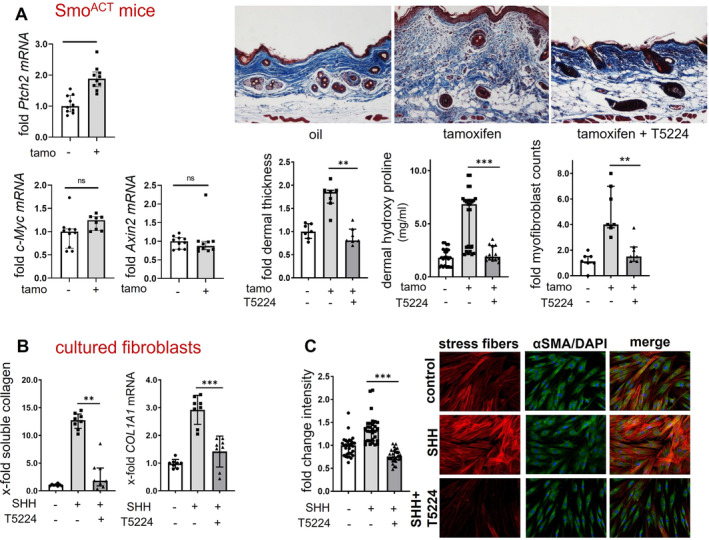
cJUN and GLI2 are concomitantly up-regulated and colocalize in fibroblasts of patients with SSc compared to healthy controls. Activation of hedgehog/GLI2 signaling induces the expression of cJUN in vitro and in vivo, whereas inactivation of GLI2 inhibits cJUN expression. Likewise, inactivation of cJUN impairs the expression of GLI2. This mutual regulation occurs at the level of transcription with binding of cJUN and GLI2 to specific binding motifs. Interference with this mutual amplification of cJUN signaling and GLI2 signaling inhibits fibroblast activation and collagen release: Inhibition of cJUN/AP-1 signaling ameliorates hedgehog-induced fibroblast activation and skin fibrosis in Smo mice with a reduction of skin thickness of 103% (P = 0.0043) in the treatment group compared to the fibrotic control group. Moreover, combined pharmacologic inhibition of cJUN/AP-1 and hedgehog/GLI2 exerts additive antifibrotic effects in a model of TGFβ-driven experimental fibrosis (TBR mice).
The transcription factors cJUN and GLI2 reinforce each other's activity to promote fibroblast activation in SSc. Interruption of this crosstalk by combined inhibition of both pathways exerts additive antifibrotic effects at well-tolerated doses.
cJUN/AP-1和刺猬信号通路/GLI2信号通路失调与系统性硬化症(SSc)中的成纤维细胞活化有关。然而,它们同时上调的后果尚不清楚。在此,我们检验了这一假说,即两条通路的相互放大可能驱动成纤维细胞持续活化。
对弥漫性SSc患者和健康志愿者的培养成纤维细胞及皮肤切片进行分析。采用基因敲低和药理学方法抑制cJUN/AP-1信号通路和刺猬信号通路/GLI2信号通路。通过成纤维细胞特异性过表达组成型激活的Smoothened在小鼠中激活刺猬信号通路。
与健康对照相比,SSc患者成纤维细胞中cJUN和GLI2同时上调且共定位。刺猬信号通路/GLI2信号通路的激活在体外和体内均可诱导cJUN的表达,而GLI2的失活则抑制cJUN的表达。同样,cJUN的失活也会损害GLI2的表达。这种相互调节发生在转录水平,cJUN和GLI2与特定结合基序结合。干扰cJUN信号通路和GLI2信号通路的这种相互放大可抑制成纤维细胞活化和胶原蛋白释放:抑制cJUN/AP-1信号通路可改善刺猬信号通路诱导的Smo小鼠成纤维细胞活化和皮肤纤维化,治疗组皮肤厚度比纤维化对照组降低103%(P = 0.0043)。此外,在转化生长因子β驱动的实验性纤维化模型(TBR小鼠)中,联合药理学抑制cJUN/AP-1和刺猬信号通路/GLI2具有相加的抗纤维化作用。
转录因子cJUN和GLI2相互增强活性,以促进SSc中的成纤维细胞活化。通过联合抑制两条通路来中断这种串扰,在耐受性良好的剂量下具有相加的抗纤维化作用。