Department of Oncology, The First Affiliated Hospital of Zhengzhou University, Lymphoma Diagnosis and Treatment Center of Henan Province, Zhengzhou, Henan, China.
School of Public Health, Zhengzhou University, Zhengzhou, Henan, China.
Front Immunol. 2024 Aug 12;15:1430070. doi: 10.3389/fimmu.2024.1430070. eCollection 2024.
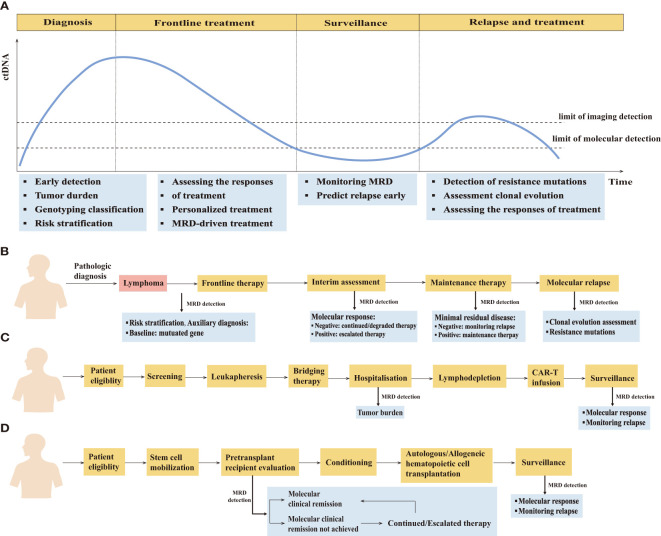
Lymphoma is a highly heterogeneous lymphohematopoietic tumor. As our understanding of the biological and pathological characteristics of lymphoma improves, we are identifying an increasing number of lymphoma subtypes. Genotyping has enhanced our ability to diagnose, treat, and monitor the prognosis of lymphoma. Despite significant improvements in treatment effectiveness, traditional methods for assessing disease response and monitoring prognosis are imperfect, and there is no significant improvement in overall remission rates for lymphoma patients. Minimal Residual Disease (MRD) is often indicative of refractory disease or early relapse. For lymphoma patients, personalized MRD monitoring techniques offer an efficient means to estimate disease remission levels, predict early relapse risk, and assess the effectiveness of new drug regimens. In this review, we delve into the MRD procedures in lymphoma, including sample selection and requirements, detection methods and their limitations and advantages, result interpretation. Besides, we also introduce the clinical applications of MRD detection in lymphoma.
淋巴瘤是一种高度异质性的淋巴造血系统肿瘤。随着我们对淋巴瘤生物学和病理学特征的认识不断提高,越来越多的淋巴瘤亚型被识别出来。基因分型提高了我们诊断、治疗和监测淋巴瘤预后的能力。尽管治疗效果有了显著提高,但传统的疾病反应评估和预后监测方法并不完善,淋巴瘤患者的总体缓解率并没有显著提高。微小残留病灶(MRD)通常提示难治性疾病或早期复发。对于淋巴瘤患者,个性化的 MRD 监测技术提供了一种有效的方法来估计疾病缓解水平,预测早期复发风险,并评估新药方案的疗效。在这篇综述中,我们深入探讨了淋巴瘤中的 MRD 检测程序,包括样本选择和要求、检测方法及其局限性和优点、结果解释。此外,我们还介绍了 MRD 检测在淋巴瘤中的临床应用。