Gonzalez-Martin Roberto, Palomar Andrea, Perez-Deben Silvia, Salsano Stefania, Quiñonero Alicia, Caracena Laura, Rucandio Isabel, Fernandez-Saavedra Rocio, Fernandez-Martinez Rodolfo, Conde-Vilda Estefania, Quejido Alberto J, Giles Juan, Vidal Carmen, Bellver Jose, Dominguez Francisco
IVI-RMA Global Research Alliance, IVI Foundation, Instituto de Investigación Sanitaria La Fe (IIS La Fe), 46026 Valencia, Spain.
IVI-RMA Global Research Alliance, IVI-RMA Valencia, 46015 Valencia, Spain.
J Xenobiot. 2024 Aug 8;14(3):1093-1108. doi: 10.3390/jox14030062.
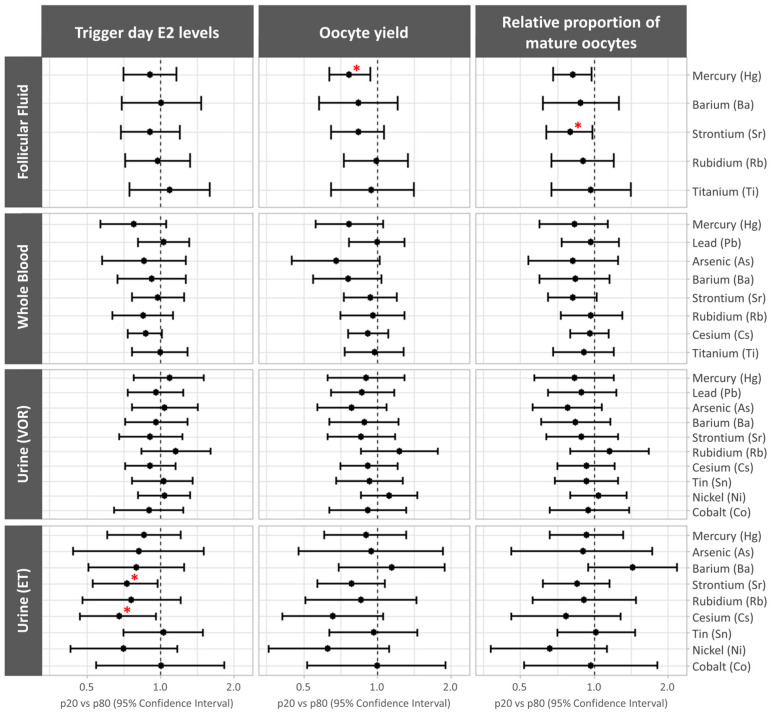
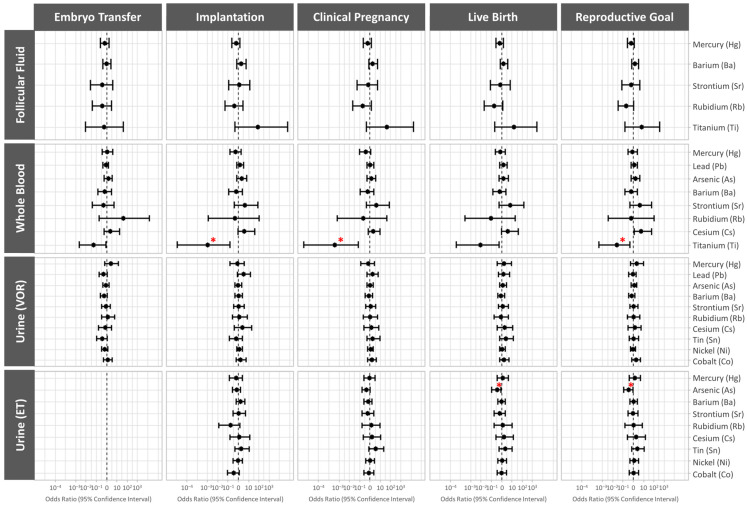
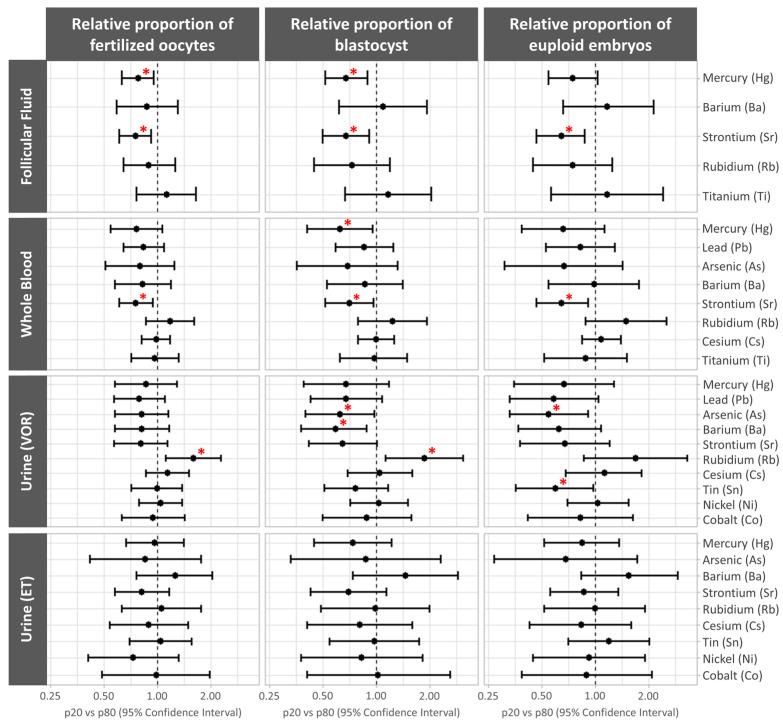
Previous studies have found inconsistent associations between heavy metals and metalloids (cadmium, lead, mercury, and arsenic), and reproductive outcomes. The biofluid concentrations of ten non-essential trace elements (Hg, Pb, As, Ba, Sr, Rb, Cs, Sn, Ni, and Co) were evaluated in 51 Spanish women undergoing ICSI, PGT-A, and SET/FET. Nine out of ten non-essential elements were detectable in follicular fluid, whole blood, and urine collected the day of vaginal oocyte retrieval (VOR) and the day of embryo transfer and then analyzed by ICP-MS or Tricell DMA-80 for mercury. Elevated mercury and strontium concentrations in follicular fluid were associated with poor ovarian response and preimplantation outcomes. Worst preimplantation outcomes were also identified in women with elevated whole-blood strontium or mercury, urinary arsenic, barium, and tin the day of VOR. High concentrations of urinary rubidium on VOR day were linked with enhanced fertilization and blastocyst development. Excessive titanium in whole blood was associated with lower odds of implantation, clinical pregnancy, and achieving a live birth in a given IVF cycle. Excessive urinary arsenic on the day of embryo transfer was associated with lower odds of live birth. Although these preliminary results need to be confirmed in larger populations, distinguishing organic and inorganic element forms, our findings show that some non-essential elements have a detrimental impact on human IVF outcomes.
先前的研究发现,重金属和类金属(镉、铅、汞和砷)与生殖结局之间的关联并不一致。对51名接受卵胞浆内单精子注射(ICSI)、植入前遗传学检测(PGT-A)以及单胚胎移植/冻融胚胎移植(SET/FET)的西班牙女性,评估了十种非必需微量元素(汞、铅、砷、钡、锶、铷、铯、锡、镍和钴)的生物流体浓度。在阴道取卵日(VOR)和胚胎移植日采集的卵泡液、全血和尿液中,十种非必需元素中有九种可检测到,然后通过电感耦合等离子体质谱法(ICP-MS)或三单元直接测汞仪(Tricell DMA-80)分析汞含量。卵泡液中汞和锶浓度升高与卵巢反应不良和植入前结局不佳有关。在VOR日全血锶或汞、尿砷、钡和锡含量升高的女性中,也发现了最差的植入前结局。VOR日尿铷浓度高与受精和囊胚发育增强有关。全血中钛含量过高与特定体外受精周期中着床、临床妊娠和活产几率降低有关。胚胎移植日尿砷含量过高与活产几率降低有关。尽管这些初步结果需要在更大规模人群中得到证实,区分有机和无机元素形式,但我们的研究结果表明,一些非必需元素对人类体外受精结局有不利影响。