McGuire Center for Lepidoptera and Biodiversity, Florida Museum of Natural History, University of Florida , Gainesville, FL 32611, USA.
Department of Biology, Florida International University , Miami, FL 33174, USA.
Proc Biol Sci. 2024 Aug;291(2029):20240591. doi: 10.1098/rspb.2024.0591. Epub 2024 Aug 28.
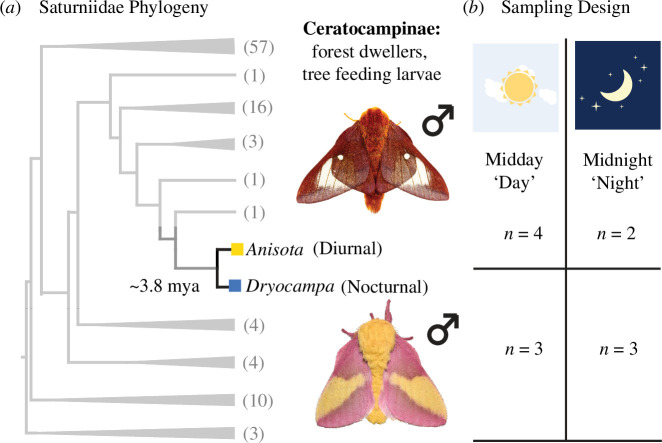
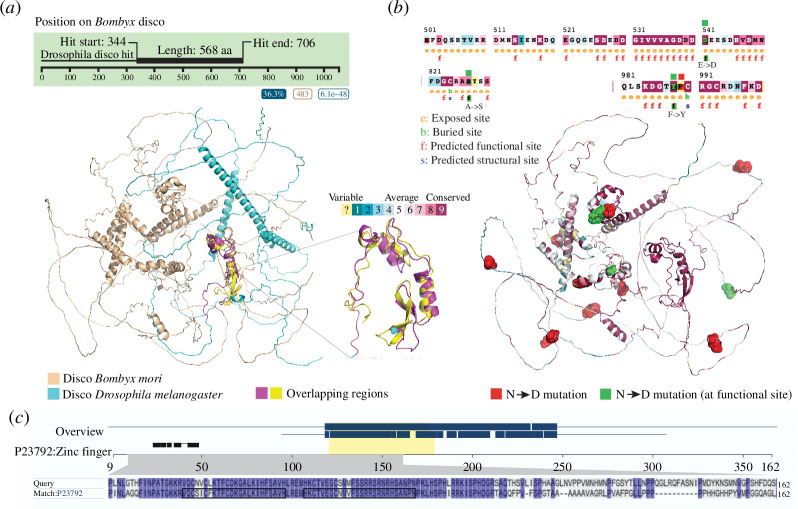
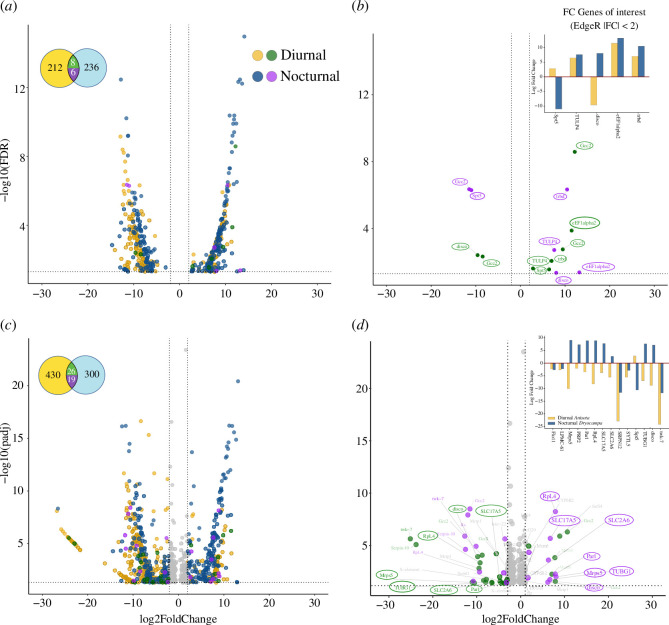
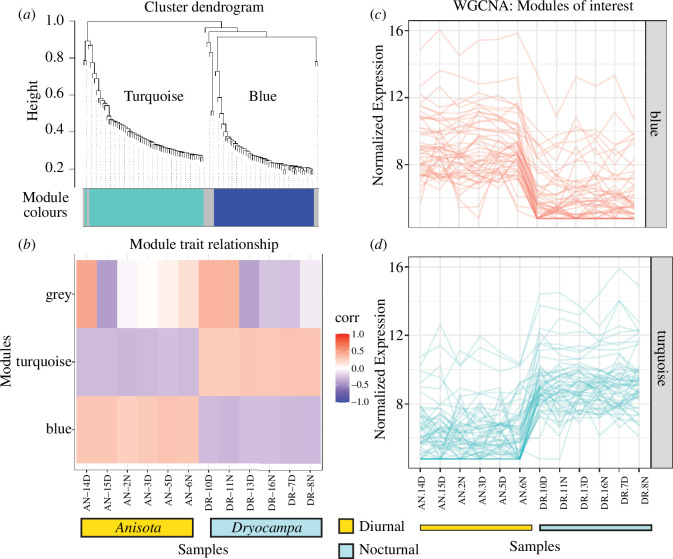
Temporal ecological niche partitioning is an underappreciated driver of speciation. While insects have long been models for circadian biology, the genes and circuits that allow adaptive changes in diel-niches remain poorly understood. We compared gene expression in closely related day- and night-active non-model wild silk moths, with otherwise similar ecologies. Using an ortholog-based pipeline to compare RNA-Seq patterns across two moth species, we find over 25 pairs of gene orthologs showing differential expression. Notably, the gene involved in circadian control, optic lobe and clock neuron development in , shows robust adult circadian mRNA cycling in moth heads. is highly conserved in moths and has additional zinc-finger domains with specific nocturnal and diurnal mutations. We propose as a candidate gene for the diversification of temporal diel-niche in moths.
时间生态位分化是物种形成的一个被低估的驱动因素。虽然昆虫长期以来一直是昼夜节律生物学的模型,但允许昼夜生态位适应性变化的基因和回路仍知之甚少。我们比较了具有相似生态的近亲昼行和夜行非模型野生蚕蛾的基因表达。使用基于直系同源物的管道比较两种蛾物种的 RNA-Seq 模式,我们发现有超过 25 对基因直系同源物表现出差异表达。值得注意的是,参与昼夜节律控制、视叶和时钟神经元发育的基因在 中,在蛾类头部表现出强烈的成年昼夜 mRNA 循环。在蛾类中高度保守,并且具有额外的锌指结构域,具有特定的夜间和日间突变。我们提出 作为蛾类时间昼夜生态位多样化的候选基因。