
稻草的一种处理方法及其在黄粉虫(L.)饲养中的应用:对昆虫生长性能和饲料消化率的影响。
A Treatment for Rice Straw and Its Use for Mealworm ( L.) Feeding: Effect on Insect Performance and Diet Digestibility.
作者信息
Saura-Martínez Jorge, Montalbán Ana, Manzano-Nicolás Jesús, Taboada-Rodríguez Amaury, Hernández Fuensanta, Marín-Iniesta Fulgencio
机构信息
Group of Research Food Biotechnology-BTA, Department of Food Science, Nutrition and Bromatology, Regional Campus of International Excellence "Campus Mare Nostrum", University of Murcia, Espinardo, 30100 Murcia, Spain.
Department of Animal Production, Faculty of Veterinary Science, Regional Campus of International Excellence "Campus Mare Nostrum", University of Murcia, Espinardo, 30100 Murcia, Spain.
出版信息
Insects. 2024 Aug 22;15(8):631. doi: 10.3390/insects15080631.
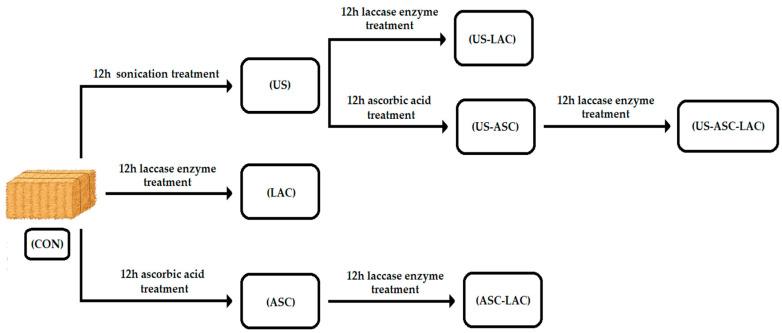
The development of reuse processes for plant by-products for both animal and human food offers numerous possibilities for quality-of-life improvements that align with a circular economy model. For this reason, we divided this study into two experiments. First, we designed a combined treatment consisting of laccase, ultrasound, and ascorbic acid to hydrolyze rice straw plant fibers and used the resulting feed as the basis for diets. Second, we formulated diets with different inclusion levels (0%, 25%, 50%, 75%, and 100%) of rice straw and treated rice straw to assess their impact on larvae growth and diet digestibility. For each treatment, six replicates were employed: four for the growth-performance-digestibility trial and two for complementary uric acid determination tests. The combined laccase enzyme, ultrasound, and ascorbic acid treatment hydrolyzed 13.2% of the vegetable fibers. The diets containing treated rice straw resulted in higher larvae weight and a better feed conversion ratio; however, reaching 100% by-product inclusion values led to similar results between both diets. In conclusion, these treatments improve the potential of low-nutritional-value vegetable by-products as part of a diet, opening the possibility of new methodologies for the use of recalcitrant vegetable by-products for insect rearing.
开发用于动物和人类食品的植物副产品再利用工艺,为改善生活质量提供了众多可能性,这与循环经济模式相契合。因此,我们将本研究分为两个实验。首先,我们设计了一种由漆酶、超声波和抗坏血酸组成的联合处理方法,用于水解稻草植物纤维,并将所得饲料作为日粮的基础。其次,我们配制了含有不同添加水平(0%、25%、50%、75%和100%)稻草和处理过的稻草的日粮,以评估它们对幼虫生长和日粮消化率的影响。对于每种处理,采用六个重复:四个用于生长性能-消化率试验,两个用于补充尿酸测定试验。漆酶、超声波和抗坏血酸联合处理水解了13.2%的植物纤维。含有处理过的稻草的日粮使幼虫体重更高,饲料转化率更好;然而,副产品添加量达到100%时,两种日粮的结果相似。总之,这些处理提高了低营养价值植物副产品作为日粮一部分的潜力,为使用顽固植物副产品进行昆虫饲养开辟了新方法的可能性。


 Zotero 插件