Tartaglione Donato, Prozzo Dario, Bianchi Renatomaria, Ciccarelli Giovanni, Cappelli Bigazzi Maurizio, Natale Francesco, Golino Paolo, Cimmino Giovanni
Vanvitelli Cardiology and Intensive Care Unit, Monaldi Hospital, 80131 Naples, Italy.
Cardiology Unit, Cardarelli Hospital, 80131 Naples, Italy.
Diseases. 2024 Aug 2;12(8):175. doi: 10.3390/diseases12080175.
Degenerative aortic valve stenosis (AS) is the most common valvular heart disease among the elderly. Once cardiac symptoms occur, current guidelines recommend aortic valve replacement. Progressive degeneration/calcification reduces leaflet mobility with gradual cardiac output (CO) impairment. Low CO might induce abnormal brain-aging with cognitive impairment and increased risk of dementia, such as Alzheimer's disease or vascular dementia. On the contrary, cognitive improvement has been reported in patients in whom CO was restored. Transcatheter aortic valve implantation (TAVI) has proven to be a safe alternative to conventional surgery, with a similar mid-term survival and stroke risk even in low-risk patients. TAVI is associated with an immediate CO improvement, also effecting the cerebrovascular system, leading to an increased cerebral blood flow. The correlation between TAVI and cognitive improvement is still debated. The present study aims at evaluating this relationship in a cohort of AS patients where cognitive assessment before and after TAVI was available.
a total of 47 patients were retrospectively selected. A transcranial Doppler ultrasound (TCD) before and after TAVI, a quality of life (QoL) score, as well as a mini-mental state examination (MMSE) at baseline and up to 36 months, were available.
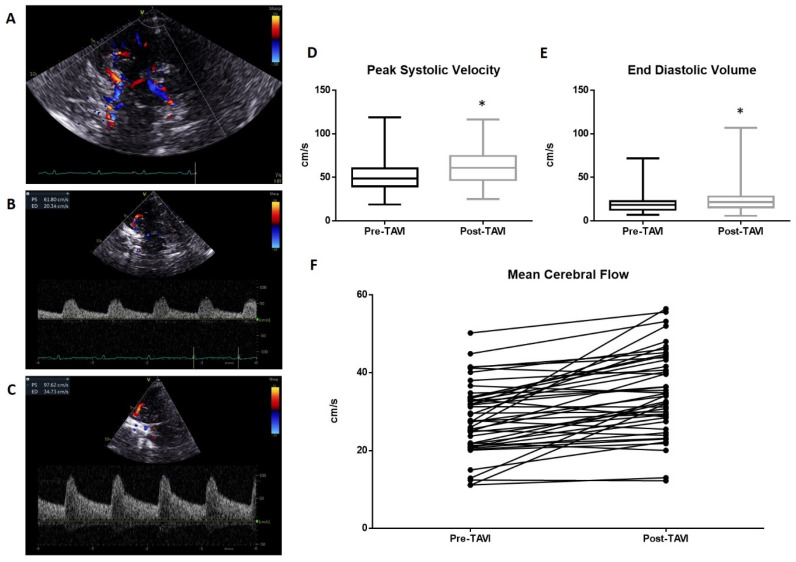
TAVI was associated with immediate increase in mean cerebral flow at TCD. MMSE slowly increase at 36-months follow-up with improved QoL mainly for symptoms, emotions and social interactions.
this proof-of-concept study indicates that TAVI might induce cognitive improvement in the long-term as a result of multiple factors, such as cerebral flow restoration and a better QoL.
退行性主动脉瓣狭窄(AS)是老年人中最常见的心脏瓣膜疾病。一旦出现心脏症状,当前指南推荐进行主动脉瓣置换。进行性退变/钙化会降低瓣叶活动度,导致心输出量(CO)逐渐受损。低心输出量可能会引发异常的脑老化,伴有认知障碍,并增加患痴呆症的风险,如阿尔茨海默病或血管性痴呆。相反,有报道称心输出量恢复的患者认知功能得到改善。经导管主动脉瓣植入术(TAVI)已被证明是传统手术的一种安全替代方法,即使在低风险患者中,其中期生存率和中风风险也相似。TAVI与心输出量的立即改善相关,这也会影响脑血管系统,导致脑血流量增加。TAVI与认知改善之间的相关性仍存在争议。本研究旨在评估一组有TAVI术前和术后认知评估的AS患者中的这种关系。
回顾性选取了47例患者。可获得TAVI术前和术后的经颅多普勒超声(TCD)、生活质量(QoL)评分,以及基线时和长达36个月的简易精神状态检查(MMSE)。
TAVI与TCD测得的平均脑血流量立即增加相关。在36个月的随访中,MMSE缓慢增加,生活质量主要在症状、情绪和社交互动方面得到改善。
这项概念验证研究表明,由于多种因素,如脑血流恢复和更好的生活质量,TAVI可能会在长期内诱导认知改善。