National Centre for Infectious Diseases, Singapore, Singapore.
Tan Tock Seng Hospital, Singapore, Singapore.
PLoS One. 2024 Aug 28;19(8):e0309089. doi: 10.1371/journal.pone.0309089. eCollection 2024.
The spread of Carbapenemase-producing Organisms (CPO) remains a major threat globally. Within clinical settings, the existing method of determining gene load involves traditional culture to determine bacterial load and polymerase-chain-reaction-based Xpert Carba-R Assay to determine carbapenemase gene type. However, there is a need for a fast and accurate method of quantifying CPO colonisation to study the risk of persistent CPO carriage.
This study evaluated the accuracy of Xpert Carba-R Ct value in estimating carbapenamase producing bacterial loads in stool samples.
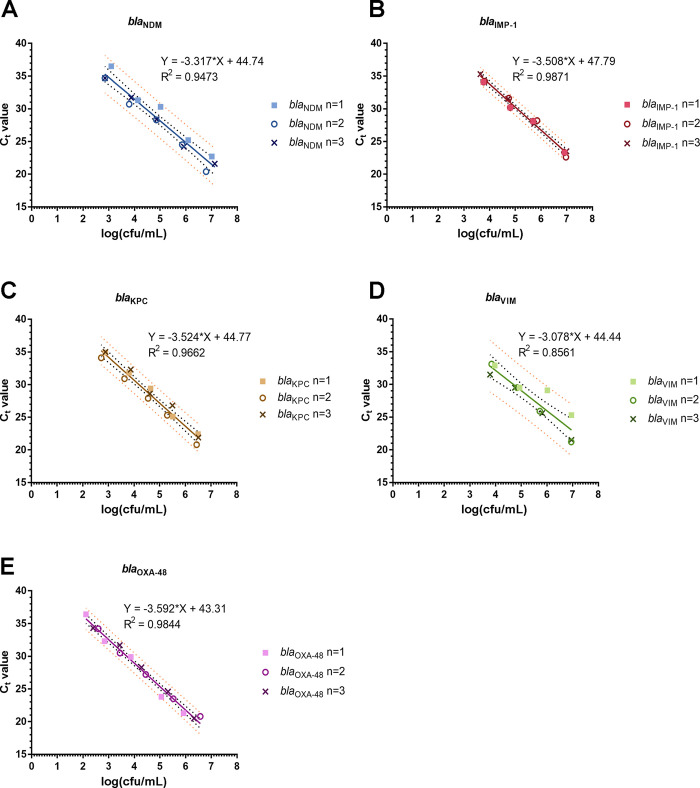
Stool samples were obtained from an ongoing study investigating the household transmission of CPO in Singapore. Stool samples lacking carbapenemase producing organisms were spiked with organism carrying a single carbapenemase gene (blaKPC, blaNDM, blaVIM, blaOXA-48(-like) or blaIMP-1) and serially diluted before being subjected to Xpert Carba-R assay and traditional culture. Standard curves with regression lines showing correlation between Ct values and plate counts were generated. The standard curves were validated with stool samples collected from patients.
The limit of detection of blaNDM, blaKPC, and blaOXA-48 was approximately 103 cfu/mL, while that of blaIMP-1 and blaVIM was approximately 104 cfu/mL. Validation of the blaNDM and blaOXA-48 curves revealed average delta values of 0.56 log(cfu/mL) (95% CI 0.24-0.88) and 0.80 log(cfu/mL) (95% CI 0.53-1.07), respectively.
Our validation data for stool positive for blaNDM and blaOXA-48-type suggests that bacterial loads can be estimated within a reasonable range of error.
碳青霉烯酶产生菌(CPO)的传播仍然是全球的主要威胁。在临床环境中,确定基因载量的现有方法包括传统培养以确定细菌载量和聚合酶链反应(PCR)基于 Xpert Carba-R 测定来确定碳青霉烯酶基因类型。然而,需要一种快速准确的方法来定量 CPO 定植以研究持续携带 CPO 的风险。
本研究评估了 Xpert Carba-R Ct 值在估计粪便样本中产生碳青霉烯酶的细菌负荷的准确性。
从新加坡正在进行的一项关于 CPO 家庭传播的研究中获得粪便样本。从缺乏碳青霉烯酶产生菌的粪便样本中提取含有单个碳青霉烯酶基因(blaKPC、blaNDM、blaVIM、blaOXA-48(类似)或 blaIMP-1)的菌,并在进行 Xpert Carba-R 检测和传统培养之前进行连续稀释。生成显示 Ct 值与平板计数之间相关性的标准曲线和回归线。使用从患者收集的粪便样本验证标准曲线。
blaNDM、blaKPC 和 blaOXA-48 的检测限约为 103 cfu/mL,而 blaIMP-1 和 blaVIM 的检测限约为 104 cfu/mL。blaNDM 和 blaOXA-48 曲线的验证显示平均 delta 值分别为 0.56 log(cfu/mL)(95% CI 0.24-0.88)和 0.80 log(cfu/mL)(95% CI 0.53-1.07)。
我们对 blaNDM 和 blaOXA-48 型粪便阳性样本的验证数据表明,可以在合理的误差范围内估计细菌载量。