Martín-Cerezuela María, Maya Gallegos Cristina, Marqués-Miñana María Remedios, Broch Porcar María Jesús, Cruz-Sánchez Andrés, Mateo-Pardo Juan Carlos, Peris Ribera José Esteban, Gimeno Ricardo, Castellanos-Ortega Álvaro, Poveda Andrés José Luis, Ramírez Galleymore Paula
Pharmacy Unit, Hospital Universitario y Politécnico La Fe, 46026 Valencia, Spain.
Intensive Care Unit, Hospital Universitario y Politécnico La Fe, 46026 Valencia, Spain.
Antibiotics (Basel). 2024 Jul 29;13(8):706. doi: 10.3390/antibiotics13080706.
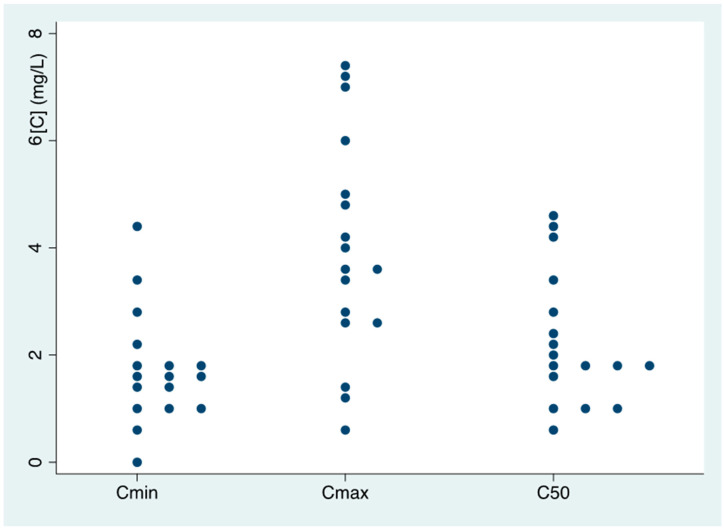
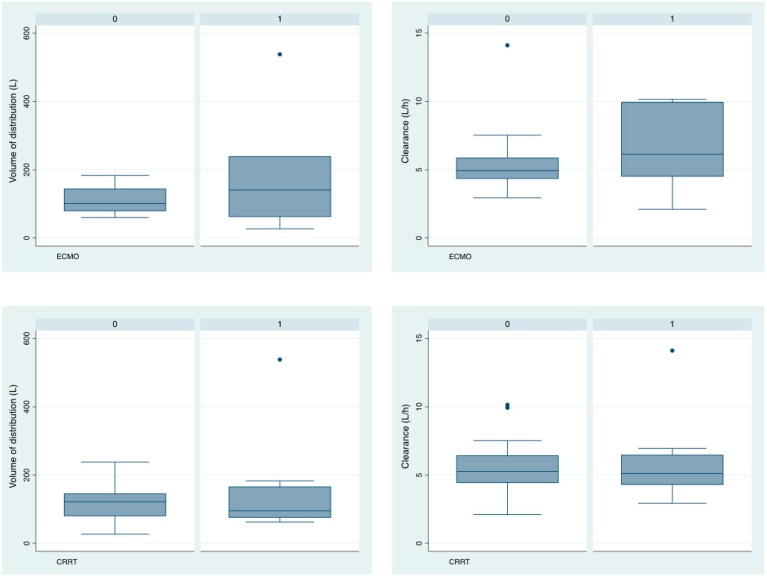
Isavuconazole is used to treat fungal infections. This study aims to describe isavuconazole pharmacokinetics in critically ill patients and evaluate their relationship with clinical efficacy and patient safety. We conducted a prospective, observational study in patients treated with intravenous isavuconazole. Samples were collected at predose (Cmin), 1 h (Cmax) and 12 h (C50) after the last dose. The plasma concentration was determined by high-performance liquid chromatography. The relationship between plasma concentration and clinical and microbiological outcomes and safety was evaluated. The influence of covariates (age, sex, weight, SAPS3, creatinine, liver enzymes and extracorporeal devices: continuous renal replacement therapy (CRRT) and extracorporeal membrane oxygenation (ECMO)) was analysed. Population pharmacokinetic modelling was performed using NONMEN. A total of 71 isavuconazole samples from 24 patients were analysed. The mean Cmin was 1.76 (1.02) mg/L; 87.5% reached the optimal therapeutic target and 12.5% were below 1 mg/L. Population pharmacokinetics were best described by a one-compartment model with first-order elimination. No factor had a significant impact on the plasma concentration or pharmacokinetic parameters. Thus, isavuconazole could be safely used in a critically ill population, even in those treated with CRRT and ECMO, from a pharmacokinetic standpoint. Therefore, routine therapeutic drug monitoring may not be strictly necessary in daily clinical practice.
艾沙康唑用于治疗真菌感染。本研究旨在描述艾沙康唑在重症患者中的药代动力学,并评估其与临床疗效和患者安全性的关系。我们对接受静脉注射艾沙康唑治疗的患者进行了一项前瞻性观察性研究。在末次给药前(Cmin)、给药后1小时(Cmax)和12小时(C50)采集样本。采用高效液相色谱法测定血浆浓度。评估血浆浓度与临床及微生物学结局和安全性之间的关系。分析协变量(年龄、性别、体重、序贯器官衰竭评估(SAPS3)、肌酐、肝酶和体外装置:持续肾脏替代治疗(CRRT)和体外膜肺氧合(ECMO))的影响。使用非线性混合效应模型(NONMEN)进行群体药代动力学建模。共分析了来自24例患者的71份艾沙康唑样本。平均Cmin为1.76(1.02)mg/L;87.5%达到最佳治疗靶点,12.5%低于1mg/L。群体药代动力学最好用具有一级消除的单室模型来描述。没有因素对血浆浓度或药代动力学参数有显著影响。因此,从药代动力学角度来看,艾沙康唑即使在接受CRRT和ECMO治疗的重症患者中也可安全使用。因此,在日常临床实践中可能并非严格需要进行常规治疗药物监测。