Graham Lara V, Khakoo Salim I, Blunt Matthew D
School of Clinical and Experimental Sciences, Faculty of Medicine, University of Southampton, Southampton SO16 6YD, UK.
Biomedicines. 2024 Jul 25;12(8):1667. doi: 10.3390/biomedicines12081667.
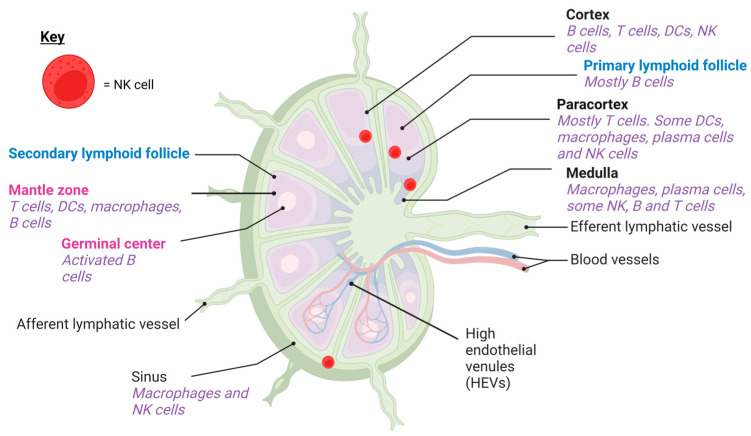
The lymph nodes are vital to enable adaptive immune responses to infection. Natural killer (NK) cells are cytotoxic lymphocytes that directly kill cancer cells and modulate the activation of other immune cells during anti-tumour immune response. NK cells in the lymph nodes are involved in the regulation of T-cell and B-cell populations and the clearance of viral infections. In solid tumours, lymph nodes are a frequent site of metastasis and immune cell priming, whilst in haematological malignancies, tumour cells can proliferate in the lymph nodes. Thus, lymph nodes are an important site in anti-tumour immunity and therapy resistance. It is therefore crucial to identify strategies to increase recruitment and overcome suppression of NK cells in the lymph node microenvironment to improve tumour clearance. In this review, we summarise the literature interrogating NK cell phenotype and function in the lymph nodes in the context of infection and cancer and evaluate both current and potential strategies to mobilise and activate NK cells within the lymph nodes of cancer patients.
淋巴结对于引发针对感染的适应性免疫反应至关重要。自然杀伤(NK)细胞是一种细胞毒性淋巴细胞,可直接杀死癌细胞,并在抗肿瘤免疫反应中调节其他免疫细胞的激活。淋巴结中的NK细胞参与T细胞和B细胞群体的调节以及病毒感染的清除。在实体瘤中,淋巴结是转移和免疫细胞启动的常见部位,而在血液系统恶性肿瘤中,肿瘤细胞可在淋巴结中增殖。因此,淋巴结是抗肿瘤免疫和治疗抵抗的重要部位。因此,确定增加NK细胞募集并克服淋巴结微环境中NK细胞抑制的策略以改善肿瘤清除至关重要。在本综述中,我们总结了在感染和癌症背景下研究淋巴结中NK细胞表型和功能的文献,并评估了当前和潜在的策略,以在癌症患者的淋巴结中动员和激活NK细胞。