School of Dentistry, University of Dundee, Dundee DD1 4HR, UK.
Int J Mol Sci. 2024 Aug 12;25(16):8777. doi: 10.3390/ijms25168777.
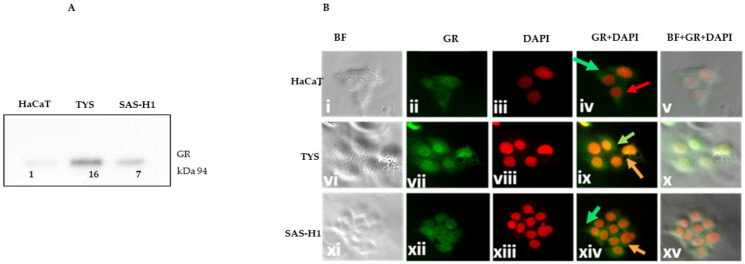
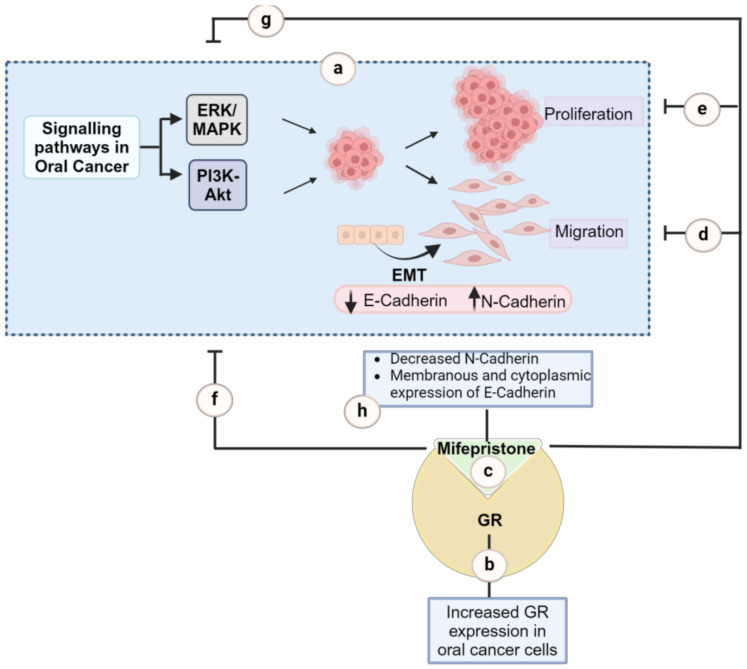
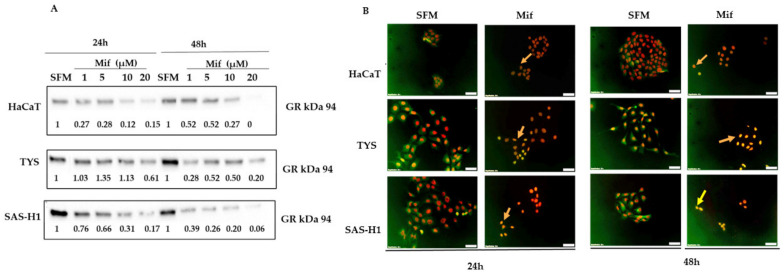
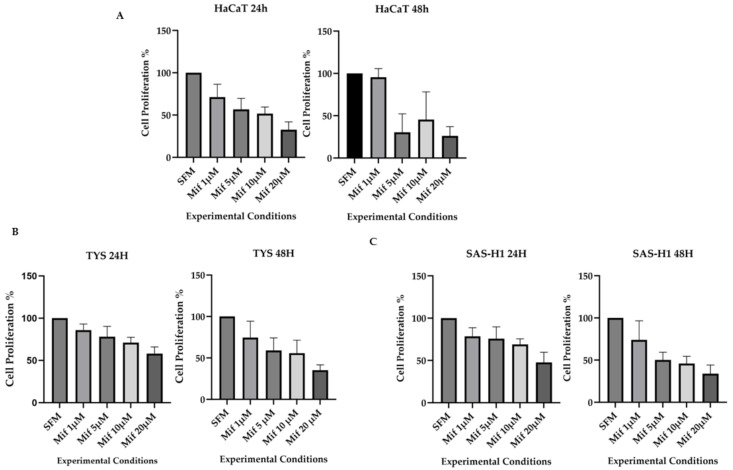
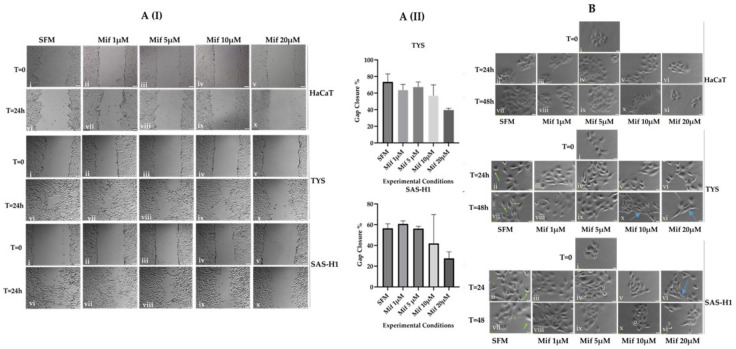
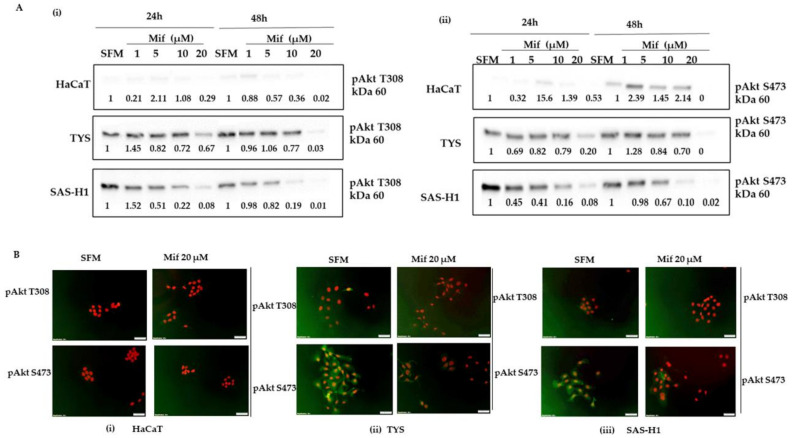
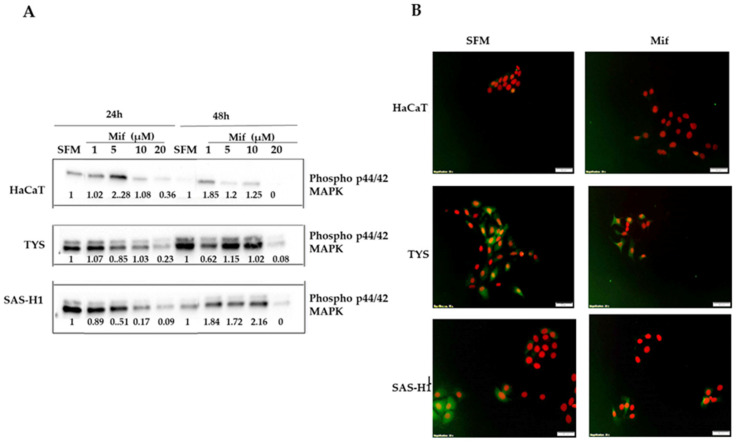
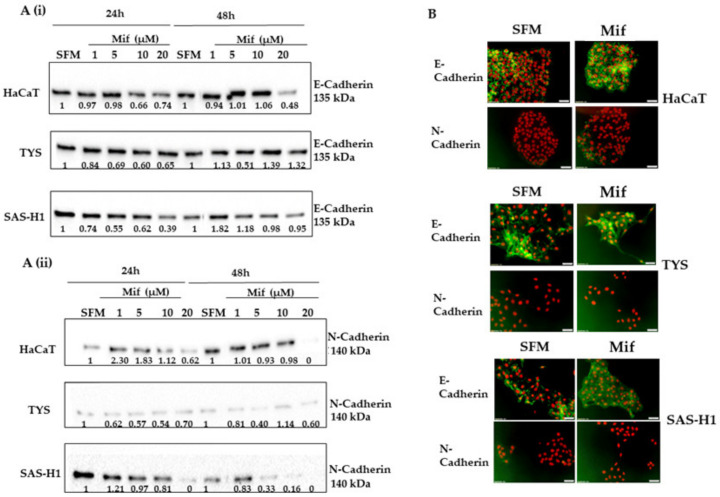
Glucocorticoid receptor (GR) overexpression has been linked to increased tumour aggressiveness and treatment resistance. GR antagonists have been shown to enhance treatment effectiveness. Emerging research has investigated mifepristone, a GR antagonist, as an anticancer agent with limited research in the context of oral cancer. This study investigated the effect of mifepristone at micromolar (µM) concentrations of 1, 5, 10 and 20 on the proliferation and migration of oral cancer cells, at 24 and 48 h. Scratch and scatter assays were utilised to assess cell migration, MTT assays were used to measure cell proliferation, Western blotting was used to investigate the expression of GR and the activation of underlying Phosphoinositide 3-kinase (PI3K)/protein kinase B (Akt) and mitogen-activated protein kinase (MAPK) signalling pathways, and immunofluorescence (IF) was used to determine the localisation of proteins in HaCaT (immortalised human skin keratinocytes), TYS (oral adeno squamous cell carcinoma), and SAS-H1 cells (squamous cell carcinoma of human tongue). Mifepristone resulted in a dose-dependent reduction in the proliferation of HaCaT, TYS, and SAS-H1 cells. Mifepristone at a concentration of 20 µM effectively reduced collective migration and scattering of oral cancer cells, consistent with the suppression of the PI3K-Akt and MAPK signalling pathways, and reduced expression of N-Cadherin. An elongated cell morphology was, however, observed, which may be linked to the localisation pattern of E-Cadherin in response to mifepristone. Overall, this study found that a high concentration of mifepristone was effective in the suppression of migration and proliferation of oral cancer cells via the inhibition of PI3K-Akt and MAPK signalling pathways. Further investigation is needed to define its impact on epithelial-mesenchymal transition (EMT) markers.
糖皮质激素受体 (GR) 过表达与肿瘤侵袭性和治疗耐药性增加有关。GR 拮抗剂已被证明可以增强治疗效果。新的研究调查了米非司酮,一种 GR 拮抗剂,作为一种抗癌药物,在口腔癌方面的研究有限。本研究调查了米非司酮在微摩尔(µM)浓度为 1、5、10 和 20 时对口腔癌细胞增殖和迁移的影响,在 24 和 48 小时。划痕和散射实验用于评估细胞迁移,MTT 实验用于测量细胞增殖,Western blot 用于研究 GR 的表达和潜在的 Phosphoinositide 3-kinase (PI3K)/protein kinase B (Akt) 和 mitogen-activated protein kinase (MAPK) 信号通路的激活,免疫荧光 (IF) 用于确定蛋白质在 HaCaT(永生化人皮肤角质形成细胞)、TYS(口腔腺样鳞状细胞癌)和 SAS-H1 细胞(人舌鳞状细胞癌)中的定位。米非司酮导致 HaCaT、TYS 和 SAS-H1 细胞增殖呈剂量依赖性降低。浓度为 20 µM 的米非司酮有效降低了口腔癌细胞的集体迁移和散射,与 PI3K-Akt 和 MAPK 信号通路的抑制以及 N-Cadherin 表达减少一致。然而,观察到伸长的细胞形态,这可能与米非司酮对 E-Cadherin 的定位模式有关。总的来说,这项研究发现,高浓度的米非司酮通过抑制 PI3K-Akt 和 MAPK 信号通路,有效地抑制了口腔癌细胞的迁移和增殖。需要进一步研究来确定其对上皮-间充质转化 (EMT) 标志物的影响。