Institute of Animal Sciences, Chinese Academy of Agricultural Sciences, Beijing 100080, China.
College of Animal Science and Technology, Qingdao Agricultural University, Qingdao 266109, China.
Int J Mol Sci. 2024 Aug 15;25(16):8890. doi: 10.3390/ijms25168890.
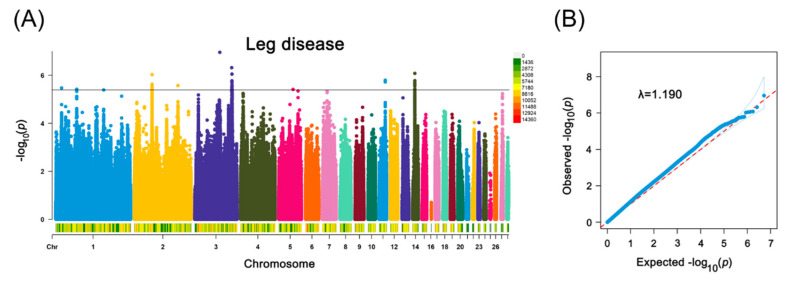
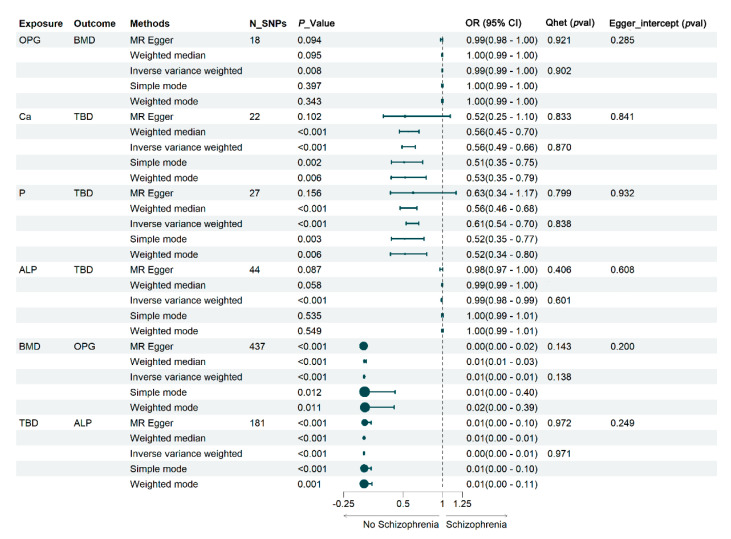
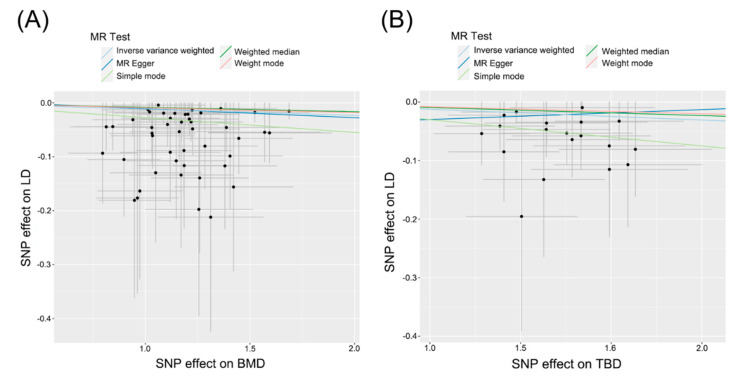
Clinical investigations have highlighted disruptions in bone metabolic processes and abnormal fluctuations in serum indicator levels during the onset of leg disease (LD) in broilers. However, the presence of a genetic causal relationship for this association remains undetermined. Therefore, the aim of this study is to discern the risk factors underlying LD development using 1235 sequenced white-feathered broilers. We employed Mendelian randomization (MR) analysis to assess the associations of bone strength (BS), bone mineral density (BMD), tibial bone weight (TBW), tibial bone length (TBL), tibial bone diameter (TBD), bone ash (BA), ash calcium (Ash Ca), ash phosphorus (Ash P), serum calcium (Ca), serum phosphorus (P), serum alkaline phosphatase (ALP), and serum osteoprotegerin (OPG) with the incidence of LD. Compelling evidence underscores a causal link between the risk of developing LD and decreased BMD (odds ratio (OR) = 0.998; 95% CI: 0.983, 0.993; < 0.001) and narrower TBD (OR = 0.985, 95% CI: 0.975, 0.994, = 0.002). Additionally, serum OPG concentrations (OR: 0.995, 95% CI: 0.992, 0.999, = 0.008) were associated with BMD (OR = 0.0078, 95% CI = 0.0043 to 0.0140, < 0.001), indicating a robust genetic relationship between ALP concentrations (OR: 0.988, 95% CI: 0.984, 0.993, < 0.001) and TBD (OR = 0.0046, 95% CI = 0.0026, 0.0083, < 0.001). Moreover, elevated serum Ca (OR: 0.564, 95% CI: 0.487, 0.655, < 0.001) and P (OR: 0.614, 95% CI: 0.539, 0.699, < 0.001) levels were associated with a narrower TBD. Elevated serum levels of Ca, P, ALP, and OPG contribute to disturbances in bone metabolism, while decreased BMD and narrower TBD are associated with a greater risk of developing LD in broilers. This discovery elucidates the metabolic risk factors for LD in broilers and could provide information on LDs, such as osteoporosis, in humans.
临床研究已经强调了在肉鸡腿部疾病(LD)发病过程中骨代谢过程的中断和血清指标水平的异常波动。然而,这种关联是否存在遗传因果关系仍未确定。因此,本研究的目的是使用 1235 只白羽肉鸡来识别 LD 发展的风险因素。我们采用孟德尔随机化(MR)分析来评估骨强度(BS)、骨密度(BMD)、胫骨重量(TBW)、胫骨长度(TBL)、胫骨直径(TBD)、骨灰分(BA)、灰分钙(Ash Ca)、灰分磷(Ash P)、血清钙(Ca)、血清磷(P)、血清碱性磷酸酶(ALP)和血清护骨素(OPG)与 LD 发生率之间的关联。强有力的证据表明,LD 发病风险与较低的 BMD(比值比(OR)=0.998;95%可信区间:0.983,0.993;<0.001)和更窄的 TBD(OR=0.985,95%可信区间:0.975,0.994,=0.002)之间存在因果关系。此外,血清 OPG 浓度(OR:0.995,95%可信区间:0.992,0.999,=0.008)与 BMD 相关(OR=0.0078,95%可信区间=0.0043 至 0.0140,<0.001),表明 ALP 浓度(OR:0.988,95%可信区间:0.984,0.993,<0.001)和 TBD(OR=0.0046,95%可信区间=0.0026,0.0083,<0.001)之间存在强有力的遗传关系。此外,血清 Ca(OR:0.564,95%可信区间:0.487,0.655,<0.001)和 P(OR:0.614,95%可信区间:0.539,0.699,<0.001)水平升高与更窄的 TBD 相关。血清 Ca、P、ALP 和 OPG 水平升高导致骨代谢紊乱,而 BMD 降低和 TBD 变窄与肉鸡发生 LD 的风险增加有关。这一发现阐明了肉鸡 LD 的代谢风险因素,并为人类的骨质疏松症等 LD 提供了信息。