Department of Virology, Instituto de Microbiologia Paulo de Góes, Universidade Federal do Rio de Janeiro (UFRJ), Rio de Janeiro 21941-902, Brazil.
Instituto de Ciências Biomédicas, Universidade Federal do Rio de Janeiro (UFRJ), Rio de Janeiro 21941-902, Brazil.
Int J Mol Sci. 2024 Aug 16;25(16):8909. doi: 10.3390/ijms25168909.
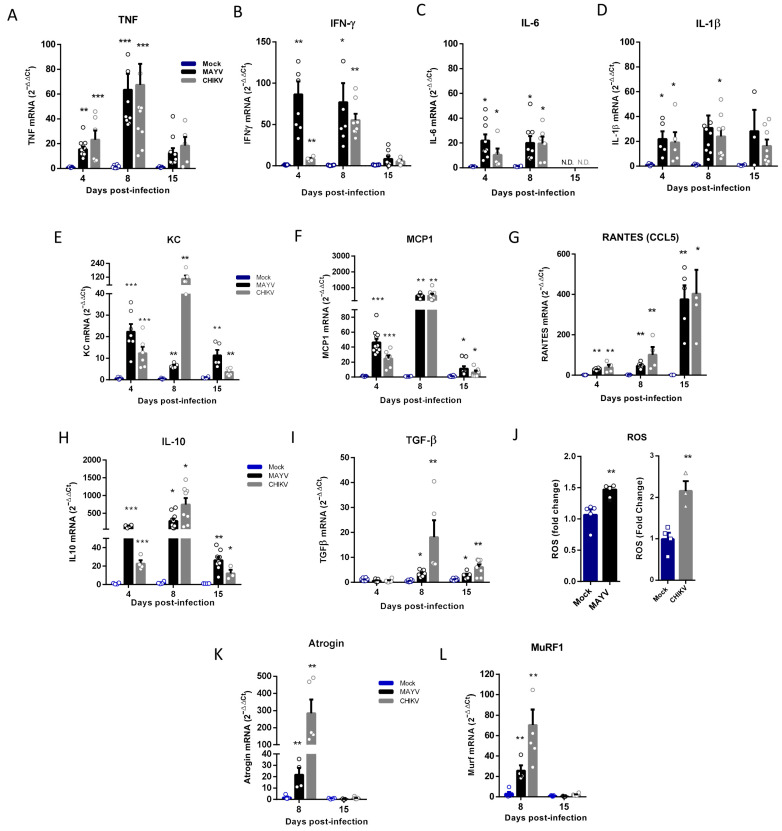
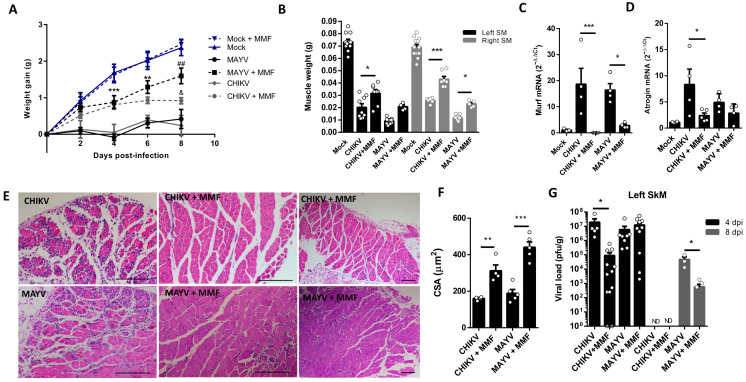
Chikungunya (CHIKV) and Mayaro (MAYV) viruses are arthritogenic alphaviruses that promote an incapacitating and long-lasting inflammatory muscle-articular disease. Despite studies pointing out the importance of skeletal muscle (SkM) in viral pathogenesis, the long-term consequences on its physiology and the mechanism of persistence of symptoms are still poorly understood. Combining molecular, morphological, nuclear magnetic resonance imaging, and histological analysis, we conduct a temporal investigation of CHIKV and MAYV replication in a wild-type mice model, focusing on the impact on SkM composition, structure, and repair in the acute and late phases of infection. We found that viral replication and induced inflammation promote a rapid loss of muscle mass and reduction in fiber cross-sectional area by upregulation of muscle-specific E3 ubiquitin ligases MuRF1 and Atrogin-1 expression, both key regulators of SkM fibers atrophy. Despite a reduction in inflammation and clearance of infectious viral particles, SkM atrophy persists until 30 days post-infection. The genomic CHIKV and MAYV RNAs were still detected in SkM in the late phase, along with the upregulation of chemokines and anti-inflammatory cytokine expression. In agreement with the involvement of inflammatory mediators on induced atrophy, the neutralization of TNF and a reduction in oxidative stress using monomethyl fumarate, an agonist of Nrf2, decreases atrogen expression and atrophic fibers while increasing weight gain in treated mice. These data indicate that arthritogenic alphavirus infection could chronically impact body SkM composition and also harm repair machinery, contributing to a better understanding of mechanisms of arthritogenic alphavirus pathogenesis and with a description of potentially new targets of therapeutic intervention.
基孔肯雅热(CHIKV)和马亚罗(MAYV)病毒是致关节炎的甲病毒,可引起使人丧失能力和持久的炎症性肌肉关节疾病。尽管有研究指出骨骼肌(SkM)在病毒发病机制中的重要性,但对其生理学的长期影响以及症状持续存在的机制仍知之甚少。我们结合分子、形态学、磁共振成像和组织学分析,在野生型小鼠模型中对 CHIKV 和 MAYV 的复制进行了时间性研究,重点研究了其对 SkM 组成、结构和感染急性和晚期修复的影响。我们发现,病毒复制和诱导的炎症通过上调肌肉特异性 E3 泛素连接酶 MuRF1 和 Atrogin-1 的表达,促进肌肉质量的快速丧失和纤维横截面积的减少,这两种蛋白都是 SkM 纤维萎缩的关键调节因子。尽管炎症减轻和传染性病毒颗粒清除,但 SkM 萎缩仍持续到感染后 30 天。在晚期,SkM 中仍检测到基因组 CHIKV 和 MAYV RNA,同时趋化因子和抗炎细胞因子的表达上调。与炎症介质参与诱导萎缩一致,使用 TNF 中和抗体和 Nrf2 激动剂富马酸单甲酯减轻氧化应激,可降低肌萎缩基因的表达和萎缩纤维,同时增加治疗小鼠的体重增加。这些数据表明,致关节炎的甲病毒感染可能会长期影响机体 SkM 的组成,并损害修复机制,有助于更好地理解致关节炎的甲病毒发病机制的机制,并描述潜在的新治疗干预靶点。