Lee Chung-Lin, Chuang Chih-Kuang, Chen Ming-Ren, Lin Ju-Li, Chiu Huei-Ching, Chang Ya-Hui, Tu Yuan-Rong, Lo Yun-Ting, Lin Hsiang-Yu, Lin Shuan-Pei
Department of Pediatrics, MacKay Memorial Hospital, Taipei 10449, Taiwan.
Institute of Clinical Medicine, National Yang-Ming Chiao-Tung University, Taipei 112304, Taiwan.
Diagnostics (Basel). 2024 Aug 20;14(16):1815. doi: 10.3390/diagnostics14161815.
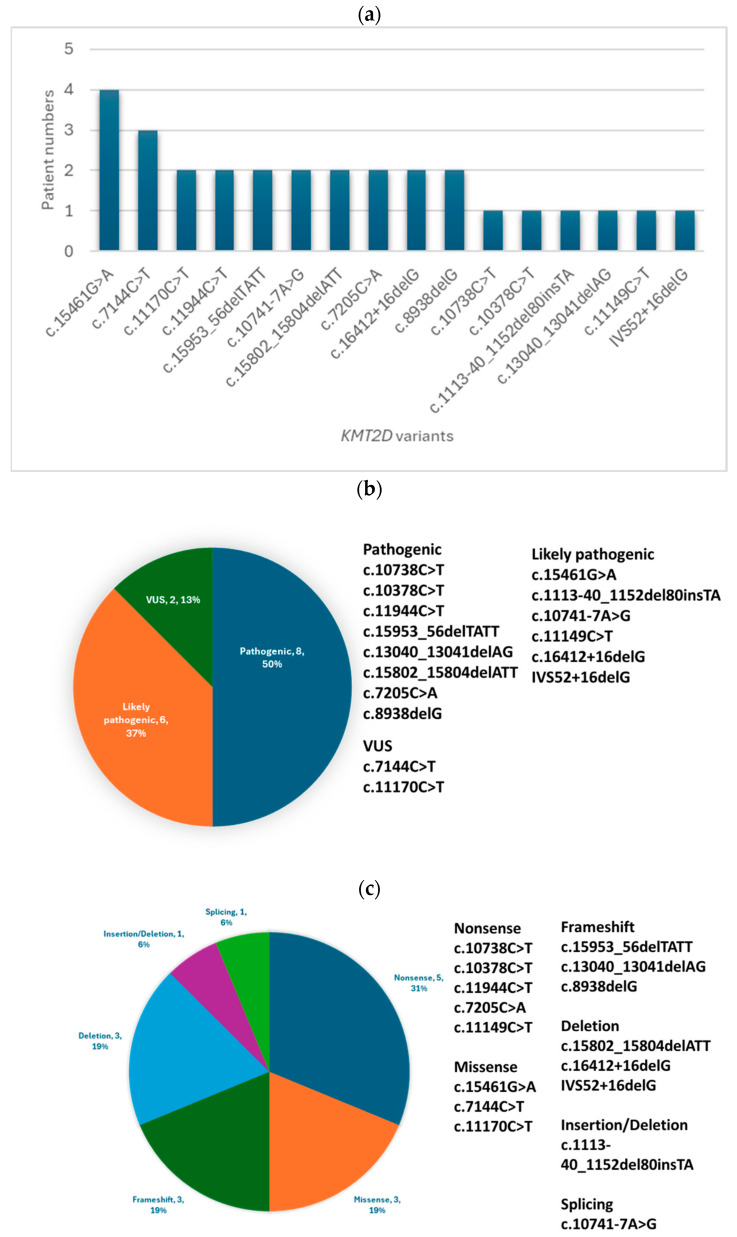
Kabuki syndrome (KS) is a rare genetic disorder characterized by distinct facial features, intellectual disability, and multiple congenital anomalies. We conducted a comprehensive analysis of the genetic and phenotypic spectrum of KS in a Taiwanese patient group of 23 patients. variants were found in 22 individuals, with missense (26.1%), nonsense (21.7%), and frameshift (17.4%) variants being the most prevalent. One patient had a variant of uncertain significance. The most common clinical characteristics included distinct facial features (100%), intellectual disability (100%), developmental delay (95.7%), speech delay (78.3%), hypotonia (69.6%), congenital heart abnormalities (69.6%), and recurrent infections (65.2%). Other abnormalities included hearing loss (39.1%), seizures (26.1%), cleft palate (26.1%), and renal anomalies (21.7%). This study broadens the mutational and phenotypic spectrum of KS in the Taiwanese population, highlighting the importance of comprehensive genetic testing and multidisciplinary clinical evaluations for diagnosis and treatment.
歌舞伎综合征(KS)是一种罕见的遗传性疾病,其特征为独特的面部特征、智力残疾和多种先天性异常。我们对23名台湾患者组成的队列进行了KS遗传和表型谱的综合分析。在22名个体中发现了变异,其中错义变异(26.1%)、无义变异(21.7%)和移码变异(17.4%)最为常见。一名患者有一个意义未明的变异。最常见的临床特征包括独特的面部特征(100%)、智力残疾(100%)、发育迟缓(95.7%)、语言迟缓(78.3%)、肌张力减退(69.6%)、先天性心脏异常(69.6%)和反复感染(65.2%)。其他异常包括听力损失(39.1%)、癫痫发作(26.1%)、腭裂(26.1%)和肾脏异常(21.7%)。本研究拓宽了台湾人群中KS的突变和表型谱,突出了全面基因检测和多学科临床评估对诊断和治疗的重要性。