Department of Microbiology, Genetics and Immunology, Michigan State University, East Lansing, MI 48824, USA.
Department of Small Animal Clinical Sciences, Michigan State University, East Lansing, MI 48824, USA.
Genes (Basel). 2024 Aug 9;15(8):1050. doi: 10.3390/genes15081050.
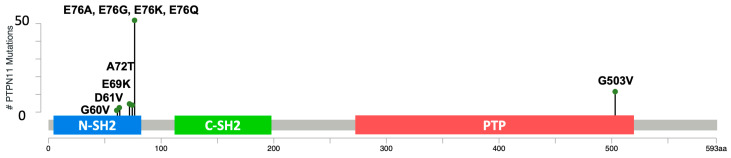
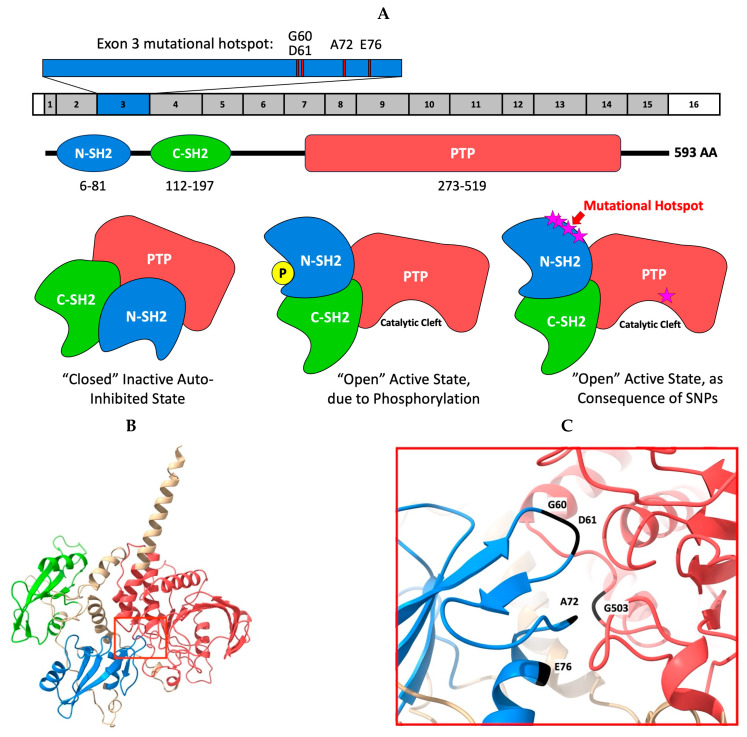
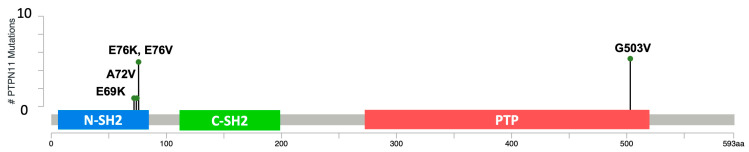
Histiocytic sarcoma (HS) is a rare and highly aggressive cancer in humans and dogs. In dogs, it has a high prevalence in certain breeds, such as Bernese mountain dogs (BMDs) and flat-coated retrievers. Hemophagocytic histiocytic sarcoma (HHS) is a unique form of HS that presents with erythrophagocytosis. Due to its rareness, the study of HHS is very limited, and mutations in canine HHS patients have not been studied to date. In previous work, our research group identified two major /SHP2 driver mutations, E76K and G503V, in HS in dogs. Here, we report additional mutations located in exon 3 of /SHP2 in both HS and HHS cases, further supporting that this area is a mutational hotspot in dogs and that mutations in tumors and liquid biopsies should be evaluated utilizing comprehensive methods such as Sanger and NextGen sequencing. The overall prevalence of /SHP2 mutations was 55.8% in HS and 46.2% in HHS. In addition, we identified mutations in , in about 3% of HS and 4% of HHS cases. These findings point to the shared molecular pathology of activation of the MAPK pathway in HS and HHS cases. We evaluated the efficacy of the highly specific MEK inhibitor, cobimetinib, in canine HS and HHS cell lines. We found that the IC values ranged from 74 to 372 nM, which are within the achievable and tolerable ranges for cobimetinib. This finding positions cobimetinib as a promising potential candidate for future canine clinical trials and enhances our understanding of the molecular defects in these challenging cancers.
组织细胞肉瘤(HS)是一种在人类和犬类中罕见且高度侵袭性的癌症。在犬类中,某些品种如伯恩山犬(BMD)和平毛寻回猎犬,HS 的患病率较高。噬血细胞性组织细胞肉瘤(HHS)是一种独特的 HS 形式,表现为红细胞吞噬作用。由于其罕见性,对 HHS 的研究非常有限,迄今为止尚未研究犬 HHS 患者的突变。在之前的工作中,我们的研究小组在犬 HS 中鉴定出两个主要的 /SHP2 驱动突变,E76K 和 G503V。在这里,我们报告了在 HS 和 HHS 病例中 /SHP2 外显子 3 中发现的其他突变,进一步支持该区域是犬中突变的热点,并且肿瘤和液体活检中的突变应利用 Sanger 和 NextGen 测序等综合方法进行评估。/SHP2 突变在 HS 中的总体患病率为 55.8%,在 HHS 中的患病率为 46.2%。此外,我们在约 3%的 HS 和 4%的 HHS 病例中发现了 突变。这些发现表明 MAPK 途径激活的共同分子病理学存在于 HS 和 HHS 病例中。我们评估了高度特异性 MEK 抑制剂 cobimetinib 在犬 HS 和 HHS 细胞系中的疗效。我们发现 IC 值范围为 74 至 372 nM,这在 cobimetinib 的可实现和可耐受范围内。这一发现使 cobimetinib 成为未来犬科临床试验的有前途的候选药物,并增强了我们对这些具有挑战性的癌症中分子缺陷的理解。