Department of Pharmaceutical Biology, Institute of Pharmacy, Freie Universität Berlin, Königin-Luise-Straße 2+4, 14195 Berlin, Germany.
Department of Pharmaceutical and Medicinal Chemistry, Institute of Pharmacy, Freie Universität Berlin, Königin-Luise-Straße 2+4, 14195 Berlin, Germany.
Molecules. 2024 Aug 22;29(16):3975. doi: 10.3390/molecules29163975.
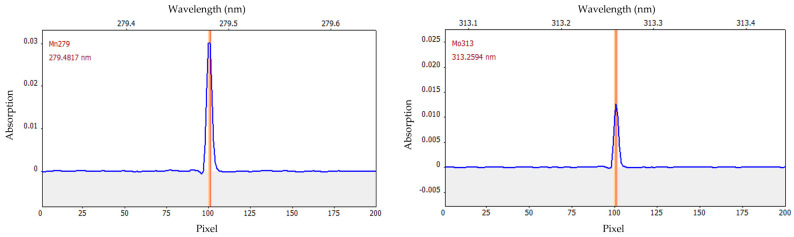
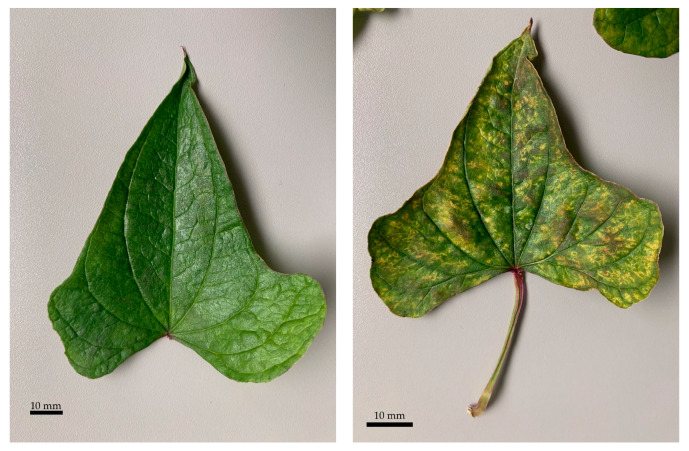
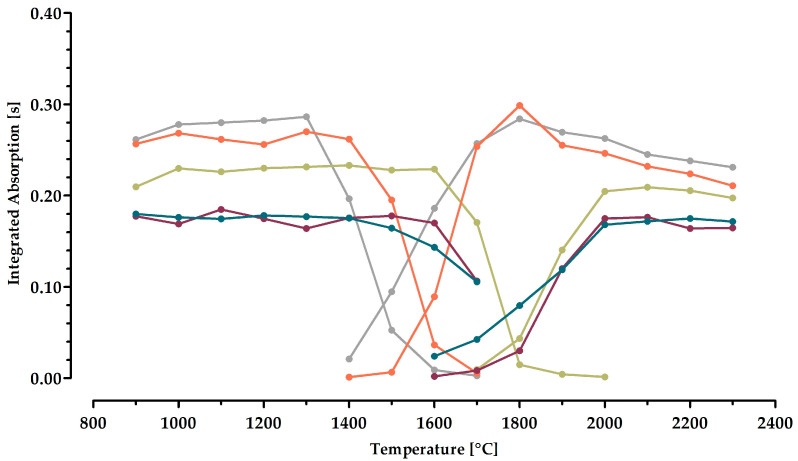
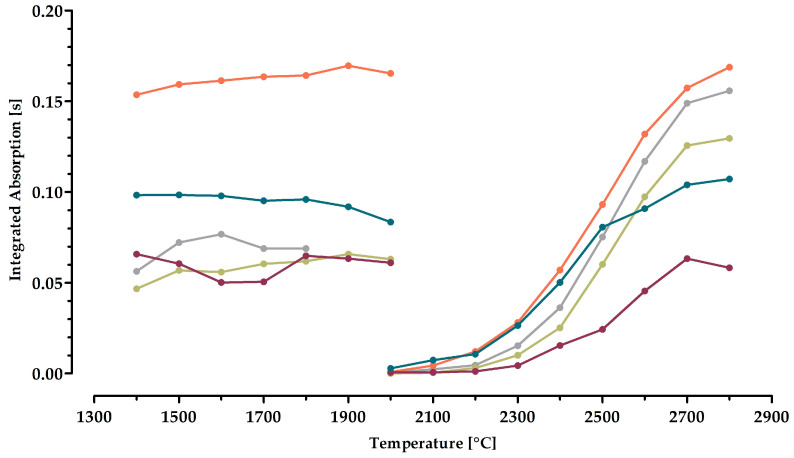
The Chinese yam (, DP) is promising for the food and pharmaceutical industries due to its nutritional value and pharmaceutical potential. Its proper cultivation is therefore of interest. An insufficient supply of minerals necessary for plant growth can be manifested by discoloration of the leaves. In our earlier study, magnesium deficiency was excluded as a cause. As a follow-up, this work focused on manganese and molybdenum. To quantify both minerals in leaf extracts of DP, analytical methods based on atomic absorption spectrometry (AAS) using the graphite furnace sub-technique were devised. The development revealed that the quantification of manganese works best without using any of the investigated modifiers. The optimized pyrolysis and atomization temperatures were 1300 °C and 1800 °C, respectively. For the analysis of molybdenum, calcium proved to be advantageous as a modifier. The optimum temperatures were 1900 °C and 2800 °C, respectively. Both methods showed satisfactory linearity for analysis. Thus, they were applied to quantify extracts from normal and discolored leaves of DP concerning the two minerals. It was found that discolored leaves had higher manganese levels and a lower molybdenum content. With these results, a potential explanation for the discoloration could be found.
由于山药具有营养价值和药用潜力,因此在食品和制药行业有很大的发展前景。因此,对其进行适当的种植很有意义。如果植物生长所需的矿物质供应不足,就会表现为叶片变色。在我们之前的研究中,已经排除了镁缺乏是造成这种现象的原因。作为后续研究,本工作重点关注锰和钼。为了定量分析山药叶片提取物中的这两种矿物质,我们设计了基于原子吸收光谱法(AAS)并使用石墨炉技术的分析方法。研究结果表明,在不使用任何研究中的修饰剂的情况下,锰的定量分析效果最佳。最佳的热解和原子化温度分别为 1300°C 和 1800°C。对于钼的分析,钙被证明是一种有利的修饰剂。最佳温度分别为 1900°C 和 2800°C。两种方法的分析均表现出良好的线性关系。因此,我们应用这两种方法对正常和变色的山药叶片提取物中的这两种矿物质进行了定量分析。结果发现,变色叶片的锰含量较高,钼含量较低。有了这些结果,就可以对叶片变色的原因做出一个合理的解释。