
基于深度强化学习的无线时间敏感网络自适应调度
Deep Reinforcement Learning-Based Adaptive Scheduling for Wireless Time-Sensitive Networking.
作者信息
Kim Hanjin, Kim Young-Jin, Kim Won-Tae
机构信息
Future Convergence Engineering Major, Department of Computer Science and Engineering, Korea University of Technology and Education, Cheonan-si 31253, Republic of Korea.
Department of Artificial Intelligence Big Data, Sehan University, Dangjin-si 31746, Republic of Korea.
出版信息
Sensors (Basel). 2024 Aug 15;24(16):5281. doi: 10.3390/s24165281.
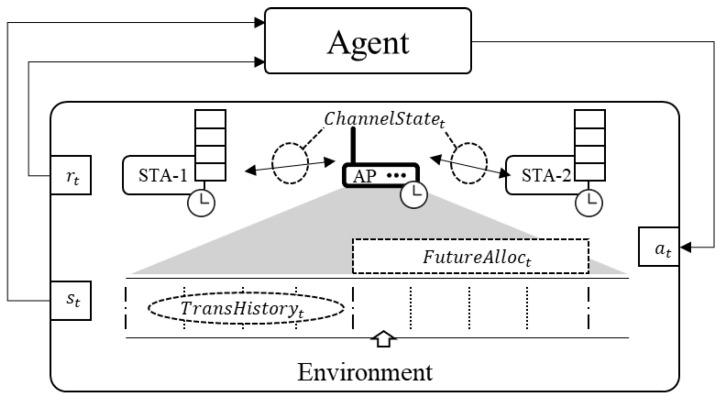
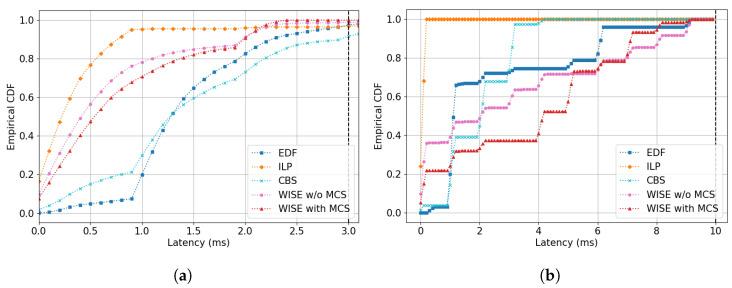
Time-sensitive networking (TSN) technologies have garnered attention for supporting time-sensitive communication services, with recent interest extending to the wireless domain. However, adapting TSN to wireless areas faces challenges due to the competitive channel utilization in IEEE 802.11, necessitating exclusive channels for low-latency services. Additionally, traditional TSN scheduling algorithms may cause significant transmission delays due to dynamic wireless characteristics, which must be addressed. This paper proposes a wireless TSN model of IEEE 802.11 networks for the exclusive channel access and a novel time-sensitive traffic scheduler, named the wireless intelligent scheduler (WISE), based on deep reinforcement learning. We designed a deep reinforcement learning (DRL) framework to learn the repetitive transmission patterns of time-sensitive traffic and address potential latency issues from changing wireless conditions. Within this framework, we identified the most suitable DRL model, presenting the WISE algorithm with the best performance. Experimental results indicate that the proposed mechanisms meet up to 99.9% under the various wireless communication scenarios. In addition, they show that the processing delay is successfully limited within the specific time requirements and the scalability of TSN streams is guaranteed by the proposed mechanisms.
时间敏感网络(TSN)技术因支持时间敏感通信服务而受到关注,最近其应用范围已扩展到无线领域。然而,由于IEEE 802.11中存在竞争性信道利用,将TSN应用于无线领域面临挑战,这就需要为低延迟服务提供专用信道。此外,由于动态无线特性,传统的TSN调度算法可能会导致显著的传输延迟,必须加以解决。本文提出了一种用于IEEE 802.11网络专用信道接入的无线TSN模型,以及一种基于深度强化学习的新型时间敏感流量调度器,即无线智能调度器(WISE)。我们设计了一个深度强化学习(DRL)框架,以学习时间敏感流量的重复传输模式,并解决因无线条件变化而产生的潜在延迟问题。在此框架内,我们确定了最合适的DRL模型,提出了性能最佳的WISE算法。实验结果表明,所提出的机制在各种无线通信场景下的成功率高达99.9%。此外,结果还表明,所提出的机制成功地将处理延迟限制在特定的时间要求内,并保证了TSN流的可扩展性。




 Zotero 插件