Li Yifei, Zhang Jie, Li Juan, Chen Yiping, Zhang Jingping, Zuo Man
Xiangya Nursing School of Central South University, Changsha, Hunan, China.
Hunan University of Chinese Medicine, Changsha, Hunan, China.
Front Psychol. 2024 Aug 14;15:1361281. doi: 10.3389/fpsyg.2024.1361281. eCollection 2024.
This study aimed to understand the consciousness of gender equality among school-aged children in China and its influencing factors using structural equation modeling to explore the pathways, intensity and group differences among these factors.
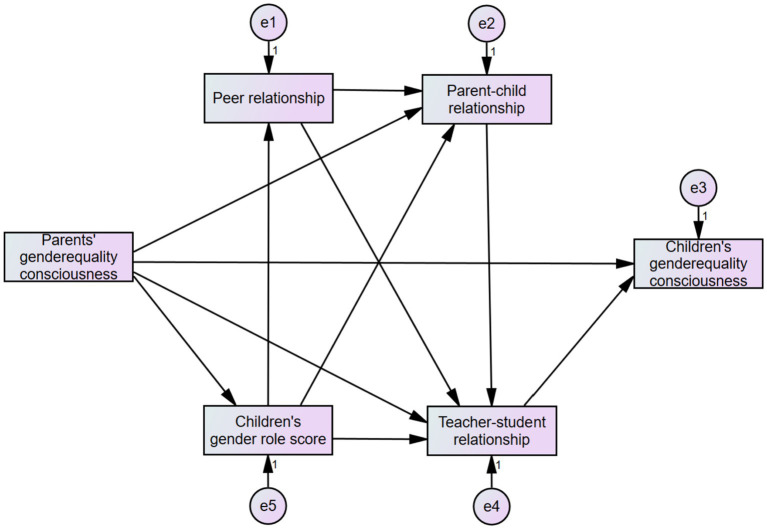
A cross-sectional survey was conducted using stratified random whole-group sampling of primary school students in grades 1-6 and their parents who met the inclusion and exclusion criteria. In this study, 1,312 valid questionnaires were collected from a total of 1,500 school-aged children in Hunan Province, China (effective response rate of 87.5%). Statistical analysis was conducted using SPSS 26.0 and AMOS 24.0 software. Statistical inference consisted of -tests, analysis of variance, the LSD test, Pearson correlation analysis, multiple stepwise linear regression analysis and structural equation modeling.
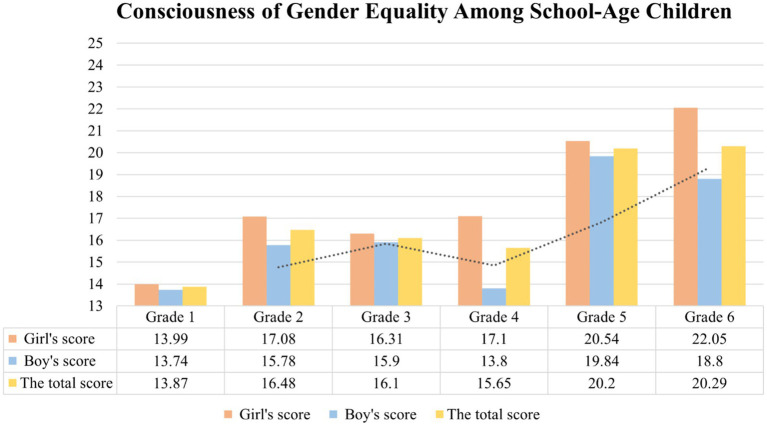
School-aged children had the lowest consciousness of gender equality in the area of occupation and relatively higher consciousness in the areas of family and school. Children's age, gender, gender role, parent-child relationship, teacher-student relationship and parents' gender equality consciousness had predictive effects on children's consciousness of gender equality. The structural equation model constructed in this study is applicable to school-aged children of different genders. There was a significant difference in the structural equation modeling for children in different study period groups.
In the education process, parents and teachers should attempt to improve their own consciousness of gender equality, integrate the concept of androgynous education, enhance close relationships with children, and adopt appropriate education methods according to the characteristics of different groups of children.
本研究旨在了解中国学龄儿童的性别平等意识及其影响因素,运用结构方程模型探索这些因素之间的路径、强度和群体差异。
采用分层随机整群抽样方法,对1-6年级符合纳入和排除标准的小学生及其家长进行横断面调查。本研究共收集了来自中国湖南省1500名学龄儿童的1312份有效问卷(有效回收率为87.5%)。使用SPSS 26.0和AMOS 24.0软件进行统计分析。统计推断包括t检验、方差分析、LSD检验、Pearson相关分析、多元逐步线性回归分析和结构方程模型。
学龄儿童在职业领域的性别平等意识最低,在家庭和学校领域的意识相对较高。儿童的年龄、性别、性别角色、亲子关系、师生关系以及家长的性别平等意识对儿童的性别平等意识具有预测作用。本研究构建的结构方程模型适用于不同性别的学龄儿童。不同学习阶段组儿童的结构方程模型存在显著差异。
在教育过程中,家长和教师应努力提高自身的性别平等意识,融入双性化教育理念,加强与儿童的亲密关系,并根据不同儿童群体的特点采取适当的教育方法。