Tanaka Kairi, Collins Scott, Polkoff Kathryn, Fellner Vivek
Department of Animal Science, North Carolina State University, Raleigh, NC, United States.
Department of Plant and Microbial Biology, North Carolina State University, Raleigh, NC, United States.
Front Microbiol. 2024 Aug 14;15:1322207. doi: 10.3389/fmicb.2024.1322207. eCollection 2024.
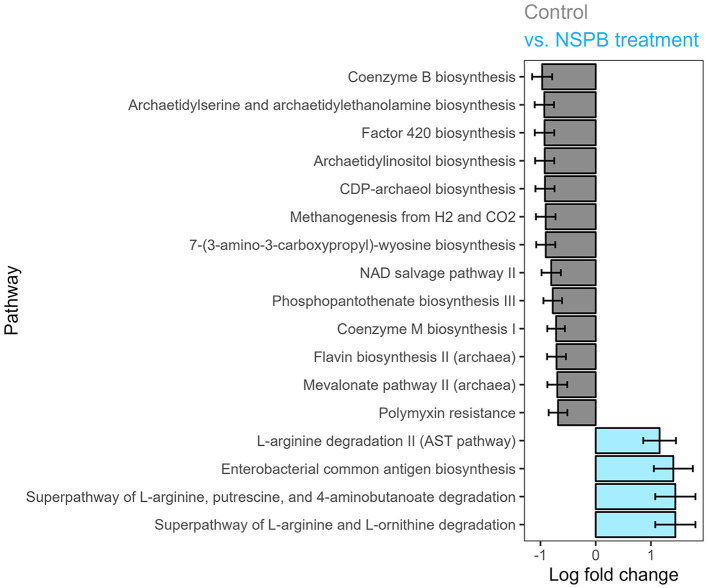
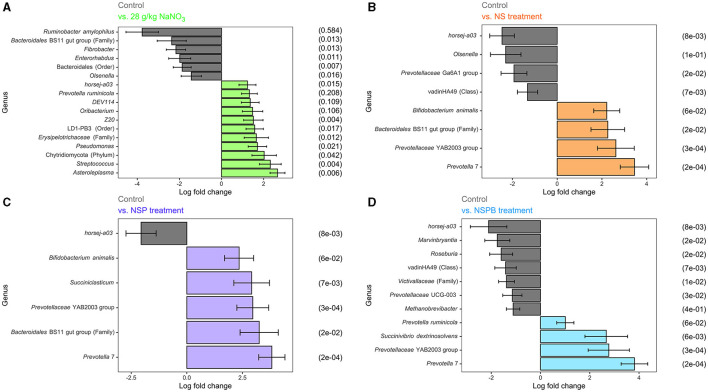
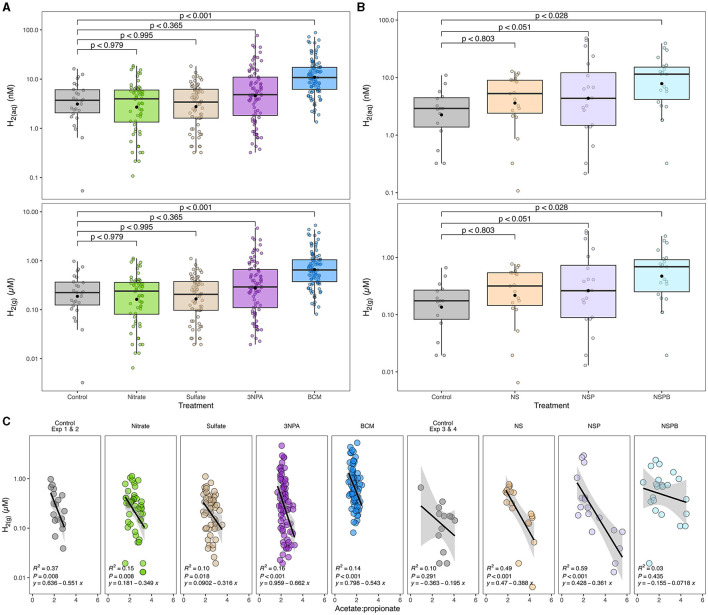
Mitigation of enteric methane (CH) emissions from ruminant livestock represents an opportunity to improve the sustainability, productivity, and profitability of beef and dairy production. Ruminal methanogenesis can be mitigated via two primary strategies: (1) alternative electron acceptors and (2) enzymatic inhibition of methanogenic pathways. The former utilizes the thermodynamic favorability of certain reactions such as nitrate/nitrite reduction to ammonia (NH) while the latter targets specific enzymes using structural analogs of CH and methanogenic cofactors such as bromochloromethane (BCM). In this study, we investigated the effects of four additives and their combinations on CH production by rumen microbes in batch culture. Sodium nitrate (NaNO), sodium sulfate (NaSO), and 3-nitro-1-propionate (3NPA) were included as thermodynamic inhibitors, whereas BCM was included as a enzymatic inhibitor. Individual additives were evaluated at three levels of inclusion in experiments 1 and 2. Highest level of each additive was used to determine the combined effect of NaNO + NaSO (NS), NS + 3NPA (NSP), and NSP + BCM (NSPB) in experiments 3 and 4. Experimental diets were high, medium, and low forage diets (HF, MF, and LF, respectively) and consisted of alfalfa hay and a concentrate mix formulated to obtain the following forage to concentrate ratios: 70:30, 50:50, and 30:70, respectively. Diets with additives were placed in fermentation culture bottles and incubated in a water bath (39°C) for 6, 12, or 24h. Microbial DNA was extracted for 16S rRNA and ITS gene amplicon sequencing. In experiments 1 and 2, CH concentrations in control cultures decreased in the order of LF, MF, and HF diets, whereas in experiments 3 and 4, CH was highest in MF diet followed by HF and LF diets. Culture pH and NH in the control decreased in the order of HF, MF, to LF as expected. NaNO decreased ( < 0.001) CH and butyrate and increased acetate and propionate ( < 0.03 and 0.003, respectively). Cultures receiving NaNO had an enrichment of microorganisms capable of nitrate and nitrite reduction. 3NPA also decreased CH at 6h with no further decrease at 24 h ( < 0.001). BCM significantly inhibited methanogenesis regardless of inclusion levels as well as in the presence of the thermodynamic inhibitors ( < 0.001) while enriching succinate producers and assimilators as well as propionate producers ( < 0.05). However, individual inclusion of BCM decreased total short chain fatty acid (SCFA) concentrations ( < 0.002). Inhibition of methanogenesis with BCM individually and in combination with the other additives increased gaseous H concentrations ( < 0.001 individually and 0.028 in combination) while decreasing acetate to propionate ratio ( < 0.001). Only the cultures treated with BCM in combination with other additives significantly (p < 0.05) decreased the abundance of expressed as log fold change. Overall, the combination of thermodynamic and enzymatic inhibitors presented a promising effect on ruminal fermentation , inhibiting methanogenesis while optimizing the other fermentation parameters such as pH, NH, and SCFAs. Here, we provide a proof of concept that the combination of an electron acceptor and a methane analog may be exploited to improve microbial efficiency via methanogenesis inhibition.
减少反刍家畜的肠道甲烷(CH)排放为提高牛肉和奶制品生产的可持续性、生产力及盈利能力提供了契机。瘤胃甲烷生成可通过两种主要策略来减轻:(1)替代电子受体,以及(2)对产甲烷途径的酶抑制。前者利用某些反应(如硝酸盐/亚硝酸盐还原为氨(NH))的热力学有利性,而后者使用CH和产甲烷辅因子(如溴氯甲烷(BCM))的结构类似物来靶向特定酶。在本研究中,我们调查了四种添加剂及其组合对分批培养中瘤胃微生物CH产生的影响。硝酸钠(NaNO)、硫酸钠(NaSO)和3-硝基-1-丙酸盐(3NPA)作为热力学抑制剂,而BCM作为酶抑制剂。在实验1和2中,对每种添加剂的三个添加水平进行了评估。在实验3和4中,使用每种添加剂的最高水平来确定NaNO + NaSO(NS)、NS + 3NPA(NSP)和NSP + BCM(NSPB)的组合效应。实验日粮为高、中、低牧草日粮(分别为HF、MF和LF),由苜蓿干草和一种精料混合料组成,其配制目的是获得以下牧草与精料比例:分别为70:30、50:50和30:70。含添加剂的日粮置于发酵培养瓶中,并在水浴(39°C)中孵育6、12或24小时。提取微生物DNA用于16S rRNA和ITS基因扩增子测序。在实验1和2中,对照培养物中的CH浓度按LF、MF和HF日粮的顺序降低,而在实验3和4中,MF日粮中的CH最高,其次是HF和LF日粮。对照中的培养物pH和NH按预期的HF、MF至LF的顺序降低。NaNO降低了(<0.001)CH和丁酸,并增加了乙酸和丙酸(分别<0.03和0.003)。接受NaNO的培养物中能够进行硝酸盐和亚硝酸盐还原的微生物有所富集。3NPA在6小时时也降低了CH,在24小时时没有进一步降低(<0.001)。无论添加水平如何以及在存在热力学抑制剂的情况下,BCM均显著抑制甲烷生成(<0.001),同时使琥珀酸盐生产者和同化者以及丙酸盐生产者富集(<0.05)。然而,单独添加BCM会降低总短链脂肪酸(SCFA)浓度(<0.002)。单独使用BCM以及与其他添加剂联合使用对甲烷生成的抑制增加了气态H浓度(单独<0.001,联合为0.028),同时降低了乙酸与丙酸的比例(<0.001)。只有用BCM与其他添加剂联合处理的培养物显著(p<0.05)降低了以对数倍数变化表示的丰度。总体而言,热力学抑制剂和酶抑制剂的组合对瘤胃发酵呈现出有前景的效果,抑制甲烷生成的同时优化了其他发酵参数,如pH、NH和SCFAs。在此,我们提供了一个概念验证,即电子受体和甲烷类似物的组合可用于通过抑制甲烷生成来提高微生物效率。