
进展时机和早期挽救性手术在经肝动脉化疗栓塞术联合酪氨酸激酶抑制剂及程序性死亡受体1抑制剂治疗的不可切除肝细胞癌中的作用
The Role of Timing of Progression and Early Salvage Surgery in Unresectable Hepatocellular Carcinoma Treated with TACE Plus TKIs and PD‑1 Inhibitors.
作者信息
Li Xingzhi, Tang Zhihong, Pang Qingqing, Wang Xiaobo, Bai Tao, Chen Jie, Wei Meng, Wei Tao, Li Lequn, Wu Feixiang
机构信息
Department of Hepatobiliary Surgery, Guangxi Medical University Cancer Hospital, Nanning, People's Republic of China.
Department of Hepatobiliary Surgery, Nanchong Central Hospital, The Second Clinical College of North Sichuan Medical College, Nanchong, People's Republic of China.
出版信息
J Hepatocell Carcinoma. 2024 Aug 24;11:1641-1652. doi: 10.2147/JHC.S481816. eCollection 2024.
BACKGROUND
The prognosis of initially unresectable hepatocellular carcinoma (iuHCC) has been improved by TACE with TKIs and PD-1 inhibitors (TTP). However, the role of timing of tumor progression and and early salvage surgery during TTP therapy remains unclear.
PATIENTS AND METHODS
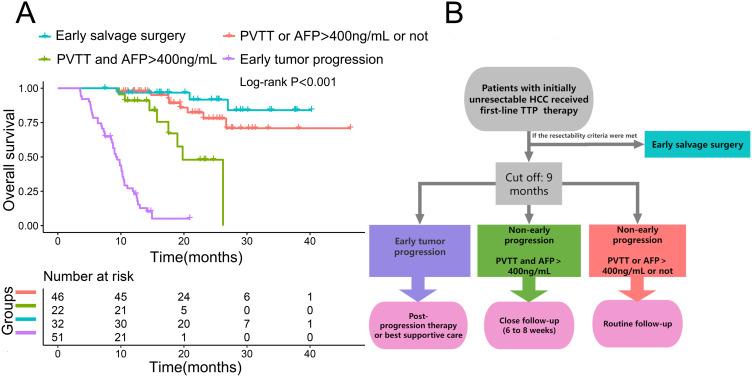
The data of 151 patients who received TTP for iuHCC consecutively between November 2019 and December 2022 were retrospectively analyzed. The X-Tile software was used to determine the optimal threshold of progression timing to differentiate the post-progression survival (PPS) for patients with tumor progression, ultimately yielding 9 months as the optimal cut-off time. Early tumor progression was defined as patients with tumor recurrence (surgical patients) or progressive disease by mRECIST (nonsurgical patients) within 9 months of initial treatment. Accordingly, early salvage surgery was defined as salvage surgery performed within 9 months of the initial treatment.
RESULTS
Out of all the patients, 55 (36.4%) patients showed early tumor progression, 33 (34.4%) showed late tumor progression, and 63 (41.7%) showed non-progression. Patients who experienced early tumor progression had a median PPS of 5.2 months, while those with late tumor progression had a median PPS of 16.8 months ( < 0.001). Multivariable analysis revealed a robust independent correlation between early tumor progression and PPS (HR = 3.279, 95% CI: 1.591-6.756; = 0.001). Patients who received early salvage surgery showed a considerably lower early tumor progression rate when compared with patients who did not receive early surgery (12.5% vs 42.9%, = 0.002). The multivariable analysis revealed that early salvage surgery was an independent factor influencing early tumor progression (OR = 0.246; 95% CI: 0.078-0.773; = 0.016).
CONCLUSION
Early tumor progression is associated with worse PPS in patients with iuHCC receiving TTP therapy. Early salvage surgery can further improve patient outcomes by lowering the incidence of early progression.
背景
经动脉化疗栓塞术(TACE)联合酪氨酸激酶抑制剂(TKIs)和程序性死亡受体1(PD-1)抑制剂(TTP)改善了初始不可切除肝细胞癌(iuHCC)的预后。然而,肿瘤进展时间以及TTP治疗期间早期挽救性手术的作用仍不明确。
患者与方法
回顾性分析了2019年11月至2022年12月期间连续接受TTP治疗的151例iuHCC患者的数据。使用X-Tile软件确定进展时间的最佳阈值,以区分肿瘤进展患者的进展后生存期(PPS),最终得出9个月为最佳截断时间。早期肿瘤进展定义为初始治疗后9个月内出现肿瘤复发(手术患者)或根据改良实体瘤疗效评价标准(mRECIST)出现疾病进展(非手术患者)。相应地,早期挽救性手术定义为在初始治疗后9个月内进行的挽救性手术。
结果
在所有患者中,55例(36.4%)出现早期肿瘤进展,33例(34.4%)出现晚期肿瘤进展,63例(41.7%)未出现进展。早期肿瘤进展的患者中位PPS为5.2个月,而晚期肿瘤进展的患者中位PPS为16.8个月(P<0.001)。多变量分析显示早期肿瘤进展与PPS之间存在显著的独立相关性(风险比[HR]=3.279,95%置信区间[CI]:1.591-6.756;P=0.001)。与未接受早期手术的患者相比,接受早期挽救性手术的患者早期肿瘤进展率显著更低(12.5%对42.9%,P=0.002)。多变量分析显示早期挽救性手术是影响早期肿瘤进展的独立因素(比值比[OR]=0.246;95%CI:0.078-0.773;P=0.016)。
结论
接受TTP治疗的iuHCC患者中,早期肿瘤进展与较差的PPS相关。早期挽救性手术可通过降低早期进展的发生率进一步改善患者预后。


 Zotero 插件