Vollmers Luis, Zacharias Martin
Physics Department and Center of Protein Assemblies, Technical University Munich, Garching, Germany.
Physics Department and Center of Protein Assemblies, Technical University Munich, Garching, Germany.
Biophys J. 2024 Oct 1;123(19):3463-3477. doi: 10.1016/j.bpj.2024.08.022. Epub 2024 Aug 28.
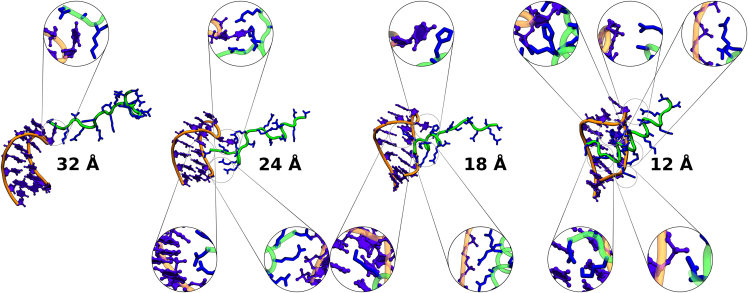
Protein-RNA interactions are crucially important for numerous cellular processes and often involve coupled folding and binding of peptide segments upon association. The Nut-utilization site (N)-protein of bacteriophages contains an N-terminal arginine-rich motif that undergoes such a folding transition upon binding to the boxB RNA hairpin loop target structure. Molecular dynamics free energy simulations were used to calculate the absolute binding free energy of the N-peptide of bacteriophage P22 in complex with the boxB RNA hairpin motif at different salt concentrations and using two different water force field models. We obtained good agreement with experiment also at different salt concentrations for the TIP4P-D water model that has a stabilizing effect on unfolded protein structures. It allowed us to estimate the free energy contribution resulting from restricting the molecules' spatial and conformational freedom upon binding, which makes a large opposing contribution to binding. In a second set of umbrella sampling simulations to dissociate/associate the complex along a separation coordinate, we analyzed the onset of preorientation of the N-peptide and onset of structure formation relative to the RNA and its dependence on the salt concentration. Peptide orientation and conformational transitions are significantly coupled to the first contact formation between peptide and RNA. The initial contacts are mostly formed between peptide residues and the boxB hairpin loop nucleotides. A complete transition to an α-helical bound peptide conformation occurs only at a late stage of the binding process a few angstroms before the complexed state has been reached. However, the N-peptide orients also at distances beyond the contact distance such that the sizable positive charge points toward the RNA's center-of-mass. Our result may have important implications for understanding protein- and peptide-RNA complex formation frequently involving coupled folding and association processes.
蛋白质 - RNA相互作用对众多细胞过程至关重要,并且在结合时通常涉及肽段的耦合折叠和结合。噬菌体的营养利用位点(N) - 蛋白包含一个富含N端精氨酸的基序,该基序在与boxB RNA发夹环靶结构结合时会发生这种折叠转变。利用分子动力学自由能模拟,在不同盐浓度下并使用两种不同的水势场模型,计算噬菌体P22的N肽与boxB RNA发夹基序复合物的绝对结合自由能。对于对未折叠蛋白质结构具有稳定作用的TIP4P - D水模型,我们在不同盐浓度下也获得了与实验的良好一致性。这使我们能够估计由于结合时限制分子的空间和构象自由度而产生的自由能贡献,这对结合有很大的反向贡献。在第二组伞形采样模拟中,沿着分离坐标解离/缔合复合物,我们分析了N肽预取向的起始以及相对于RNA的结构形成起始及其对盐浓度的依赖性。肽的取向和构象转变与肽和RNA之间的首次接触形成显著耦合。初始接触大多在肽残基和boxB发夹环核苷酸之间形成。只有在结合过程的后期,即在达到复合状态前几埃时,才会完全转变为α - 螺旋结合肽构象。然而,N肽在超出接触距离的距离处也会取向,使得可观的正电荷指向RNA的质心。我们的结果可能对理解经常涉及耦合折叠和缔合过程的蛋白质和肽 - RNA复合物形成具有重要意义。