Nam Bora, Choi Nayeon, Koo Bon San, Kim Jiyeong, Kim Tae-Hwan
Department of Rheumatology, Hanyang University Hospital for Rheumatic Diseases, 222-1 Wangsimni- ro, Seongdong-gu, Seoul, 04763, Republic of Korea.
Hanyang University Institute for Rheumatology Research, Seoul, Republic of Korea.
BMC Rheumatol. 2024 Aug 30;8(1):39. doi: 10.1186/s41927-024-00410-w.
To investigate the factors associated with cause-specific discontinuation of long-term anti-tumor necrosis factor (TNF) agent use in patients with ankylosing spondylitis (AS).
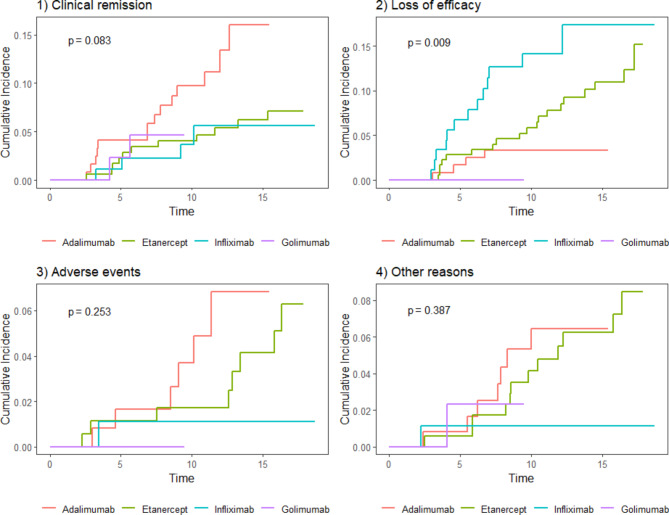
AS patients who initiated first-line anti-TNF treatment between 2004 and 2018 and continued treatment for at least two years were enrolled in the study. Enrolled patients were observed until the last visit, discontinuation of treatment, or September 2022. Reasons for discontinuation of the first-line anti-TNF agent were categorized into the following: (1) clinical remission, (2) loss of efficacy, (3) adverse events, and (4) other reasons including loss to follow-up, cost, or reimbursement issues. A cumulative incidence function curve was used to visualize the cumulative failure rates over time for each specific reason. Univariable and multivariable cause-specific hazard models were utilized to identify factors associated with cause-specific discontinuation of the first-line anti-TNF agent.
A total of 429 AS patients was included in the study, with 121 treated with adalimumab (ADA), 176 with etanercept (ETN), 89 with infliximab (INF), and 43 with golimumab (GLM). The median overall survival on the first-line anti-TNF agent was 10.6 (7.9-14.5) years. Among the patients, 103 (24.0%) discontinued treatment, with 36 (34.9%) due to inefficacy, 31 (30.1%) due to clinical remission, 15 (14.6%) due to adverse events, and 21 (20.4%) due to other reasons. Patients treated with ETN had a lower risk of discontinuation due to clinical remission compared to those receiving ADA (hazard ratio [HR] 0.45 [0.21-0.99], P = 0.048). Higher baseline Bath Ankylosing Spondylitis Disease Activity Index (BASDAI; HR 1.31 [1.04-1.65], P = 0.023) and INF use were linked to a higher risk of treatment discontinuation for inefficacy compared to ADA use (HR 4.53 [1.45-14.16], P = 0.009). Older age was related to an increased risk of discontinuation due to infection-related adverse events (HR 1.07 [1.02-1.12], P = 0.005), and current smoking was a risk factor for discontinuation due to other reasons (HR 6.22 [1.82-21.28], P = 0.004).
AS patients on their first anti-TNF treatment for at least two years demonstrated a favorable long-term treatment retention rate, with a 24.0% discontinuation rate over a 10.6-year overall survival period. The predictors for discontinuation varied by causes, underscoring the complexity of treatment response and the importance of personalized approaches to treatment management.
探讨强直性脊柱炎(AS)患者长期使用抗肿瘤坏死因子(TNF)药物特定原因停药的相关因素。
纳入2004年至2018年间开始一线抗TNF治疗且持续治疗至少两年的AS患者。对纳入患者进行观察,直至最后一次随访、停药或2022年9月。一线抗TNF药物停药原因分为以下几类:(1)临床缓解,(2)疗效丧失,(3)不良事件,(4)其他原因,包括失访、费用或报销问题。采用累积发病率函数曲线来直观显示每种特定原因随时间的累积失败率。使用单变量和多变量特定原因风险模型来确定与一线抗TNF药物特定原因停药相关的因素。
本研究共纳入429例AS患者,其中121例使用阿达木单抗(ADA)治疗,176例使用依那西普(ETN)治疗,89例使用英夫利昔单抗(INF)治疗,43例使用戈利木单抗(GLM)治疗。一线抗TNF药物的中位总生存期为10.6(7.9 - 14.5)年。在这些患者中,103例(24.0%)停药,其中36例(34.9%)因疗效不佳停药,31例(30.1%)因临床缓解停药,15例(14.6%)因不良事件停药,21例(20.4%)因其他原因停药。与接受ADA治疗的患者相比,接受ETN治疗的患者因临床缓解而停药的风险较低(风险比[HR] 0.45 [0.21 - 0.99],P = 0.048)。与使用ADA相比,较高的基线巴斯强直性脊柱炎疾病活动指数(BASDAI;HR 1.31 [1.04 - 1.65],P = 0.023)和使用INF与因疗效不佳而停药的风险较高相关(HR 4.53 [1.45 - 14.16],P = 0.009)。年龄较大与因感染相关不良事件停药的风险增加有关(HR 1.07 [1.02 - 1.12],P = 0.005),当前吸烟是因其他原因停药的危险因素(HR 6.22 [1.82 - 21.28],P = 0.004)。
接受首次抗TNF治疗至少两年的AS患者显示出良好的长期治疗保留率,在10.6年的总生存期内停药率为24.0%。停药的预测因素因原因而异,突出了治疗反应的复杂性以及个性化治疗管理方法的重要性。