Teeter Jacob D, Sarker Mamun, Lu Wenchang, Tao Chenggang, Baddorf Arthur P, Huang Jingsong, Hong Kunlun, Bernholc Jerry, Sinitskii Alexander, Li An-Ping
Center for Nanophase Materials Sciences, Oak Ridge National Laboratory, Oak Ridge, TN, USA.
Department of Chemistry, University of Nebraska-Lincoln, Lincoln, Nebraska, USA.
Commun Chem. 2024 Aug 31;7(1):193. doi: 10.1038/s42004-024-01253-9.
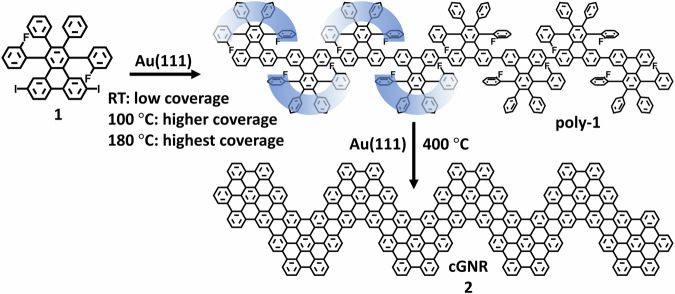
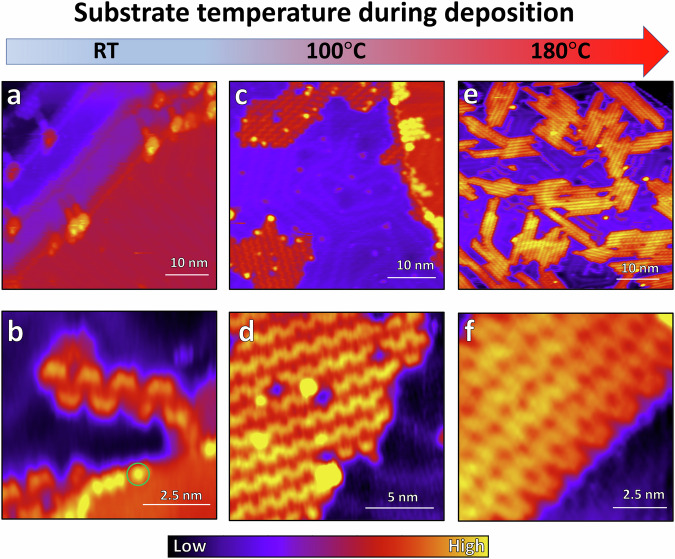
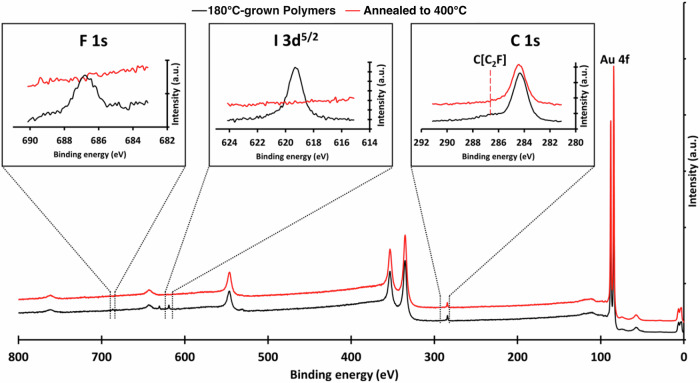
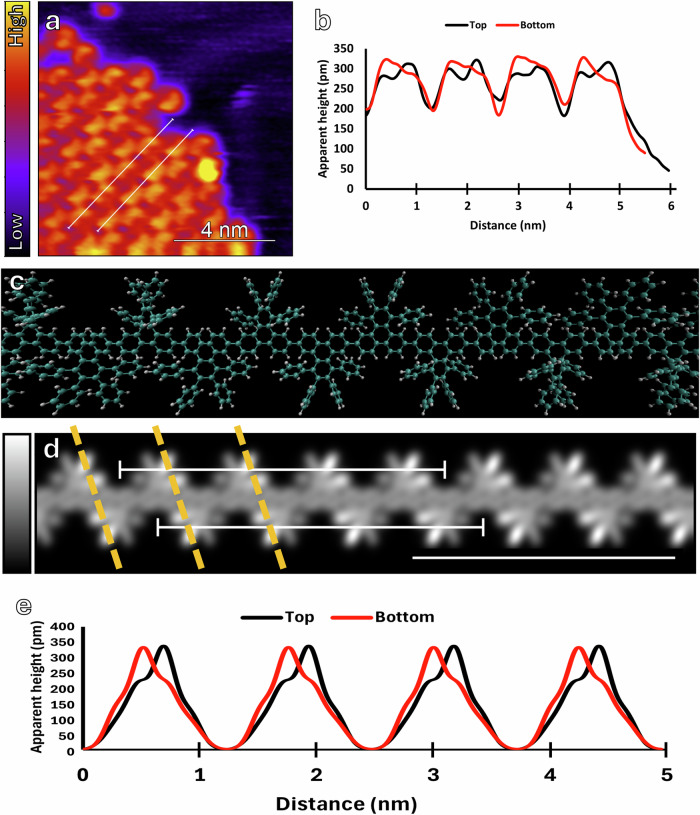
Graphene nanoribbons (GNRs) of precise size and shape, critical for controlling electronic properties and future device applications, can be realized via precision synthesis on surfaces using rationally designed molecular precursors. Fluorine-bearing precursors have the potential to form GNRs on nonmetallic substrates suitable for device fabrication. Here, we investigate the deposition temperature-mediated growth of a new fluorine-bearing precursor, 6,11-diiodo-1,4-bis(2-fluorophenyl)-2,3-diphenyltriphenylene (CHFI), into helically shaped polymer intermediates and chevron-type GNRs on Au(111) by combining scanning tunneling microscopy, X-ray photoelectron spectroscopy, and density functional theory simulations. The fluorinated precursors do not adsorb on the Au(111) surface at lower temperatures, necessitating an optimum substrate temperature to achieve maximum polymer and GNR lengths. We compare the adsorption behavior with that of pristine chevron precursors and discuss the effects of C-H and C-F bonds. The results elucidate the growth mechanism of GNRs with fluorine-bearing precursors and establish a foundation for future synthesis of GNRs on nonmetallic substrates.
精确的尺寸和形状对于控制电子特性及未来的器件应用至关重要,通过使用合理设计的分子前驱体在表面进行精确合成,可以实现这种石墨烯纳米带(GNRs)。含氟前驱体有潜力在适合器件制造的非金属衬底上形成GNRs。在此,我们通过结合扫描隧道显微镜、X射线光电子能谱和密度泛函理论模拟,研究了一种新型含氟前驱体6,11 - 二碘 - 1,4 - 双(2 - 氟苯基)- 2,3 - 二苯基三蝶烯(CHFI)在沉积温度介导下在Au(111)上生长为螺旋状聚合物中间体和人字形GNRs的过程。在较低温度下,氟化前驱体不会吸附在Au(111)表面,因此需要一个最佳的衬底温度来实现聚合物和GNRs的最大长度。我们将吸附行为与原始人字形前驱体的吸附行为进行了比较,并讨论了C - H键和C - F键的影响。这些结果阐明了含氟前驱体生长GNRs的机制,并为未来在非金属衬底上合成GNRs奠定了基础。